Sunday, April 19, 2020

“Until it Hits Someone You Know”


Last summer, Urban Sketchers Seattle met in the Leschi neighborhood where I grew up. Although the Leschi Market storefront is not usually the type of building that would attract my attention, I sketched it purely out of nostalgia. Only a half-mile or so from my childhood home, it was the store where my mom sometimes shopped for groceries (she didn’t drive, so she walked there when she needed a few things). On summer days, my sister and I would stop there after hanging out in Leschi Park, then eat popsicles on the walk home. It was that kind of neighborhood market. It still is.

One of the owners of Leschi Market has died of COVID-19. I didn’t know Steve Shulman, but his family has owned the store since the ‘40s. According to The Seattle Times article, he had been working at the store since he was a teenager, which means he was probably there on some of the many days that my family shopped there. Maybe he sold me a popsicle.


In Danny Westneat’s column the week prior, he quotes the store’s co-owner saying, “People are having a hard time believing that this virus is actually happening,’” and then observes, “Maybe you don’t really believe it until it hits someone you know.”

When you watch the staggering statistics of deaths and infections pile up in news stories or scroll by on Facebook, it feels like any other disaster, war, bombing, what have you. If you know just one of those people or have any kind of personal connection with one, it suddenly becomes real.


Saturday, April 18, 2020

Vintage Colored Pencils: General’s Multichrome


When I acquire a vintage colored pencil, it’s always intriguing from a historical or at least pencil-geeky perspective, but I never expect its performance to be anything better than mediocre (or worse). Pencil-making technology has improved enough over the years that it’s rare to find old pencils that are as good as contemporary ones. I’m fine with that, though; while it’s always fun to give old pencils a try, usability is not the primary reason I collect them. Finding the rare exception, though, is what makes collecting exciting!

First, here’s a back story: A few months ago, I reviewed vintage sets of General’s Kimberly watercolor pencils and Color-tex pencils, which I had purchased easily and inexpensively on eBay. It was mostly a fit of sudden patriotism that drove me to want them; I realized that General’s is the only pencil company that still manufactures colored pencils in the U.S. As fully expected, the pencils weren’t great to use, and sadly, General’s contemporary colored pencils are equally mediocre.

An easel-backed box that was typical in this era
I did note, however, that the back of the vintage packages listed “thick lead” Multichrome as another colored pencil type that the company had made back then. This was intriguing because Multichrome is not a current General’s offering, even though Kimberly’s and Color-tex both are.

While old sets of Kimberly’s and Color-tex are common and plentiful, I had never seen a Multichrome set of any size on eBay. Imagine my surprise when an unused set of 48 Multichrome pencils – the largest set made – suddenly appeared one day! And imagine my ecstasy when I discovered that General’s Multichrome colored pencils are a delight to use!
 
Inside of box lid

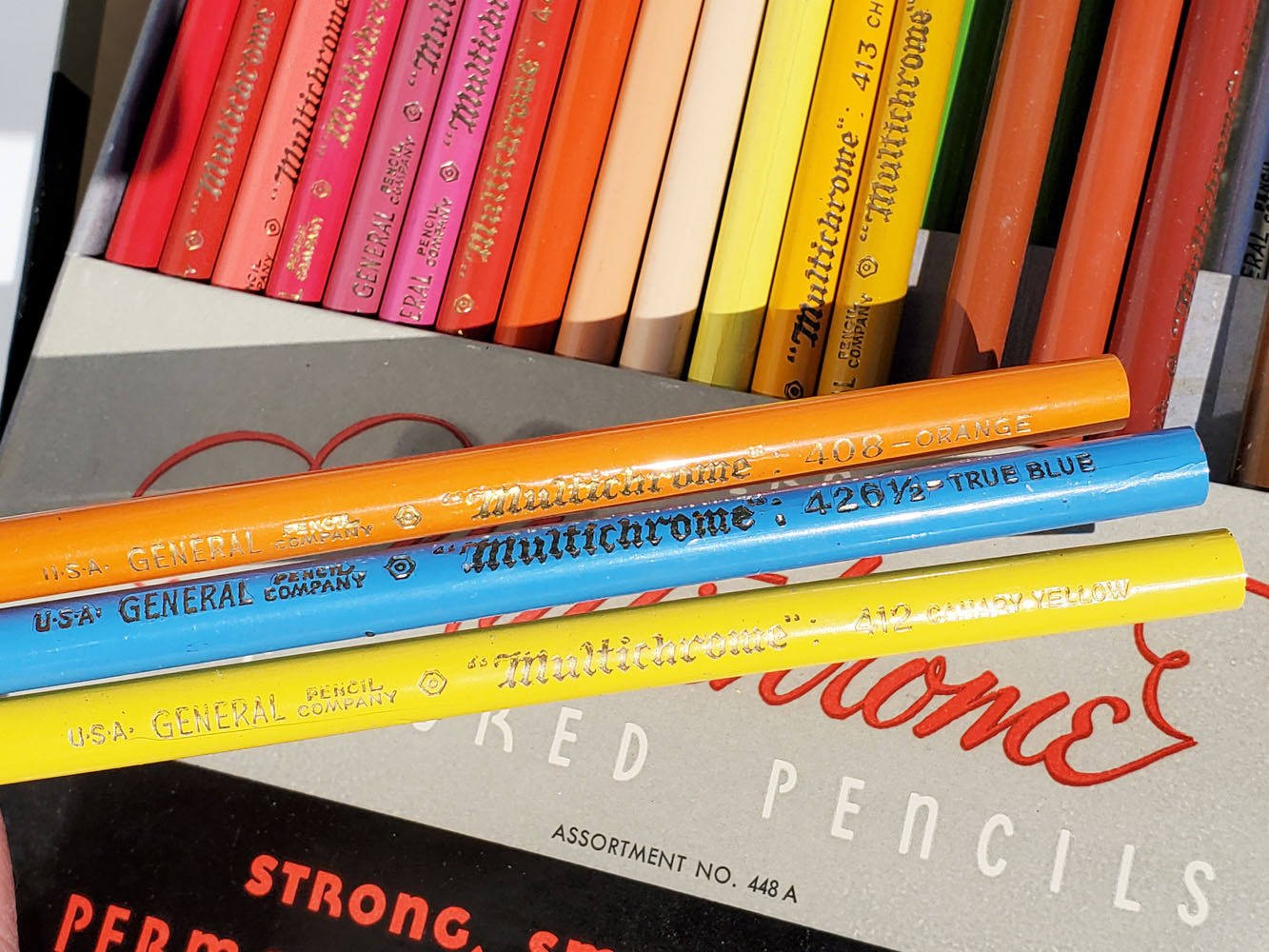
In appearance, they seem to emulate the Prismacolor model: glossy, round, core-matched barrels with unfinished ends. The “Multichrome” typeface (with quotation marks) is gorgeous!
 
A lovely vintage typeface!
"Thick leads," indeed!

As promised in the description, Multichromes have “thick leads,” uncommon among vintage pencils, that are comparable in size to Prismacolors.

The set came with a large flier (below) showing the 50 colors that Multichromes come in (yet only 48 are in the largest set? How annoying – why not put all 50 in!?). Five pencils in the set had been factory-sharpened but showed no sign of use. The rest were unsharpened. (Yes, I always pause before I sharpen old, unused pencils for a moment of silent reverence. Then I quickly sharpen before I lose my nerve. Pencils are made to be used.)


The set came with this 2-sided flier showing the 50 Multichrome colors available... yet only 48 are in the set!


Soft without being waxy, they are a touch harder than Prismacolors. Although they don’t blend as easily as some artist grade pencils I’ve used, they apply smoothly and are heavily pigmented. I would say they would have easily competed with Eagle/Berol Prismacolors in their day.

4/10/20 Multichrome pencils in Stillman & Birn Epsilon sketchbook
There’s one more way in which the Multichromes resemble Prismacolors that will not be apparent from my photos: They smell exactly the same! Somewhere close to licorice, Good & Plenty or some other candy attached to the lower brain stem of my memory, the scent is intoxicating. (In the privacy of my studio, I have been caught deeply inhaling.)

As I happily sketched the apple with this amazing find, many questions came to mind, chiefly: Why did General’s stop producing such an excellent product while continuing to produce two mediocre ones? When did they stop? And how old is the set I acquired?

Further poking around eBay, I found this intriguing item: An original advertisement for General’s Multichrome pencils. Familiar? It looks exactly like the flier that came with my set. The advertisement’s seller stated that the ad was from 1947. When I inquired how he knew the ad’s age, he said it was dated by the magazine in which the ad appeared.
 
Original advertisement offered on eBay
$8 in 1947?

On one side of the box I found a handwritten price: $8. That seems a bit high for the 1940s; using an online inflation calculator, the price of the set would cost more than $90 in today’s dollars. I’ve certainly paid the equivalent for contemporary pencils, but I have no idea how much artist-grade pencils would have gone for in 1947. It’s thrilling to think that they might be that old though, isn’t it? And more thrilling still to know that I’m the first to use them – and will joyfully continue to use them.

Friday, April 17, 2020

Recalling My Graphite Breakthrough

4/10/20 Across the street, Maple Leaf neighborhood

Nearly two years ago, I took a workshop at the Porto Urban Sketchers Symposium from Eduardo Bajzek that changed the way I used graphite as a sketching medium. Much more important, though, was that “Graphite is the Matter” changed the way I started seeing values. You can read the summary of the workshop (linked above), but I’m not sure whether I was able to explain in that post exactly how the change occurred. I think it was one of those light bulb moments, and once the light is turned on, it can’t be turned off. It was truly a breakthrough for me.

At right is a sketch I made from our bedroom window last week. Other sketches shown in this post are from Eduardo’s Porto workshop, Delft last summer, and our snowpocalypse last February.

* * *


7/19/18 Porto
Last week would have been the 11th annual Urban Sketchers Symposium, hosted by Hong Kong. Political strife and potential violence in that city forced organizers to reluctantly cancel the event earlier this year. Ironically, the symposium would undoubtedly have been cancelled this month no matter where it was being hosted. Whether from political unrest or a global pandemic, it seems the symposium this year was doomed.

Regardless, it was heartbreaking when the Hong Kong Urban Sketchers team had to cancel after working hard on the event for nearly a year before making that difficult decision. As an expression of support and solidarity, urban sketchers everywhere posted their sketches from Hong Kong or shared stories of “breakthroughs” they have experienced from being part of Urban Sketchers. This was my story.

7/30/19 Delft
2/11/19 Our backyard

Thursday, April 16, 2020

Draw a Bird Day

4/8/20 male goldfinch at our feeder

No, I don’t make this stuff up: April 8 was Draw a Bird Day! Begun in England in 1943, the day originated with a touching story about a young girl and her uncle who was injured in the war that I’ll let you read for yourself.

I heard about this internationally recognized day incidentally from a Facebook post on that date. Right after I saw the post, I looked out our kitchen window and saw a male goldfinch at our feeder now wearing his breeding colors. I had to draw him, right?

Now that we go out so infrequently and only for “essential” matters, we appreciate our garden birds more than ever. Not all is right with the world, but many parts of it are still beautiful.

Wednesday, April 15, 2020

Notable Pencils: The Many Dresses of Blackwing Colors

Initial releases of Palomino Colors (prior to 2010)

I gave Blackwing Colors a full review a few years ago, so I won’t say much about pencil performance in this post. What is “notable” about this colored pencil set put out by the brand that is better known for high-end graphite pencils is the variety of packaging and appearances it has had.

When I wrote that review in 2017, I didn’t know yet that California Republic had released traditional and water-soluble (Aquas) sets of colored pencils under the Palomino brand several years before the set I reviewed. With a round barrel, silver band and finished, rounded end cap, the look reminds me a bit of Faber-Castell Polychromos. The barrels of both the traditional colored pencils and the Aquas look identical except the latter include a paintbrush icon.
 
California Republic's Palomino logo
I was told that these Palomino sets came out prior to the first Palomino Blackwing graphite release in 2010. They bear the same horse logo (at right) that also appeared on the Blackwing graphite pencils of 2010 - 2015. I acquired both through swaps long after they were no longer available at retail. They came packaged in flimsy plastic cases (above).

At some point I acquired a more durable wood-boxed set on eBay that must have been released as a gifty item around the same time (below). I’m not aware of a corresponding gift set of the Aquas. (4/15/20 correction: A friend on social media has pointed out that there was a gift set of Aquas!)


The gift set came in a wood box


Next came the Blackwing Colors set I reviewed in 2017 that had been released the year before. This matte black windowed box is one of the nicest presentations I’ve seen for a small set of colored pencils. The windowed “door” opens to silver-capped, hexagonal pencils – a complete change in appearance from the prior Palomino sets. The Palomino pony disappeared (as it did from the graphite Blackwings of 2016), and the simple italic-slanted Blackwing logo is imprinted in silver.
 
The first windowed box (2016)


In early 2020, Blackwing changed its corporate identity and logo and re-released all its standard edition graphite pencils with new logos and redesigned packaging. A curious thing happened with the Colors, however: First the unchanged 12 pencils were re-packaged in the old Blackwing box – the same kind that the standard edition and limited edition Volumes had come in prior to the 2020 change – with a new Colors sleeve.


New sleeve, old box, old pencils (2020)


Although I wasn’t necessarily fond of the new branding, I couldn’t help feeling a bit miffed: What – aren’t colored pencils good enough to wear the new look, too? Just give the hand-me-down old boxes to the stepsister Colors, shall we? (OK, so I took it a bit personally.)

It turned out that the stepsister repackaging was a transitional step: Very shortly later, the Colors, too, were re-released bearing the new logo in a redesigned windowed box similar to the one of 2016 but with new branding. I’m not sure why the transitional packaging was necessary, especially for such a short time (maybe a month or two?), but I am already imagining the tizzy of future colored pencil historians asking the same thing (as they frantically hunt down the sleeved box on eBay).
 
The current look: Redesigned windowed box, new logo (2020)


The questions I ask today are these: Whatever happened to the Aquas, and why was it apparently dropped as a Blackwing product line? Granted, it is not a high-quality watercolor pencil, but it would have been fun to collect all of its many clothes, too. And perhaps a wistful, rhetorical question: Will Blackwing ever come out with more colors for Colors? It seems doubtful, though I wouldn’t be surprised if new packaging comes along again sometime.

(This is part of my series of occasional posts that are not really reviews but stories about products I find notable for one reason or another.)

Tuesday, April 14, 2020

East and West

4/8/20 Maple Leaf neighborhood, facing east

4/9/20 Maple Leaf neighborhood, facing west
We have a tiny sundeck off our upstairs bedroom. You’d think I’d be sketching from up there often, especially now that we’re mostly housebound, but the view seems like a cluttered mess that’s difficult for me to sort a composition from.

Desperate times call for desperate compositions, however, so on a gorgeous afternoon last week, I put on my shades and sun hat (yes, that sunny!) to see what I could see. Above is the view toward the east. Much of the foliage looks surprisingly like fall rather than spring – some trees seem to have yellowish-reddish branches before they leaf out. Many trees are still as bare as winter. Then there’s our next-door neighbor’s tree, which is dark red year-round, that dominates my view in that direction. I tried to identify it from Google images. . . maybe a Crimson King maple?

The next morning I went out on the deck again, this time facing west. This view is even messier – layers of houses and cars parked on both sides of the street. I simplified liberally.

Monday, April 13, 2020

Wallet-Friendly Traditional Colored Pencils

Blick Studio Colored Pencils

After reading my roundup of favorite colored pencils, I was asked to recommend some that “don’t break the bank.” Admittedly, most of my favorites are what would be considered high end. I’m not someone who buys the most expensive one just because I think it must be “better.” But if you ask for my favorites, I will name the ones that have qualities I either demand or appreciate, and they tend to be qualities that make pencils cost more (high pigment content, for example).

In general, I believe that when it comes to art supplies, it usually makes sense to buy the best quality you can afford for one important reason: Inferior materials often make it more difficult to learn how to draw, paint or otherwise use the material. If you are still just learning, you won’t know if your unsatisfactory results are coming from a lack of skill or simply because your supplies are crappy. In my experience (I, too, paid my dues by thinking I could use cheap stuff “until I got good”), poor quality materials lead to nothing but frustration.

Still, I also know that many people just want to give something a try, and they don’t want to invest in high-end products that they may decide they don’t enjoy using. And I have used enough colored pencil brands to have found some that, in fact, do not break the bank yet still have decent qualities. To go along with last year’s roundup of wallet-friendly watercolor pencils, here are three traditional (wax- or oil-based) pencil lines that are an excellent value for the price (in order of preference).

4/2/20 Blick Studio pencils in Stillman & Birn Epsilon sketchbook
First up is Blick Studio, which I reviewed a few years ago when I first began using colored pencils seriously. This is the Blick art store chain’s brand made for it by Utrecht in the Czech Republic (recently highlighted in a “notable” post). At half the price of my favorite Faber-Castell Polychromos, the core has a similar hardness and feels nearly as smooth in application, too. They blend and layer beautifully. Along with others, I used Blick Studio pencils in my colored pencil class at Gage a few years ago because some hues in the range fill in gaps that other product lines seem to have.

I’ve experienced a few Blick colors with small gritty bits that I had to work out on scrap paper, but otherwise, this high-quality line is an excellent value. Blick’s site provides lightfast ratings for all colors – an essential feature to be considered artist quality. In addition, all colors are available open stock.

Sivo Vivid pencils -- remarkably inexpensive.
The second pencil is a delightful dark horse – Sivo Vivid made by the Hindustan company of India. At the time of my purchase, I got a set of 36 for about 8 bucks on Amazon. I see that the same set is now 12 bucks, but even so, it’s still a good value. In fact, in my throwdown of cheap colored pencils a few years ago, it came out the winner.

I hadn’t used Sivo Vivid pencils since that throwdown, so I made a new sketch to refresh my memory. As noted in the previous post, the nice thick cores are on the harder side – similar to Polychromos – and they blend and layer remarkably well for such inexpensive pencils. The color range (lots of pinks) might be favored more by pre-teen girls than urban sketchers, and I certainly couldn’t vouch for their lightfastness rating. Other major drawbacks are that they bear no color name or number, nor are they available open stock. My guess is that they are intended for kids, but they sure beat any colored pencil I used as a kid.
 
4/2/20 Sivo Vivid pencils in S&B Epsilon sketchbook
Speaking of which, who remembers Crayola colored pencils in the trademark yellow and green box? If you do, then you’re probably wincing at the thought of those hard, dry, unpigmented sticks that were passed off as coloring agents. Give me a crayon instead of those any day! That’s why you’ll be shocked to discover the name of the third pencil in this budget-friendly lineup: Crayola Signature Blend & Shade. A set of 50 goes for $30 at Blick. Not quite as cheap as Sivo Vivid, it’s still a good value. (If you shop for this on Amazon, beware that there’s another Crayola set that’s even cheaper, but I don’t know anything about that one. Look for “Signature” in the name.)

4/3/20 Crayola Signature pencils in S&B Epsilon sketchbook
More surprising than the low price, though, is that the Crayola name is on this set, which is unexpectedly pleasant to use. While the Blick and Sivo Vivid pencils are both on the harder side, Crayola Signature is quite a bit softer. Mind you, for this price, you won’t find something as soft and creamy in application as Caran d’Ache Pablo, Cd’A Luminance or Prismacolor. But many less-expensive soft colored pencils are crayony or waxy in a way that feels like successive layers push previous layers around instead of blending with them. Crayola Signature is the best of the cheap soft pencils I’ve tried – they are easy to blend and have reasonably high pigment.

Although the barrels have no color numbers, they at least have color names. I almost always transfer pencils from their original tin or box to a mug or plastic storage bin, and I must have tossed the Crayola Signature packaging because I couldn’t find it. Therefore, unfortunately, I can’t say where they were made, but according to Wikipedia, Crayola colored pencils “are made by Faber-Castell Brazilian plants.”

So that’s my roundup of pencils with high value – very reasonably priced while still being usable. Frankly, the Blick line is a solid, affordable, artist-grade colored pencil that could give Polychromos a run for its money. The other two are definitely not artist grade, but for the price, they are unbeatable.


Related Posts Plugin for WordPress, Blogger...