Showing posts with label observational cartooning. Show all posts

Tuesday, October 19, 2021

Pike Place Market People


10/17/21 Pike Place Market

Sunday was the international Urban Sketchers 24-hour event, USk Sketch Together, with sketchers around the globe taking part with live videos and images from their respective sketch outings. USk Seattle chose iconic Pike Place Market for our event. The forecast all week was for rain that day, but once again, the weather gods were with us: Not a drop!

Before the pandemic, I used to happily sketch people on buses and light rail trains whenever I had somewhere to go. Throughout the wet-weather months, I had taken for granted being able to draw people in coffee shops. The thing I missed most during the worst of the pandemic was sketching people in public. For Sunday’s outing, I decided it was time to get back on public transportation. As a personal celebration during the Sketch Together event, I dedicated the outing to sketching nothing but people. In fact, I used the “observational cartooning” technique I learned from Taylor Dow in his workshop a couple of weeks ago to help tell the story of people at the Market: drawings made from life combined with written commentary.

On the level below the Market Commons, I could look up at a corner of the pedestrian area with one of the best waterfront views (above). It turned out to be a popular corner to take selfies and other photos. I started there but realized quickly that my view was limited.

Next I got up on the upper level myself so that I could see and sketch more people, especially their various photo stances – both taking and posing. Many were selfies, but others were couples and families who asked a passing stranger to snap a photo for them. When I wasn’t sketching, I timed a few: On average, I have about six seconds to capture a selfie. If someone else is taking the photo, I have a bit longer. The typical pose for couples is for one to put an arm around the other. When couples take a selfie together, they snap one, then usually one person is more interested than the other in the result and often needs a retake. I had as much fun people-observing as people-sketching.


It feels good to sketch people again!

To see what the rest of the world sketched that day, search the hashtag #usksketchtogether.

Many snoozers on the light rail train, a.m.
and p.m.


I seem to be the only one awake
on this train. It was my first public
transportation ride in 19 months.


USk Seattle knows how to Sketch Together!

Friday, October 8, 2021

Observational Cartooning, Part 3: Insights


I’m still digesting all that I learned and experienced in Taylor Dow’s excellent, mind-expanding workshop. I’ll probably continue to have insights, but here are some I’ve been thinking about since last weekend:

As Taylor talked about the process of cartoon character development, I realized that I had gone through exactly that process to create Weather Bunny – but I didn’t know that’s what I was doing. In fact, I had no intention of creating a cartoon character when I started – she was just an Inktober sketch at the time. I started by drawing from a photo of a real rabbit that I had found on the Internet. While drawing her repeatedly, I continued simplifying and refining, and eventually she turned into the character she is today. It was satisfying to realize that I had used an organic and traditional cartooning process without even being aware of it.

The evolution of Weather Bunny began here.


She hasn't changed much the past few years,
 though she seems to be putting on weight!


Although I had fun entertaining myself by writing dialog between inanimate objects I was drawing, recording my own authentic observations and memories was more satisfying. While most of my exposure to comics has been of the humorous kind (newspaper “funnies” or those in the New Yorker), comics do not need to be humorous. I’m not even sure I want to make comics, but it became clear to me that whatever results from my cartooning work is better if it’s authentic and not necessarily intended for the amusement of others (or even myself).

A sketch from 2019. A heavy marker is ideal for the flat, cartoony look.
(Sigh... I sure miss sketching on the bus.)

Another thing I have been doing on my own without realizing all of its benefits is regularly using a black, thick-line brush marker for most of my small, quick sketches. It is my choice mainly for expeditious reasons: I can finish a sketch quickly when I focus only on a line drawing that does result in a flat, cartoony look. In class, it was a definite benefit to have this experience. Classmates who were used to sketching with pencil had more difficulty adjusting to a Sharpie’s aggressive, unforgiving line.

After I posted my 10-year retrospective sketches, a follower commented that she enjoyed seeing my writing integrated with the first-year sketch by wrapping it diagonally across it. I like the look of that too, and I started thinking about why I stopped doing that. The answer is probably this blog. I have always done the kind of reflection and observation that I practiced in the workshop last weekend, but I keep the writing separate by putting it here on the blog. The Day 2 observational pages I made during the workshop made me want to start reincorporating writing with my sketches again.

My first urban sketch incorporated observations and thoughts.

I now give myself more credit than I had been for some ability to draw from memory. At the top of this post is a tiny sketch I made during one of the Day 1 workshop exercises: a man spreading a blanket onto the grass. I know this motion took only a second or two – much less time than it took me to see the action and then capture it on the page. I obviously did sketch this from memory, yet most of the time I’m not aware of how much my visual memory is assisting. I became much more aware of it when I heard my classmates talk about the difficulties of sketching people who are moving around and doing things. I knew that they all had varying degrees of experience with drawing, some with lengthy experience, yet none seemed to have as much experience as I do drawing from life. Drawing from life helps. A lot. For every kind of drawing but maybe especially for drawing from memory.

My car drawn from memory isn’t too bad, either. But the memory has been built over 10 years of drawing many cars from life.

Car from life

Car from memory


My biggest insight is perhaps refuting the concern I had stated in my Part 1 post: “I’ve wondered if my strong reliance on the fundamental principles of drawing from life – observing closely, measuring, checking spatial relationships and proportions – has made it harder for me to draw from my mind.” No – the skill of using those fundamental principles is necessary for drawing realistically from my mind and also makes it easier, not harder (based on the experiences of my classmates). It just took a workshop in cartooning to appreciate that skill.

Finally, I’ll end this post not with an insight but with a practical matter that was critical last weekend: I finally found a reliable N95 mask that is both comfortable and doesn’t fog my glasses. Although I knew we would spend only a couple of hours inside the classroom and the rest of the time outdoors, I had to have a safe mask that would enable me to draw, which is difficult and annoying when one’s glasses are constantly fogging!

Thursday, October 7, 2021

Observational Cartooning, Part 2: Finding My Voice


Do you recognize any of these cartoon characters' eyes?

Exhausted but exhilarated, I got home from Day 1 of Taylor Dow’s workshop with my head blown open from all the drawing experiences that were new to me. By the next morning, I also had my first insight: Although the most creative and entertaining part of the day’s exercises was making up dialog between inanimate objects, ultimately I felt like I was just telling jokes to myself. Reading the sketchbook pages felt unsatisfying, and it wasn’t a sustainable practice.

Day 2 began with a brief lecture and demo about how cartoon characters are developed. Taylor also teaches a workshop on cartoon character development, and most of my classmates were interested in this aspect of cartooning. Although I’m less interested, it was nonetheless fascinating to see examples of how familiar characters can be broken down into simple parts often made of geometric shapes – eyes, mouths, noses, hair – that had been honed over time by their artists into the characters we now recognize easily. These elements do not need to be invented or reinvented. We can “collect” images we like from characters we see, copy them as a way of study, and reassemble them in unique ways. After doing this over and over again, refining as we go, the uniqueness becomes our own.

To demonstrate this principle, we viewed images of well-known families of characters – the Simpsons, for example, or Loony Tunes – and then drew only the eyes, only the mouths, etc. We all found this exercise fun as well as illuminating. I had never noticed that almost all Simpsons characters have tiny dots for pupils!

Mouths (I drew several more pages of cartoon character parts!)

It was time to go back to Volunteer Park for observational work. (This was harder on Day 2 because the weather became much cooler, grayer and a bit drizzly.) Taylor told us that the focus of the day’s exercises would shift to being autobiographical. Instead of speculating or imagining, we were instructed to draw whatever we saw while making personal reflections, observations and connections. We were still encouraged to incorporate sensory perceptions like smells and sounds, overheard conversations, memories prompted by what we drew and whatever was part of the actual experience of the day.

Once again, my biggest struggle was avoiding going into autopilot urban sketching mode. I kept my sketches small so that I would not be tempted to draw too much context or detail. Capturing elemental images of both people and objects, I followed Taylor’s instructions and paid attention to my perceptions, feelings, thoughts and memories prompted by the drawings.


Once I dialed past the “urban sketching” setting, the writing came easily and quickly to me (writing usually does), and the exercise led to some insights related to my own drawing practice and process. For example, I suddenly realized that I was making exactly the kind of small, simple sketches that I had always wanted to do before I started learning to draw. I have been doing this for a long time, of course, but never noticed consciously that it is what I used to wish I could do. Another example is that when I was drawing some balloons, I really wanted to color them to help show that they were balloons – and I had to nearly physically restrain myself not to pull out a few colored pencils!

The biggest insight I had from the day was that these sketches with “autobiographical” observations were not necessarily humorous or entertaining like dialog between trees and fire plugs, but they felt authentic and honest. The writing was not much different from what I am used to doing in my journal, but these reflections, thoughts and memories came directly from the act of drawing. This is not a new concept – the whole “art journal” movement is based on this concept – and yet I had not really made that connection with sketches that are otherwise similar to my usual sketches made on location. And it turns out that this was, in fact, the purpose of the exercise: Drawing as an autobiographical act is one way to find one’s authentic voice which can then be expressed as a comic.

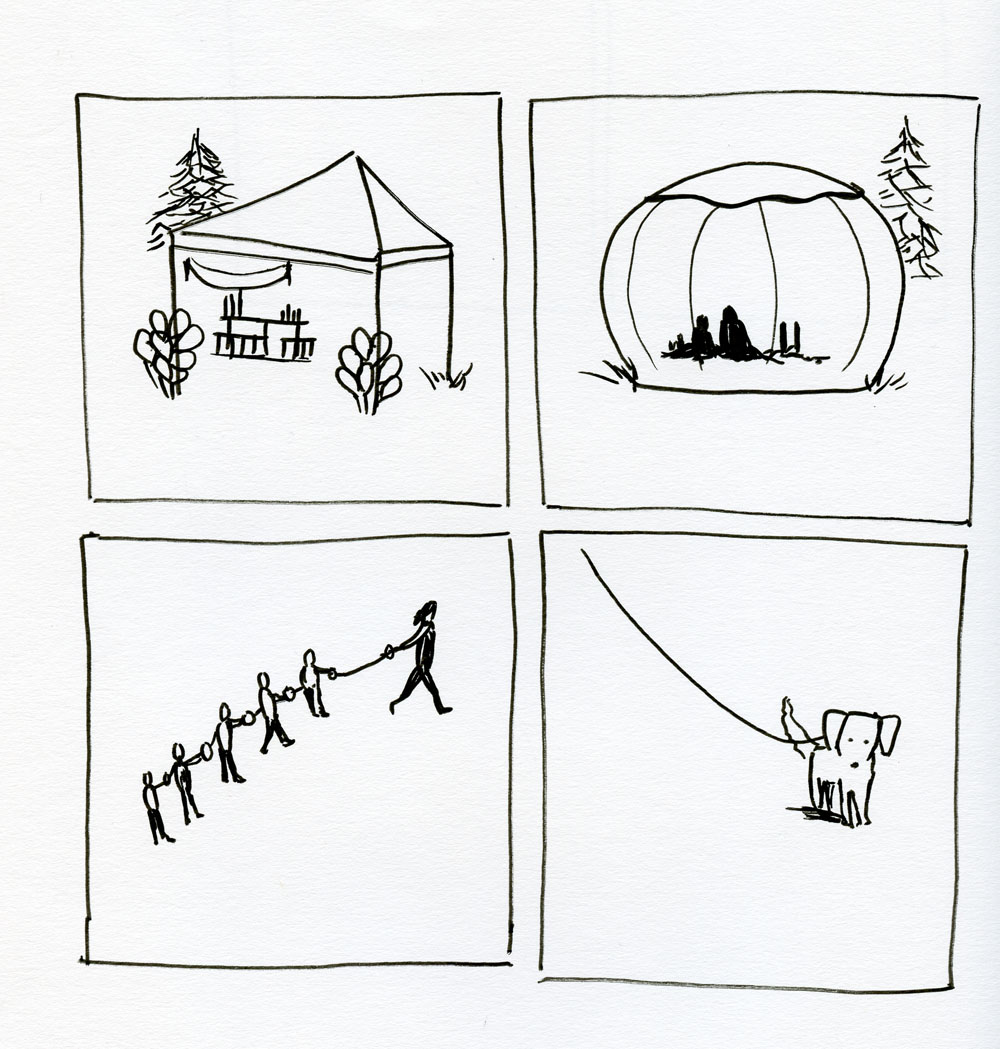
Back in the classroom, we finished the exercise by choosing a few favorite drawings and turning them into more finished comics. Taylor suggested making a four-panel grid of squares and simplifying and redrawing the favorite images, one per square, and possibly repeating. The primary benefit of this repetitive drawing exercise is that each time it is redrawn, an image is further simplified to its essential elements. Below is my first grid.


The urban sketcher in me added trees to the background of the birthday party tent and the “bubble” tent to show context that would indicate that they were in a park. Looking at the grid, however, I felt I had made the images more cluttered rather than more refined. I also did not see a connection among the four images, and the lack of “story” bothered me (you can take urban sketching away from the girl, but you can’t take urban sketching out of the girl… or something like that).

What I saw then were pairs of images. Instead of using a grid of four panels, I redrew the images into vertical pairs. Taylor suggested that a few words could also help tell the story. Below are my final results.


Not coloring the balloons still bothered me, so I asked Taylor for help. He drew a classic cartoon balloon, which always has a reflection shaped like a window (we laughed when we both said this at the same moment). He pointed out that as long as one thing reads as “balloon,” the viewer will get it and apply that to all the rest of the balloons. I played with this on my sketch until I came up with the idea of putting a single balloon on the left, which I thought would read better as a balloon compared to the cluster of balloons on the right.

By the way, if you’re wondering what the second party was – the thing that is shaped like a transparent pumpkin with people inside – I took the photo below to show you (I was so busy drawing that it was the only photo I took the whole weekend). Almost everyone in class drew it because it was so wonderful to see: A catered birthday celebration picnic including the tent! I learned about this type of all-weather picnic service from Gabi Campanario’s Seattle Sketcher column several months ago.

We all drew this delightful sheltered birthday picnic!

The third and last part in this series will include more insights from the workshop.

Wednesday, October 6, 2021

Observational Cartooning, Part 1: Outside the Comfort Zone


"Draw a car" - 4 minutes and 2 minutes

In recent years I have been wanting to expand my drawing skills beyond observational practices by pushing myself to use my memory and imagination – drawing from my mind instead of through my eyes. And when I say “draw from my mind,” I’m not talking about fantastical images of creatures or machines that some artists are able to create; I’m just talking about being able to picture a chair and then draw it realistically as if I were looking at it. I know I readily and easily drew imaginatively when I was a child, and yet like many adults, I lost that ability at some point. 

Of course, learning foundational drawing skills is essential to being able to draw realistically from the mind. However, many times as I’ve struggled to draw from memory or imagination, I’ve wondered if my strong reliance on the fundamental principles of drawing from life – observing closely, measuring, checking spatial relationships and proportions – has made it harder for me to draw from my mind. I can look at something very closely and think that I understand it, but as soon as I look away, poof – it’s gone.

Studying Lynda Barry’s books was one step in this direction, but I found it so challenging to pull things straight out of my brain that I felt like some steps were missing. Barry’s cartooning principles rely heavily on mining personal childhood memories that might be productive for some, but it wasn’t for me. I also did not necessarily find it satisfying to create a fictional character as a voice for expression. It felt artificial and forced instead of organic and authentic. 

When I read a description of a Gage workshop called “Observational Cartooning,” I thought it might put me on a more accessible path toward the type of skills I want to develop. I get the “observational” part – how does it lead to “cartooning”? Two days with instructor Taylor Dow would give me an answer.

Day 1 of the weekend workshop was a mix of the familiar and being pushed completely out of my comfort zone. Materials were simpler than in any art class I’ve taken: A sketchbook and a black pen with a heavy tip, like a Sharpie. I used my favorite Uni Pin brush pen. Taylor recommends this type of drawing tool because it immediately makes a thick, bold, “cartoony” line that does not allow for “sketchy, scratchy” lines and constant erasing and correcting. We were not allowed to “render” (give shading to objects to evoke a three-dimensional form) during the workshop, and we were encouraged not to think about perspective, proportion and other basic principles of realism to make “good” drawings.

After a brief slideshow introduction to Taylor’s work and how he had developed observational cartooning, we launched into a challenging but fun – and funny – exercise: Draw a car from memory. (Lynda Barry discusses the same exercise in her books, so it was familiar to me, but I had never done it myself.) Starting at four minutes, we were instructed to draw a car, and with each successive sketch, the time limit gets shorter and shorter all the way down to one second. The idea behind this exercise is that as each time period gets shorter, we are forced to reduce the concept of “car” to its most fundamental and basic – which is the root of a cartoon drawing. My classmates and I all chuckled during this exercise as our cars became more abstract and sometimes absurd. Sharing our work afterwards was both entertaining and illuminating to see how many different ways people imagine “car.” Although it was difficult, my experience sketching many, many cars from life was certainly helpful. (First two drawings in the exercise shown above; the rest below.)

1 minute and 30 seconds
30, 10 and 5 seconds

2 and 1 second. These were the most humorous to see; one classmate's 1-second car consisted of only the wheels! I got the rest of it -- only the top and one wheel well!


The next exercise was far more challenging for me. We all took turns naming a cartoon character, and we were given 30 seconds to draw it. Of course, most were familiar to me – Bullwinkle, Lisa Simpson, Tweety Bird – and yet I could not imagine them clearly enough to draw them in 30 seconds (though more time would not necessarily have been helpful). I was not familiar with some contemporary characters at all, and in those cases, Taylor instructed us to make something up. Shown below is one sketchbook page; we did many more examples of these.

Draw cartoon characters from memory

The rest of the day we left the Gage classroom and walked to nearby Volunteer Park for the “observational” practice. Ah – now this would be comfortable to me, I thought! I know how to do this part! The first exercise was to draw only people for an hour – as many people as possible. We were to draw simply and quickly without worrying about proportions. The catch (for me) was that we were to play with characterization by exaggerating or changing features or actions and to use words to describe, speculate or otherwise observe what we are drawing. Taylor also suggested incorporating conversations we overheard or smells and sounds as part of our observations. Fortunately for us, the beautiful, sunny day had brought out many people, so we had subjects in every direction.


My classmates, who all had less experience with sketching on location, had the most difficulty with simply drawing people who move and change. (I got that part down.) My big challenge was “playing” with what I saw – I could only draw what I saw, and exaggeration or changing features was difficult. I had a much easier time using words to speculate on their actions or relationships, and this is when the exercise became fun for me. (A few sketchbook pages are shown above; I did more like those.)

The next exercise was even more challenging: Instead of people, we were to draw only inanimate objects with the same emphasis: Play with scale and relationships, exaggerate features, and use words to describe or observe. Again in an hour, we were to draw as many objects this way as possible.

My immediate response was to start urban sketching – find a building or tree or fire plug and draw it in context – and I knew that if I did that, I would easily fill the hour with only one or two typical urban sketches without fulfilling the assignment. I had to slap my left hand to keep myself from falling into this well-honed habit!


Playing with some ideas, I found that if I paired a tree with some other object and imagined their conversations, I could most easily force myself out of simply drawing what I see and focus on relationships, scale and thoughts. Although these sketches may look like my typical urban sketches, the objects were not necessarily together in reality. For example, the traffic cone was not right next to the tree. (OMG, I’m not being truthful to what I see!) When I overheard something interesting, I used quotation marks to distinguish those words from my own thoughts. Once I got into this, the exercise became enormously entertaining.

Afterwards when we shared our work and discussed our processes for the day, my classmates and I all agreed that the exercise with people was much easier than with inanimate objects. Although the others seemed to have more experience drawing imaginatively and knew more about comics and cartooning than I do (I haven’t read or studied many comics), they all seemed to struggle more with drawing from life. I was pleased to realize that my decade of location-sketching practice and even studio life drawing served me well in these exercises because I could focus on the more imaginative parts while the drawing part came relatively easily.

I went home mentally exhausted! Day 2 was even more draining – but also illuminating and ultimately insightful.

Related Posts Plugin for WordPress, Blogger...