|
| My picks, from top: Dixon's Typhonite Eldorado, Faber-Castell 9000, Staedtler Mars Lumograph. The other two didn't make the cut. |
 |
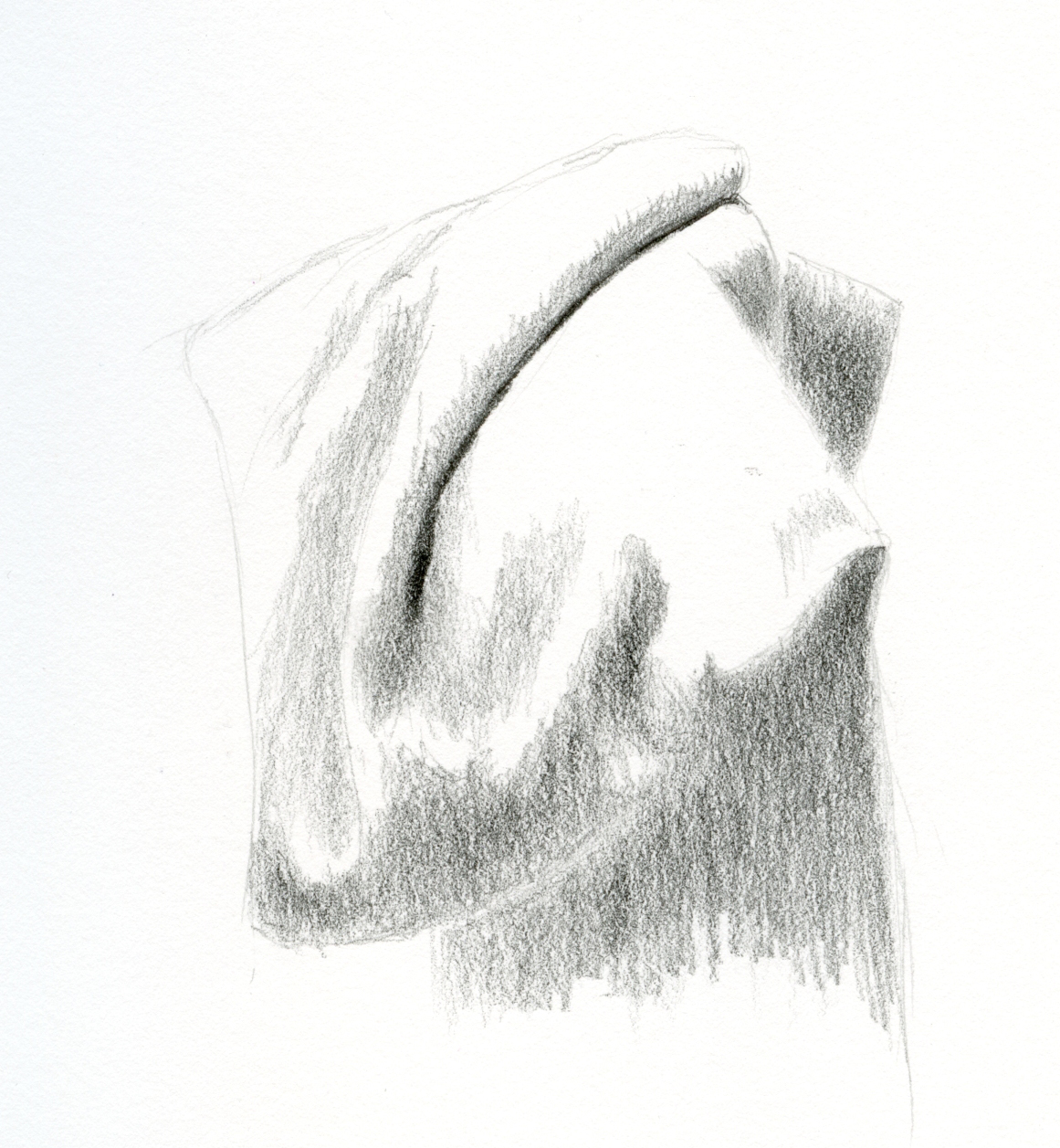
| 11/27/24 Faber-Castell 9000 8B |
Regular readers of this blog know my preoccupation with thinking about what I’d take to Gilligan’s Island. Don’t laugh – when it comes to art supplies, it’s an important question. Although I typically ponder this issue as it relates to my entire sketch kit, which would always certainly include at least one graphite pencil, it was only recently that I began thinking more specifically about which graphite pencil I would take.
The question came up during Pencilvember while I was
using a Faber-Castell “Castell” 9000 pencil for a draped scarf study. For
a graphite sketch, I typically use one hard grade to begin, then finish with a
softer grade. In the case of a full-on, finished drawing, I might use several
grades in between. But I was in a hurry that day with only 20 minutes before I
had to leave for an appointment, so I tried an experiment: Instead of my
typical method, I used only the F-C 9000 in 8B.
I know 8B sounds way too soft, and I thought it would be challenging
to draw the initial blocking and lightest values with a pencil that dark. In fact,
it is very strangely both hard and soft. While the end result is not as smooth
as it might have been had I started with a harder grade, I was happy with it –
both the result and the process. Because the entire 9000 range is so hard
(compared to any Japanese range and probably even some European ranges), the 8B
was suitably hard while also being dark. Huh – I wouldn’t even mind taking it
to Gilligan’s Island.
 |
| 11/29/24 Dixon Typhonite Eldorado 3B |
That’s what got me thinking: what other graphite pencils
would be good candidates for the “three-hour tour”? Before I get started, let’s
consider the criteria:
Multiples and variations must be minimized. Anticipating
a potential rescue, the Skipper tells the castaways that they may bring only
the “bare essentials” (a term that makes Mrs. Howell gasp and adolescent 1960s viewers
titter). Ginger’s 15 evening gowns would not make the cut, and neither would a full
range of graphite pencils.
In addition to being compact, each choice must be
versatile. If one colored pencil can take the place of two (oooh, bicolors!),
that’s great, but if it’s also a watercolor pencil, all the better. The double-sided
Viking Verso would be an ideal graphite choice – if only I liked the
scratchy graphite.
Practical matters must also be considered. One could
make the argument that a clutch and a box of leads in a variety of grades would
certainly be a compact graphite set for the island. But how practical would it
be to continually change the lead in a clutch while making a drawing? Not at
all. I’d be rescued by the time I finished that sketch.
Finally, a subjective criterion is also important. I must enjoy using the pencil, or being stranded for any length of time would be intolerable.
 |
| 12/1/24 Staedtler Mars Lumograph 2B |
With these criteria in mind, I determined that a pencil for
Gilligan’s Island must have graphite hard enough to last far beyond that three-hour
tour to minimize sharpening, but it must also be soft enough to build darks
efficiently. While the result may not be as smooth as using multiple grades, it
must be at least adequate. To test the pencils, I made more draped fabric
studies using the Field Notes Streetscapes sketchbook.
My top three candidates are the vintage Dixon’s Typhonite Eldorado 3B, the previously mentioned Faber-Castell 9000 8B, and the Staedtler
Mars Lumograph 2B. Each is simultaneously hard and dark, making them versatile,
compact pencils. The Lumograph is not as smooth and pleasant to use as the
Eldorado or 9000, but it does meet the criteria. The Lumograph and the 9000
have the advantage of being readily available almost anywhere (except the
Island, of course) compared to the vintage Eldorado (though it can be found often
enough on eBay).
 |
| 12/2/24 Tombow Mono F: Too hard. |
Although I had doubts, I tested a long-time favorite pencil to see how it would fare: A Tombow Mono F. Sometimes I start graphite drawings with this F as my
first, hardest grade, then finish with a softer grade or two. Unfortunately, it's not soft enough to finish a sketch, at least with my patience level, because it
takes too long to build up the darkest darks. (Who’s got that kind of time when
there are coconuts to pick?)
My search was by no means exhaustive; I probably have other
pencils that would pass the Gilligan test. These were simply the ones that were
fresh in my memory from this year’s and last year’s Pencilvember. What are your
graphite candidates for Gilligan’s Island?
 |
| 12/2/24 vintage Eberhard Faber Microtomic 6B: Too soft. |
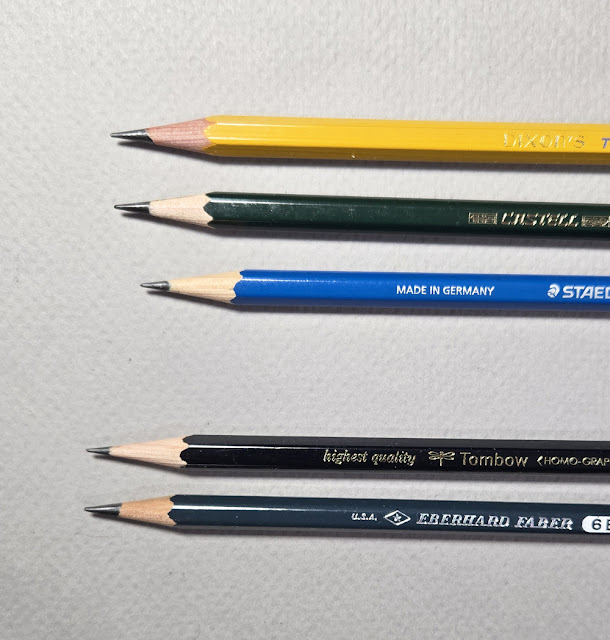 |
| All pencils were freshly sharpened before making the test sketches. This image shows how the points looked after the sketches were finished. |