Showing posts with label Prismacolor Art Stix. Show all posts

Monday, March 16, 2026

Master Copies of Van Gogh


3/10/26 Master copy of Vincent Van Gogh

A website called Draw Paint Academy recently crossed my radar; in particular, an article about the lesser-known works of Vincent Van Gogh. Since I have no formal education in art history, I appreciate learning from writers who can talk about masterworks in a layperson’s language without getting all academic-y.

Two paintings caught my attention: Trees in the Asylum Garden and Saint-Paul Hospital Park (both from 1889). Especially struck by the vibrant color contrasts and dynamic brush strokes (the paintings seem to shimmer and vibrate), I felt inspired to make master copies.

I wasn’t going to use oil paints, of course, but I thought about what dry medium at my disposal might be able to emulate those hatchmark-like brush strokes. Although I hadn’t used them in a long time, Prismacolor Art Stix had come up in a recent conversation with Roy and Mary Jean, so they were out on my desk. Basically block-shaped colored pencils on steroids, they could make flat, broad strokes, and my set includes a good range of colors. Why not? (Related geeky afterthought: Imagine if Derwent made their Drawing Pencil cores in a block form! Be still my heart!)

It’s always instructive and illuminating to copy a masterwork. For one thing, the palettes of these two paintings look so cohesive that I thought the range of hues would be fairly limited, but once I started trying to match them all, I was surprised by how many colors are in them. You know me and my limited palettes; these were boldly outside my comfort zone!

3/12/26 Master copy of Vincent Van Gogh

I noticed that Van Gogh liked to outline shapes with a dark color. Did he “draw” the shapes first and then fill them in? Or did he paint the shapes, and outline later? I’ve seen this in his other works too, but it wasn’t until I copied these myself that I studied the paintings with those questions in mind. The technique caught my attention because it flies in the face of the traditional painting instruction we read in books or hear from instructors: Objects in reality never have lines around them; avoid drawing them (or avoid letting them show in the painting).

One thing I had difficulty with, especially using a dry medium, was covering the entire “canvas” with color as he did (and as most painters do). Sometimes I think this is one of the biggest differences between a sketcher (at least this sketcher) and a painter: I never feel compelled to cover the entire page, and, in fact, I prefer to leave white space. That’s just my style, but it’s also a limitation of my chosen media. It would be impractical and time consuming to cover every speck of paper surface with colored pencils or even crayons. With none of the grace but maybe at least some of the energy, I tried my best to emulate the spirit of Van Gogh’s gestures.

There’s plenty more to study and learn from copying Van Gogh (or any master). I’ll put this in my doomscrolling prevention tool kit. It seems like master copying might be too mentally taxing for late-evening work, and it was certainly not relaxing as, for example, sketching from my own reference photos with Derwent Drawing pencils. But trying to emulate another work takes away the need to be expressive in my own way. In any case, I recommend it.

No limited palette for Vincent!

Sunday, March 8, 2026

Beyond Doomscrolling Prevention


2/23/26 Neocolor II in Hahnemuhle sketchbook
2/23/26 Derwent Drawing pencil in Stillman & Birn Zeta sketchbook (all sketches from photo references)

An interesting thing is happening with my evening sketches from photos that began as my doomscrolling prevention program. Keeping me from reaching for my phone is still an immediate benefit, but the long-term advantage is that I’m encouraged to use more materials from my vast stash – and sometimes experiment with using them together in ways that probably wouldn’t have occurred to me otherwise.

2/26/26 Derwent Drawing pencil in S&B Zeta sketchbook

You may recall a period a few years ago when I made more than a hundred portraits based on Earthsworld’s photos. I didn’t talk about it at the time, but that late-evening practice began as self-care during what was often my only respite as a caregiver. Drawing the faces of random strangers took me outside my anxious, agitated mind and gave me a focus. After a while, though, the practice went beyond self-care; I found myself learning from the enjoyable portraiture practice and using materials I rarely used on location.

2/26/26 Neocolor II in Hahnemuhle sketchbook

My 407 consecutive days of drawing my hand had a similar outcome: What began as self-care during a historic time became a project that took on a life of its own.

2/26/26 Inktense Blocks, Neocolor II in Hahnemuhle sketchbook

Like the random Earthsworld people, the subjects of these seemingly mundane neighborhood photos don’t mean much to me beyond their composition potential or high-contrast values. I’m having so much fun just grabbing materials that feel good in my hand and seeing what happens when I apply them to paper. Who knew that doomscrolling (or avoiding it) could have such benefits?

3/2/26 This experiment was a mix of more materials than I typically use together. I first used Prismacolor Art Stix (the block form of Prismacolor colored pencils) for the areas that I wanted to remain relatively sharp. Then I used Inktense Blocks and Neocolor II crayons for foliage that I activated with a water spritzer. Finally, I used a Fibralo brush marker to give the central tree stronger definition. 

Thursday, March 7, 2024

Doggie Do-Over


3/3/24 Bug (Art Stix in Uglybook sketchbook)

In Gal Cohen’s “Unique Line” class last week, she showed us many examples of artworks that were realistic in content (not abstract) but were also highly expressive and evocative. Although many could be described as “loose,” not all were. As I’m sure I’ve mentioned before, my desire is not necessarily to be “loose” as it is to have the appearance of ease (two different things).

The images and our class discussions gave me a nudge about what I want to explore, both in and out of class. Although it wasn’t an assignment, the class prompted this idea: Use the same photo reference of a dog I had already drawn in my usual descriptive style and try to sketch it more expressively. I used chunky Prismacolor Art Stix, which help me avoid getting too detailed. I’ve tried this same approach with human portraits and even with beets. It seems to help when I make the more realistic attempt first. As with the humans, I wanted to capture Bug’s essential personality and expression with resemblance being secondary.

1/31/24 Realistically rendered Bug


Speaking of do-overs, of the 70 pet portraits I made since December and shipped to their owners, none got lost in the mail – except poor Moose (below). When I was informed by the owner that the piece never arrived, I quickly made a new one. They are both shown here. I used a slightly different mix of media the second time, but otherwise, I tried to make the second one look about the same as the first. It was an unusual circumstance to try to reproduce a drawing. Although I think the second one is more accurate in terms of resemblance, I like the first one better. Partly it has something to do with “freshness” – they eye and brain are engaged more actively the first time.


1/25/24 the original Moose, sadly lost
3/2/24 replacement Moose

Friday, April 28, 2023

My Right Hand Captures the Essence


4/1/23 Art Stix

My right-handed portrait practice continues sporadically (often late in the evening when I’m low on energy, so I have nothing to lose: My drawing skills couldn’t be much worse anyway). Resemblance is hit-and-miss as usual. I could blame proportional mistakes on my right hand, but I know that’s really the brain’s fault, and the hand is just following orders. I would have made the same mistakes with either hand.

What’s more interesting, though, is that I often find that my right hand can capture the essence of a face better than my left hand can, even if resemblance is not spot on. Maybe it’s like making blind contours when my expectations are lower. Or maybe the brain is not as familiar with controlling the right hand, so there’s a bit of a lag, and the right hand is freer to interpret the face without as much “control” from the brain. It’s hard to say why, but all of these feel successful as quick captures of the models’ essence (all portraits from Earthsworld reference photos).


4/1/23 Le Pen Flex

4/2/23 Museum Aquarelle

The sketch of the woman (below, right) was a hard lesson to learn – literally. I knew that Stabilo Original colored pencils were very hard – possibly harder than most colored pencils I own – yet I felt like using them anyway because I had just received them as a gift. They require pressure to use even with my full-strength left hand, but with my weak right, it was nearly impossible to eke out enough color for this sketch. The more frustrated I became, the more scribbly I got, but ironically, I like the very messy crosshatching that resulted. France Van Stone’s “dirty crosshatching” had a good influence on me.

4/14/23 Stabilo Original colored pencils

4/23/23 Le Pen Flex, Neocolor I


Saturday, January 8, 2022

Handy Color Studies


12/5/21 A confusing secondary triad

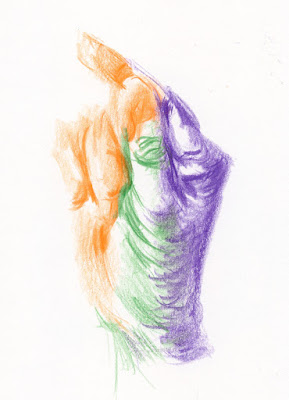
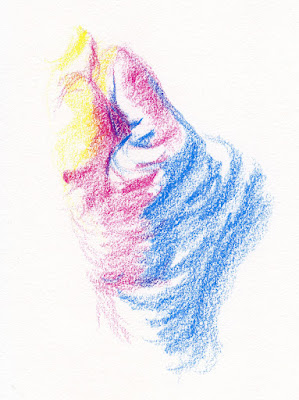
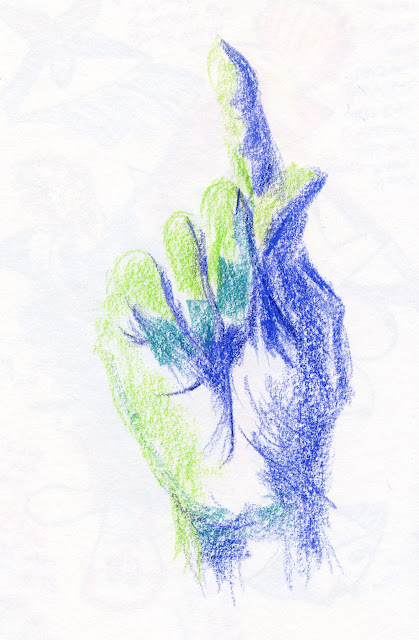
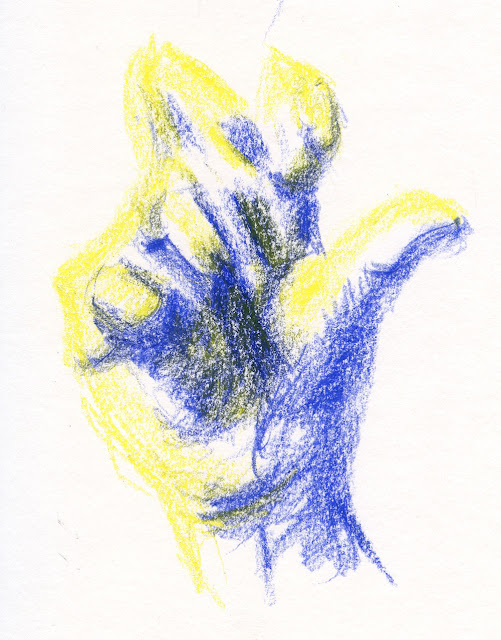
Once I understood why life-drawing models are an intriguing and challenging subject for studying color temperature, I figured I needed to practice during life-drawing sessions. But then I remembered that I have a “life model” on the end of each arm! They aren’t as fun to draw as Shawna, but my hands do show a range of subtle color temperature differences, especially when I exaggerate them by drawing with Art Stix in garish, saturated hues.

Sometimes with these exercises, the results look more like value studies than color temperature studies, since the side that faces the light tends to be warmer than the shaded side. I knew I could easily be confused by this, but I tried to keep color temperature firmly in mind as I worked.

By the way, I stopped sharing these on social media after the first one because some followers were alarmed that the reappearance of the hand meant a return to self-enforced COVID lockdown! Nothing that dramatic . . . it’s just a “handy” life model.


12/9/21 My trusty CMYK triad

12/13/21 Three fun analogous colors that were relatively easy to work with in terms of color temperature.

12/19/21 This complementary pair worked well for this experiment because the cast shadows looked slightly warmer than the form shadows, and those are the areas where the two colors mixed (into an unpleasant green).

Sunday, March 28, 2021

The Last Couple of Miles


In some ways, my pandemic hand series is easier to continue because I know it’s so close to ending. On the other hand, it’s also harder for the same reason. It’s an odd state. Maybe this is how marathon runners feel on those last couple of miles.

To keep myself challenged and motivated during the final push, I started using my right hand again. It’s been six months since I practiced drawing with my non-dominant hand. That time, my practice lasted for 63 days; I certainly hope this practice will be shorter!

With my first righty drawing, I felt so rusty that I was afraid I was going to have to start all over again. After a couple more, though, my hand started getting its chops back. It helps that Art Stix are soft, thick and forgiving. It probably also helps that the previous practice made me more ambidextrous in general. It feels natural to do some simple tasks with either hand now  scooping peanut butter from a jar, spreading it on toast.


To add to the challenge and tie the righties together visually, I decided to use my gray Stillman & Birn Nova. Of all the toned paper colors I’ve tried, cool gray is my least favorite. I’ve used it on and off for urban sketching in the winter because it matches our months-long sky so well. (Maybe that’s the problem – it reminds me too much of overcast skies.) I’m not sure why, but I have difficulty using gray as an undertone that I don’t have with warm tan and beige papers. Bright white doesn’t seem quite as bright on gray, and some colors look dull.

About half of my 92-page gray sketchbook remains. Let’s see if I can be fully vaccinated before I fill the book.


Thursday, March 25, 2021

Essential Workers


3/21/21 Life Drawing+ organizer and host Agata wears a big straw hat to talk about the
challenges of offering online life drawing. (5 minutes)
For many years, Life Drawing+ offered open sessions and classes with live models in a traditional Manchester, England, life drawing studio. When the pandemic closed the studio, organizer Agata wasted no time in moving the models to what may have been the first life-drawing program on Zoom: It began only a week after the UK’s lockdown a year ago. While life drawing online has become commonplace during the past year, the Life Drawing+ program is still the most innovative and creative that I have participated in. Some of my favorite sessions have included dramatic lighting, a lesbian couple, and a drag queen with elaborate accessories.

To commemorate the weekly program’s first anniversary, Agata presented a variety of first responders and other essential workers from the UK. Instead of modeling in the traditional sense, they were interviewed by Agata about how the pandemic has profoundly affected their lives and livelihoods. They dressed in uniforms or held props of their trades as they told stories of courage and resilience.  

First up was Agata herself (above), who talked about the challenge of helping models continue to earn a living by putting them on Zoom instead of up on a studio platform. How much easier it was, Agata said, to simply invite artists to come to the studio instead of having to remotely teach models how to use video in the best ways possible.

Amanda is a volunteer at a vaccination site. Wearing a high-visibility neon green vest, she talked about how she reassures vaccine recipients and makes sure they wait at the facility the required 15 minutes after vaccination in case of an allergic reaction.  

Amanda, vaccination site volunteer (5 minutes)

Alan, who normally delivers produce to restaurants and stores, suddenly found himself many times busier once the pandemic hit. Suddenly food became difficult to buy in stores, so individuals began calling him to deliver produce directly. He said he appreciates the contact with customers, many of whom are shut-ins who have told him, “You are literally keeping me alive.”

Alan, food distribution (10 minutes)

Organic farmer Lindsay also found herself much busier when the pandemic hit. A seller at a farmers’ market, she had initially panicked when the market was closed, but then she started receiving “a hundred emails a day” from customers asking if she could deliver produce directly. When they couldn’t buy produce easily from stores or markets as they had in the past, they became more aware of where their food comes from.

Lindsay, organic farmer (15 minutes)

Helen, a teacher, had to face the enormous challenges of learning how to teach teenagers online. She talked about how difficult it is for young people to have only their families for company and not to have social interactions with peers.

Helen, middle-school teacher (15 minutes)

Unlike food producers and distributors who suddenly found themselves in greater demand, Steve, an emergency room nurse, had the opposite experience. He said that some people who needed urgent medical care became hesitant to seek help because they were afraid of catching COVID at the hospital. Part of his work has been to educate patients about how they still need to take care of themselves and seek medical attention if they need it.

Steve, emergency nurse (5 minutes)

An art director, Alan found many of his income sources drying up. To supplement his dwindling income, he became a parcel courier (my impression was that the retail service he worked for was similar to Amazon). As retail customers began buying more and more products online, the need for couriers expanded rapidly. Paid by the parcel, not the hour, he had to learn very quickly how to make deliveries at a fast pace. He eventually came to enjoy some aspects of the job, such as the relative flexibility and the small interactions he has with customers.

Alan, courier (15 minutes)

A surprising “model” in the session was Elizabeth, who designs and builds bicycles. She has built more than 50 bikes. Her small business has boomed during the pandemic. In addition to the many commuters who started bicycling to avoid public transportation, others sought the “liberation” biking provided – fresh air, an opportunity for fitness, feeling free when so much of life felt oppressive.

Elizabeth, bike maker (15 minutes)

The last “model” of the session was Elaine, a microbiologist working in the field of infection prevention and control and specializing in children. She chose to hold a COVID testing swab as her prop because it best represented what she has been studying the past year – and she has tested herself numerous times. Part of her work has been to figure out how to conduct COVID testing in countries that may not have reliable access to electricity, computers or other technology. Elaine also talked about the false impression many have that children do not catch COVID easily or that they don’t have symptoms. In fact, although not many children die of COVID, many do suffer serious, long-term consequences.  

Elaine, microbiologist (15 minutes)

This session was probably the most meaningful sketching I have done during the pandemic. I was moved by their stories and felt honored to sketch them in recognition of the work they do so that people like me can stay safely at home. And many thanks to Agata for making it possible for artists around the world to draw them and hear their stories.

Proceeds from this session, which are normally paid to the model, are being donated to two international charities nominated and selected by the essential workers and the artists who participated.


Sunday, March 21, 2021

Finite


Lengthy art projects are not new to me. During my first year of sketching, I decided to make one hundred self-portraits, and that took me a couple of months. (Can you believe it? My attempt a couple weeks ago wasn’t the first!) As if that torture wasn’t enough, shortly after that, I sketched my hand a hundred times. My longest project was when beadwork was my primary art medium. On the day after my 49th birthday, I began weaving one small piece of beadwork every day for a year, culminating on my 50th birthday. Afterwards, I mounted the 365 pieces on a single panel for display. (You can see the completed work on this page.)

All those projects had been planned, and I had made a commitment in advance to complete them. My current series of hand drawings, however, is different.

On March 16, 2020, a few days after the World Health Organization had declared a state of global pandemic, I was filled with so much fear and anxiety that I grabbed the nearest pen and paper and drew my hand simply to quiet my agitated mind. Afterwards, I felt better, so the next day, I did it again. I never intended for these sketches to become a series. (If I’d known then that I’d still be at it more than a year later, I never would have begun!) I was a month into the hands before I had committed to the series to the extent that I bought a stamp set to ritualistically count the days.


I didn’t even know what days I was counting. Unlike some artists who had begun series of sketches to endure their locally enforced lockdowns, my effort was nebulous – a self-enforced “lockdown.” It had no end date that I knew of. A large part of my ongoing anxiety was exactly that – not knowing when it would end. Something terrible being indefinite makes it much harder to bear.

By the fourth month of the pandemic, I finally realized what this series was about: It was a metaphor for personal endurance of living through a constant state of being unsafe. It became clear, then, what I was counting: The number of days until I felt safe again.

Last Wednesday Governor Inslee announced that on March 31, 2 million more Washington State residents will be eligible to receive the vaccine, and that tier will include me. When I schedule my appointment, the wait for safety will be finite. And finite feels infinitely better than indefinite. The hand series will end. And that end will be a grateful relief in many ways.


Sunday, March 14, 2021

One Year Since


The past week was bittersweet and emotional. I hit several “one-year-since” anniversaries: my last Jazzercise class; my last in-person yoga and Gage Academy classes; our last Urban Sketchers outing; our last trip to Costco (where I sketched a few people as a lead up to the One Week 100 People challenge); the last time we shopped inside any grocery store; the last time I walked around Green Lake with the friend I’ve been walking with there for more than a decade. As you can see, I just passed Day 363, which means that I’m coming up on a year of drawing my hand. How time flies.

As for the hands, I was so busy drawing my face most of the week that I relaxed by making some fun, blind-contour abstract doodles. In the last self-portraits I made, I used two contrasting colors – one for form, one for details and the darkest values – and I enjoy the way that looks, so I will explore that further. The face helps the hands and vice versa.


Related Posts Plugin for WordPress, Blogger...