Showing posts sorted by date for query feeder. Sort by relevance Show all posts

Wednesday, October 1, 2025

Portland, Part 4: Oregon Zoo


9/22/25 Asian elephants, Oregon Zoo

Despite the many times I’ve visited Portland, I had never been to the Oregon Zoo before. It’s truly a world-class zoo with a well-designed walking flow and beautiful exhibits that enable the animals to be seen while still giving them lots of space to roam.

I spent the most time observing the Asian elephants – three adults and an adorable baby! They can eat from timed feeders, which keep the animals moving from feeder to feeder. I had so much fun sketching an adult elephant up close while she fed. To observe more of the exhibit, I walked above the feeding area, and I could see the baby playing, mom nearby.

Masai and reticulated giraffes

The Masai and reticulated giraffes, too, had an excellent, large space where they could be observed no matter where they went.

The Oregon Zoo is now on my list of regular places to visit when I go to Portland.

Mountain goat, black bear, bald eagle

Friday, October 13, 2023

Squirrel Saga


10/7/23 I imagine that the squirrel looked like this as it flew off our second-story deck.
(reference photo by Andrey Svistunov on Unsplash)

Squirrels have not always been my enemy. Up until this year, I had always been charmed by their agility, their fat, fluffy tails, and the adorable way they hold their food. I enjoy watching them dart around our backyard or scurry across power lines and up trees. I have sketched many squirrels, both from photos and from life (a few shown here).

Back in February, I had written about the squirrel that had taken up residence inside our roof for several weeks. After trapping the (probable) perp as well as numerous innocent bypassers (including one poor Steller’s jay that we released ourselves) and having exclusion work done, we thought the ordeal was over. It turned out that it had barely begun.

Shortly thereafter, another squirrel took residence for months. Eventually that one left of its own accord, but not without first annoying us with daily noisy skittering, gnawing and damage (tiny holes are visible in our bedroom ceiling). Then over the summer, yet a third moved in.

We had long ago fired the ineffectual, incompetent Willard’s Pest Control when its business model became clear: Why install effective exclusion solutions when a much better income stream comes from trapping and removal ($200 each)?

Seeing squirrels use our lilac tree as a convenient bridge to the roof, we got that pruned (though obviously it was just a convenience – squirrels can scale siding, brick and gutters almost as easily as trees).

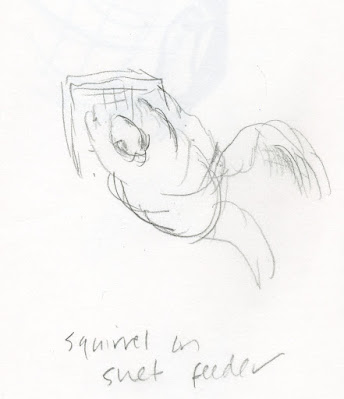
1/30/22 Squirrel on our suet feeder (sketched from life)

A new tactic

Rather than find another wildlife removal contractor, our next tactic was to hire a professional roofer. The shabby exclusion work installed by Willard’s had already been chewed through by the current squirrel, so we needed that repaired. To avoid trapping the squirrel inside, I had a plan:

Whenever we fed peanuts to the jays in the backyard, a squirrel usually interloped. Although it was impossible to know for certain, I suspected that it was the same one in residence because of how quickly it appeared with the birds. (What cushy accommodations we provide: Free room and board!)

When the roofer was ready to nail shut the last exclusionary piece, I went out to the backyard and put out peanuts. Sure enough, our probable perp showed up! While it was dining, the access hole was blocked, and no more squirrel in residence!

3/13/19 Squirrel on our bird feeder (sketched from life)

Of course, that would have been too easy. An hour later, we heard squirrely noises again. Somehow, it was back inside.

Three days later, I walked into the bedroom to see a squirrel diving under our bed. It was no longer confined to the roof – it had gained access to the living space. Flinging open the bedroom’s French doors, I wished I’d had my phone and the presence of mind to video the squirrel’s spectacular leap off the second-story deck.

Feeling fairly hostile by now, I half-dreaded, half-hoped that I’d find its little skull cracked open on the pavement below. Of course, it must have landed easily on its feet, because a few minutes later, the squirrely noises in the roof had commenced.

Time for the big guns

The next day, I came upstairs to find the squirrel darting around inside my studio. This time, however, the intrusion was informative: In response to my loud cussing, the squirrel had raced into an unfinished storage area, and then I immediately heard it skittering overhead. A-ha – so the storage area was the access from the roof! Now we gotcha, you little bugger. I slammed the door shut, confining the squirrel to the storage area, which fortunately contains no food.

4/27/20 Squirrel on our bird feeder (sketched from life)

It was time to pull out the big guns. After more research and frustration (three more pest removal contractors disappointed me even before they did any work), I finally found A Wildlife Pro. Extremely knowledgeable about pesky animal behavior, owner Sean also seemed compassionate and humane toward the wildlife that annoyed humans. In addition to inspecting our house and roof thoroughly for problem areas and proposing a plan to address them, he gave us a fascinating education in squirrel behavior (“know thy enemy” is the best strategy).

For example, only female squirrels chew their way into roofs – they are looking for safe, cozy nesting places. Assuming it was safe and cozy, they will also tend to return to the same location litter after litter – so it’s possible that we’ve had the same mama all year. As I know from every nature program I’ve ever watched, a mother mammal will do everything necessary to protect and raise her young, including defending her territory.

Pointing out fresh debris on the lawn on the side of the house where I had heard gnawing, Sean believed that the recent noises were coming from outside the roof, not inside. But then what about the squirrel I had seen in the bedroom and in my studio? It was probably not the same one doing the chewing. It was likely that we had a whole family in residence.

Setting live traps in the storage area, Sean said that if we happened to catch a nursing female, he would advise releasing her until the youngsters were weaned. Otherwise, a nest of young ones would die inside the roof. If it was obvious that the squirrel was not nursing, then he would take her away to be “euthanized.” (I asked why he can’t just drive her a half-mile to Green Lake and let her go? It’s illegal to “relocate” wildlife.)

Trapped in our storage area.

Trapped


Less than an hour after the traps were set, we caught a squirrel. After calling Sean, I took my sketchbook into the storage area to sketch it, but it was thrashing around too much. I stayed with it a while. We had already “euthanized” many squirrels this year, and likely this one would be next. Moments earlier, its only motivation had been hunger, which drove it to the peanuts in the trap. As soon as it was trapped, however, it had left the peanuts uneaten; getting free took all of its attention. Seeing it gnaw frantically, trying to escape, I empathized completely. Trapped and hungry, I would certainly try to free myself before eating.

I’m sorry, little squirrel. I know you are only trying to live your life, just like the rest of us.

10/12/23 Sean installing hardware to keep squirrels out.
Sean carried the trap out to our backyard deck to observe the squirrel in better light. Nearly full grown and probably weaned, it was a male juvenile, he said, not mama, which helped us put the likely story together: When the roofer had completed the exclusion work several days prior, mama had been outside the roof (eating our peanuts in the backyard) and could no longer get back inside, where the kids still were. Ever since, she had been trying to gnaw a new opening into the roof to get back to her kids.

Meanwhile, youngster No. 1 had found its way to the storage area and eventually flew off our deck. Youngster No. 2 was now in the trap.

As we were talking, the trapped squirrel suddenly gave a loud, shrill cry that I had never before heard from a squirrel. A distress call, Sean said. Then another squirrel dashed into our yard: Mama had heard him!

Sean looked at me. I told him to let the squirrel go. He took the trap to the top of the fence between our yard and the neighbor’s and released the little bugger.

We haven’t heard squirrely noises in more than a week – the quietest it has been in months.

Squirrels aren’t going away, and neither are we. We must learn to coexist. More than $4,000 and nine months later, we are learning.

Wednesday, February 2, 2022

My Brushes with Nature


1/28/22 Mt. Rainier from Maple Leaf Park

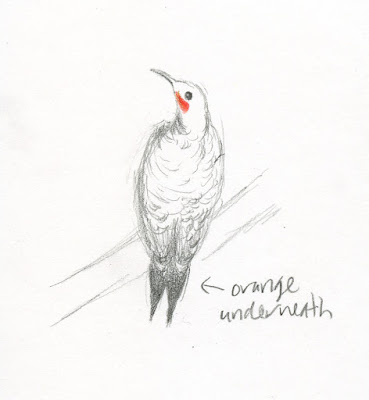
12/14/21 flicker
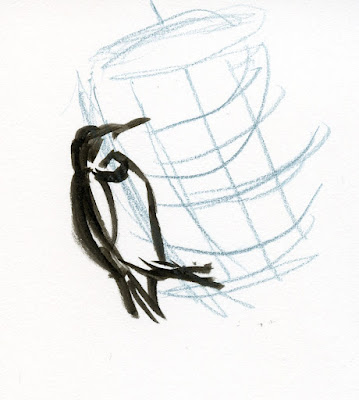
As an urban dweller, I don’t have as many brushes with wildlife as some suburban friends do, but I’m grateful to still have some backyard exposure to nature. This winter has been so cold that we’ve been hanging suet out for the birds instead of seeds. One feeder has a cage-like structure around it that the smaller birds can hop into to get to the suet, while larger birds hang onto the outer “cage.” Our primary diners are dark-eyed juncos, but we see occasional flickers, too.

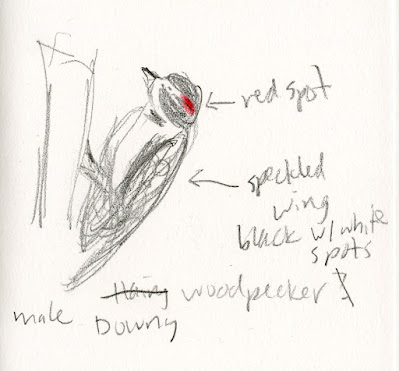
On one recent occasion, we saw a male downy woodpecker for the first time. Although much larger than juncos, he was small enough to fit inside the “cage,” hammering away at the suet when I caught him with my sketchbook.

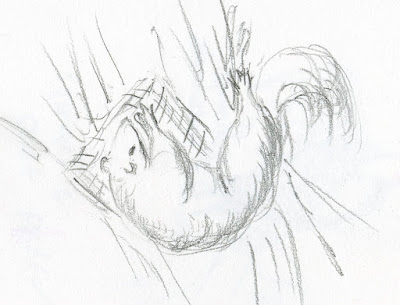
Our neighborhood squirrel also likes suet, it turns out, but to get any, it has to perform crazy acrobatic stunts. Although I’m not in the business of feeding squirrels, its performances are so entertaining that I don’t mind if it dines there, too.

1/30/22 squirrel acrobatics

1/28/22 male downy woodpecker

When I walk a few blocks to Maple Leaf Park on a clear day, I get my most spectacular brush with nature: Mt. Rainier. I can’t seem to walk past Her Majesty without a curtsy. Every time I sketch her, I learn more about her proportions.


1/17/22 This flicker perched on our fence for a leisurely minute or more,
which allowed me to capture its distinctive tail.

1/12/22

Tuesday, February 1, 2022

My New Whatever Journal

Sketchbook and journal ... separate books.

When I first discovered urban sketching and began documenting my life with sketches, I almost immediately discovered a dilemma. Admiring the works of many sketchers who use this method, I especially loved the concept of putting sketches and writing on the same page. As a lifelong journal writer, I saw the value and appeal of noting observations or other commentary related (or maybe not even related) to whatever I was sketching. The “story” seemed more complete that way.

I tried it briefly early on, but sometimes I wanted to show the sketches to someone without revealing the writing. Do I cover the writing with a Post-it, which only calls attention to whatever I want to keep private? When I eventually started sharing on social media, the problem became worse. I didn’t like the additional task of digitally obscuring text, and I definitely didn’t want my writing to become more self-conscious or filtered for my “audience.” And what about my messy handwriting? I felt compelled to upgrade that, too!

There was also the paper dilemma: Do I write on good quality watercolor paper that I preferred to sketch on, even if that paper wasn’t the best for writing? Or sketch in ordinary notebooks that were more suitable for writing? Both were unsatisfactory compromises.

None of it made sense, and after a short time, I went back to keeping my written journal separate from the sketchbook. I was relieved and happy, and it’s been that way ever since.

A sketch made during my walk and then another at home,
plus a tip I learned on Facebook.
 

In fact, the way I resolved part of the “storytelling” aspect of a sketch journal was to start this blog. Here, I show the sketches and also write related observations or commentary with a public audience in mind. It’s not the same as my journal, but it satisfies the completion of the story.

The unfiltered, unedited aspect of writing alongside sketches has continued to appeal to me, though, because it feels more integrated. Although I still enjoy keeping my scribble journal, that has always been intended as a place for sketches from memory and imagination made retroactively as a log of my completed day. Sketching from life and spontaneously writing in the moment have an entirely different energy from end-of-day summarizing.

An “Unprecious” Sketchbook

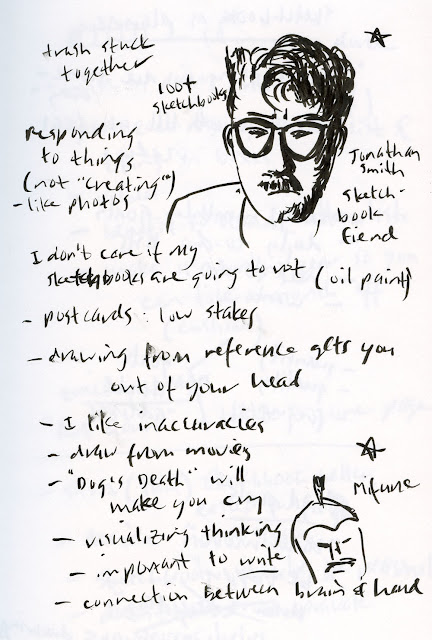
Early in the new year, I took a short online workshop with cartoonist and teacher Jonathan Smith on how he keeps a sketchbook. Sharing some pages, which he generally doesn’t do on social media, he showed how his sketchbook is a hard-working tool filled with sketches, doodles, visual and written ideas, observations and business notes. He even uses the same book for monthly and weekly goal and task planning. Calling himself a “sketchbook fiend,” he has filled more than a hundred volumes by now.

Some notes I took during Jonathan Smith's workshop

What impressed me most about his attitude and methods was the “unpreciousness” (his term) of his sketchbook. Jonathan encourages his art students to “make bad drawings” in their sketchbooks as a means to experimenting and trying new things. Although his own work is mostly cartoons of imaginary characters, in his sketchbooks he draws more from observation (life or photos), which he believes “gets you out of your head.” I appreciated this insight because one aspect of urban sketching that I value most is that it keeps me focused on the world around me – not inside my head.

Although I don’t think of my physical sketchbooks as “precious” – the process and act of sketching are far more important to me than the results – I began to realize that not wanting to write directly on my sketch pages was a form of keeping the sketches unsullied by writing.

Ink bleeding through, and I don't care.

So Many Compartmentalized Notebooks

Learning about Jonathan’s sketchbook rekindled my desire to integrate sketching and writing. It occurred to me that while I like to think of myself as experimental, when I pull out my daily-carry, A5-size sketchbook on location, I am more interested in the “story” of my urban sketches (however mundane that story might be). It’s not the same kind of working sketchbook that Jonathan advocates.

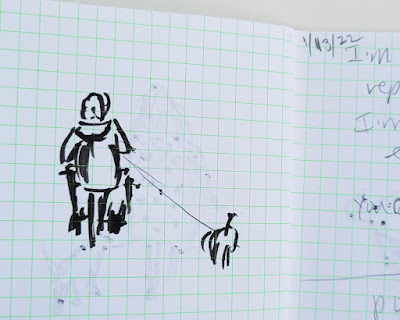
Mulling over this dilemma, the proverbial light bulb switched on: In addition to the A5 sketchbook, I also carry at least one, usually more, pocket-size notebooks for hasty sketches made on my walks or for surreptitious portraits on public transportation. These spontaneous sketches have always felt less “precious,” even though they tell no less of a story than most of my larger sketches do.

In addition, I always carry at least one other pocket-size notebook for memos, quotations, blog post ideas, other ideas, shopping lists, references, and yes – observations and other on-the-fly writing. My apparent need to segregate my writing from my sketches had resulted in multiple portable notebooks used concurrently.

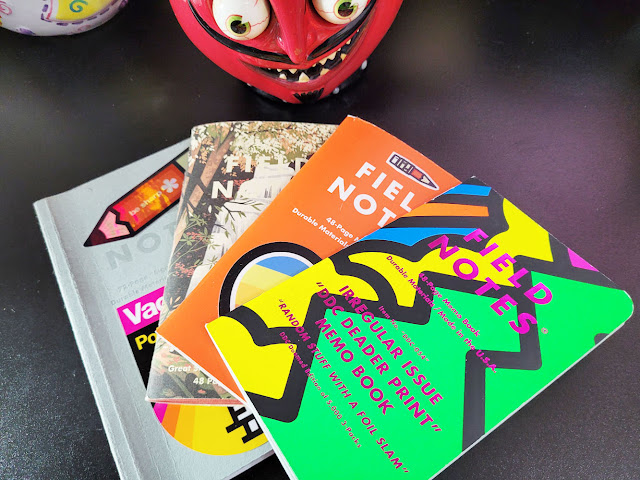
Field Notes notebooks, several of which I used and carried concurrently.

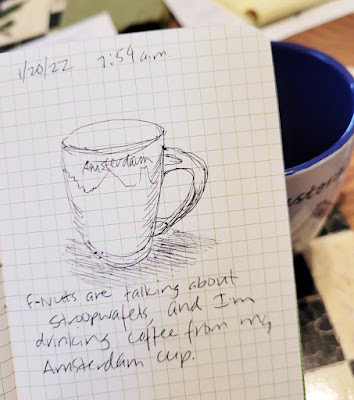
Observations over breakfast.
My Whatever Journal

I am trying something new. I still want to keep my “storytelling” sketchbook of urban sketches free of writing. But as a step toward a more integrated, working sketch journal of the type that Jonathan shared, I took all the various small notebooks out of my bag and began a fresh one. I now consolidate all contents into that one Field Notes. That means that I have also stopped fussing about what kind of Field Notes paper is better for light washes or fountain pens or whatever. The easiest way to be “unprecious” about my sketchbook is to not care if the ink bleeds through or the page warps.

I’m also trying to write more observations as I sketch. Unlike my longer-form journal writing that can become introspective or reflective, these are brief observations of the type I so thoroughly enjoyed writing when I took Taylor Dow’s workshop on observational cartooning.

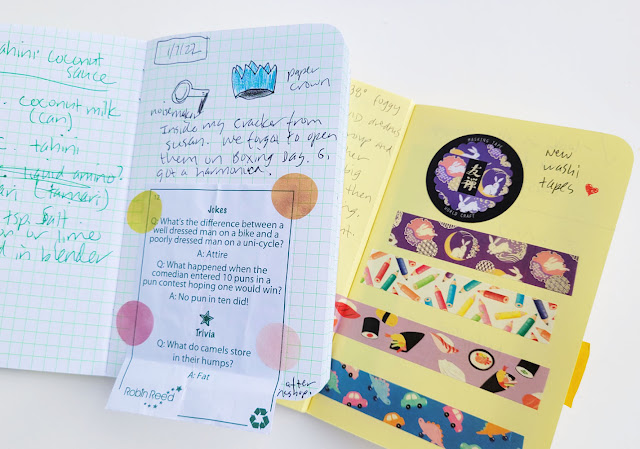
Detritus of the brain.

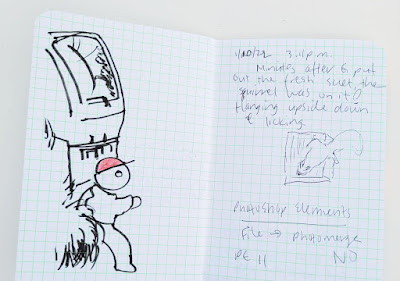
I filled my first Field Notes with this process in less than a month, and I just started my second. A recipe for tahini sauce is jotted right next to corny, glued-in jokes that fell out of a Christmas cracker. A Photoshop Elements tip I learned on Facebook is noted on the same page as a sketch of a squirrel eating from our bird feeder. Over breakfast one morning, I described the previous night’s COVID nightmare, then decorated the opposite page with washi tape. It’s a messy brain dump of words, sketches, ephemera and scribbles. It’s definitely not pretty (I’m not sharing much of it), but it is perhaps a more accurate reflection of my life than any other single book I keep. I don’t know whether this new process will stick permanently, but so far, I am thoroughly enjoying having a single place to store my daily whatever.

As an ongoing student of the creative process, I’m afraid I tend to over-analyze and over-document changes in the way I use “process tools” (as I think of all sketchbooks and notebooks). If you’ve stayed with me to the end, I thank you for indulging me in this lengthy post.

Edited 8/29/22: I happily stayed with this process for more than half the year... then it turned Ugly. 


Wednesday, December 29, 2021

First Snow


12/26/21 11:15 a.m., 27 degrees, Maple Leaf neighborhood

We had been promised a white Christmas. Although some areas of the region got a dusting on Dec. 25, we didn’t see it in Maple Leaf until Boxing Day – several inches of nonstop snowing and blowing. Fortunately, we didn’t have anywhere to go, so we could enjoy the quiet beauty through windows.

My first sketch of the day was one of our suet feeders from the kitchen (I sketched a snow scene with a different focus a few years ago from the same window). Using only graphite and a blending stump on white paper, it was challenging but satisfying to depict the snow piled up on the feeder and fence. What I didn’t capture, though, was the falling snow that was coming down hard and sideways. I didn’t think that erasing out the snowflakes would stand out sufficiently, so I left it alone.

12/26/21 2 p.m., 25 degrees, wind from north 

Later that day, I still wanted to try for falling snow, so I lowered the shade to a side window with a view of not much more than our neighbors’ downspout. This time using a gray Stillman & Birn Nova sketchbook, I had hoped that either a white Gelly Roll or a white Derwent Drawing Pencil would do the trick. Gray toned paper never quite seems dark enough, though, to make white stand out (and I didn’t mean for the wires to look like they were inside our window!). Not as satisfying.

Whenever we get the first snow of the season, I feel some pressure to sketch it as much as possible, since I never know how long it will last (unless we get another snowpocalypse, of course). I see more snowflake icons in the forecast, though, so I might have another chance soon.

Monday, September 13, 2021

Backyard Diners


9/9/21 Steller's jay

Nearly every day this summer, we’ve been having our lunches out on the back deck. Most days, our neighborhood Steller’s jays join us: When they hear us through the open kitchen door prepping our lunches, they stand on the deck railing, quietly waiting. They know we’ll be out soon, peanuts in hand. We’ve seen as many as four at a time at our makeshift feeder.

Once in a while, our local squirrels try to get in on the action. We don’t make an effort to feed them, but they and the jays seem to coexist in a non-hostile manner, so we don’t mind if they grab a few peanuts for themselves.

9/9/21 Our local squirrel

Meanwhile, Greg and I are busily grabbing, too – I, my pencil; he, his camera. Some cold and rainy day this winter, I’ll probably use one of his photos to draw a squirrel or jay, wistfully remembering these lovely summer days that are likely to end soon.

9/9/21

9/11/21

Wednesday, August 18, 2021

A Busy Street Corner


8/10/21 Maple Leaf neighborhood

My mother loved all birds, and her favorite was the Anna’s hummingbird. She kept a feeder for many years outside the kitchen window so that she could enjoy watching them as she had meals. Some cultures believe that when people die, their spirits return to earth as birds. Whenever I’m out sketching and a hummingbird shows up, I always say, “Hi, Mom!”

Sketching this sunlit scene one early morning, I noticed a lot of action: A bunch of hummingbirds were busily dining at the dark pink Neptune’s Beard growing on the corner. (I didn’t know the name of this familiar flower, but a passing dog walker kindly informed me of it because he thought that was the subject of my sketch.) The bees were busy, too. I’m not sure which hummer was my mom, but I was happy to see that she was having breakfast with many friends.

Thursday, December 10, 2020

Female Flicker


12/6/20 female flicker at our suet feeder

Whenever I’ve studied life drawing of either human models or animals, the same question comes up in one form or another: Is the life of the being visible in the drawing? One life-drawing instructor put it this way: “Is there bone, muscle, fat and blood under that skin? Is the model breathing? Or are you drawing a mannequin?”

I’ve sketched flickers many times now during the four years that we’ve had a feeder. The sketch shown here that I made last Sunday is the first time I feel satisfied that I captured the gesture well – that the life of this bird is visible. I think some sketches may have captured the proportions or details adequately, but something was missing, and the result might have been a drawing of a taxidermy specimen (even this one, the only time I worked from a photo). Nature artist and instructor John Muir Laws could probably tell me, but I haven’t done it successfully or consistently enough to know what I did right this time – or how I can repeat it. Just more practice, I guess.

Wednesday, December 2, 2020

Birds, Leisurely and Not

11/25/20 flicker on our feeder

Our feeders have been getting a lot of action the past month or so as it’s gotten colder. Mobs of bushtits and finches arrive on their respective tour buses, unload for a quick lunch, then disappear just as quickly. Flickers, on the other hand, arrive solo or in pairs (a couple have a nest nearby), and sometimes they even watch out for each other: One dines while the other stands guard on a fence. For this sketch, I started in the morning with the female of the pair to get the basic gesture until she flew off. Then in the afternoon of the same day, her colorful mate showed up, so I filled in the details. Digging for goodies from the suet block, they both took their leisurely time fattening up, enabling me to get this much of a sketch.

A couple days later on my neighborhood walk, I spotted a hummer perched on the very end of a slender branch. I wouldn’t have noticed it except I heard its buzzy sound overhead. Unlike the leisurely flickers, the hummer took off about 15 seconds later, but it was enough to capture this much.

11/27/20 hummingbird

Friday, July 10, 2020

Disheveled

6/30/20 male goldfinch

A bright yellow male goldfinch was at our feeder, but I could see that something was wrong. Injured or sick, he rested there for long periods without eating and seemed to have difficulty perching. The black chevron pattern that should have shown on his wings looked disheveled. Taking a seed or two now and then, he returned daily for a few days. Then returned no more.

Thursday, July 2, 2020

What Motivates a Sketch?

6/29/20 squirrel dining at a bird feeder (motivated by
subject matter)

If you spend any time observing the work of urban sketchers who share their work regularly, you’ll start to see what motivates their sketching. (Aside: The term inspires is often used as a synonym for motivates, but in this context, I avoid inspires because it seems to evoke an external intervention – a fickle Muse or a bolt of lightning from the heavens. I think of motivation as coming from within, not the sky.)

For many, it’s obviously color – the multi-hued flower garden; a red house with a yellow door; the elusive hue of a near-black, reddish-purple tree. For others, it’s subject matter: distinctive architecture; an ancient pickup rusting in a field; an iconic landmark. Sometimes an intriguing play of light against shadow is enough to motivate a sketch. Or perhaps seeking an interesting composition in an otherwise dull scene can be motivating because of its inherent challenge. And most of us, at some point, are motivated by nothing more than art materials themselves: Having a new pen, pencil, sketchbook or even a new sketch bag is enough to get us out the door.

6/12/20 cement mixer (motivated by this super-soft pencil)
At various times, I’ve been motivated by all of the above. Perhaps the most enjoyable sketching of all is when more than one element is a motivating factor, like a beautiful old building with dramatic light and shadows; or an exciting composition of trees bursting with pink blossoms. Who could resist a quirky landmark that is also colorful?

Now that feeling safe while sketching on location can be a formidable challenge, I’ve noticed that some sketchers have stopped altogether. I think the sketchers who have adapted the best to these challenging times are the ones who are motivated by a wide variety of elements and are even exploring new territory. For example, I’m impressed by Virginia Hein’s recent experiments with Brusho (as described in her USk Talk), which keep her motivated even when she’s still sketching mostly around her home. And I’ve been motivated myself several times by creative prompts that USk Japan has come up with to help its members keep sketching, even if the familiar scenes they see every day are not necessarily “inspiring.”
 
6/16/20 Motivated by an interesting composition and a prompt to draw
with a single, unbroken line.
I see myself as an adaptive sketcher with many motivators. What motivates you – especially during our corona times? Please share your ideas in the comments.  

Wednesday, June 17, 2020

A Walking Sketch Journal

6/12/20 Maple Leaf neighborhood

Stopping for a sketch has become an integral part of my daily walk. On many days, I stop for only a few minutes (each of these took 5 to 10). On especially pleasant days when it just feels good to stand in the sunshine, I might take a good 30 minutes or more. As I walk, I’m constantly looking around for a sketch; it keeps me engaged and observant.

When I recently tried making a sketch journal page spread to record the events of an ordinary day, I enjoyed both the process and the result, but I also knew it was not a format I was likely to continue: I felt under too much pressure to do things that were sketchable. When I look back at my small walk sketches such as these, however, I realize that they collectively form a sketch journal in some way. Nothing extraordinary ever happens on those daily walks, but if one thing catches my attention for the length of a drawing, then those few minutes are not wasted.

My sketches have also become my fitness record: Instead of looking at my steps on a FitBit, I can just look back at my sketchbook to see the days I took a walk.


6/2/20

6/3/20 A squirrel lunching from a bird feeder!


6/11/20


Thursday, June 4, 2020

Female Flicker

5/17 - 5/29/20 female flicker

Our feeders are still up. Usually we take them down in the spring when the birds get better (probably more nutritious) offers elsewhere, but the occasional visitors are still entertaining us during these stay-at-home days, so we’ve left them up. We had heard that nesting females in spring need more fat, and indeed, our suet feeder is more popular than the seed feeder lately.

Last year I caught a male flicker’s bright red chevron on the back of its neck as it struggled to eat from the seed feeder, which is intended for much smaller birds. Over the past few weeks, we’ve been watching a female flicker dining from the suet feeder, which is much larger and more accommodating. Luckily for me, she tends to hang from the same side each time, so I was able to work on this sketch over the course of three days, often weeks apart, refining the gesture and adding details each time.

A first for us was observing a family of Bewick’s wrens several times. Mom and her four chicks (I say “chicks,” but they are nearly as large as she is) stand on the fence near the feeders. Mom flies up to the suet, grabs a beakful, then stuffs the gaping mouths of the four youngsters. We didn’t know that wrens feed their young outside their nest, so we’ve been delighted to watch this scene. I’m not sure I’ll be able to catch them with my sketchbook; they are so tiny and quick. But I’m happy that our feeders are still up.

Wednesday, May 6, 2020

Better Than TV

4/27/20 Maple Leaf squirrel

Insufficiently distracted by Prime’s offerings, we recently succumbed to Netflix. Bingeing on “The Crown” has kept our evenings busy, but the best daytime entertainment is still our bird feeder. In a “normal” year, we would have taken it down by now, knowing that the birds have plenty of better food elsewhere. But this year, with fewer entertainment options, we’ve kept it up. The birds are already dining less often at our feeder, though, and we miss them.

They are, however, not our only visitors. On a recent afternoon, our yard’s resident squirrel gave us quite a show of comedic acrobatics as it tried to eat out of the tiny feeding holes. Swinging wildly from both the wind and its own weight, the squirrel kept falling off, but I have to give it credit for persistence. I wonder if it’s the same one that visited last year. . . we have a Squirrel Buster feeder that would keep it away, but I like this faulty feeder better for its entertainment value.

Though less full of pratfalls, the chickadees, juncos and finches are just as frantic as they compete for the pegs. I’ve sketched the bright yellow male American goldfinches before, but usually from the back where their striking chevron-marked wings are visible. This one stood facing the window long enough that I could capture him from the front this time.
4/23/20 male American goldfinch

And then there’s our daily neighborhood walks. In my recent post about the urban bunnies, I mentioned that they are relatively rare in these parts. Not so with raccoons; we spot them fairly often loping leisurely down the street or ducking under bushes. Once, while waiting at a bus stop, I had a lengthy stare-down with a mama and her adorable kits in tow. I know that they can be a nuisance (or worse), but they have never done me any damage or harm, so I like them. On a recent walk, I heard a sudden scramble as I approached a stand of trees, so I looked up, and two raccoons stared back at me.

If nature’s urban programming were more regular and reliable, we wouldn’t need Netflix at all.

4/28/20 raccoons of Maple Leaf

Thursday, April 16, 2020

Draw a Bird Day

4/8/20 male goldfinch at our feeder

No, I don’t make this stuff up: April 8 was Draw a Bird Day! Begun in England in 1943, the day originated with a touching story about a young girl and her uncle who was injured in the war that I’ll let you read for yourself.

I heard about this internationally recognized day incidentally from a Facebook post on that date. Right after I saw the post, I looked out our kitchen window and saw a male goldfinch at our feeder now wearing his breeding colors. I had to draw him, right?

Now that we go out so infrequently and only for “essential” matters, we appreciate our garden birds more than ever. Not all is right with the world, but many parts of it are still beautiful.

Wednesday, January 15, 2020

Bewick’s Wren

1/9/20 Bewick's wren

Last winter a Bewick’s wren visited our feeder only occasionally, and meals were extremely brief. Every time I spotted one, it would be gone by the time I picked up a pencil. The most I got were a couple of incomplete gestures last spring. Along with a nuthatch, which also visits rarely and briefly, a wren has been my sketching goal at the feeder this winter.

Hoping to attract more nuthatches, which like to hang upside-down to dine, we got a different feeder this year designed to accommodate birds that eat that way. It holds suet bricks instead of loose seeds. I guess wrens like suet, because one has been visiting more often, and last week I finally caught it! It’s still not much more than a gesture, but it’s the most complete sketch I’ve made so far.

Wednesday, December 25, 2019

Merry Chickadee

12/6 - 12/17/19 chestnut-backed chickadee at our feeder

We are seeing a couple of new regularly visiting birds at our feeder lately: a nuthatch and a chestnut-backed chickadee. Black-capped chickadees have been among our most common visitors, but we’ve never noticed the chestnut-backed before this year.

The nuthatch is especially fast, furtive and unpredictable, so I have yet to complete a sketch of one. But the chestnut-backed chickadee has visited often enough that I’ve been able to sketch this much over the course of a couple of weeks, adding a detail or two each time I see one. I apologize that it’s a rather rough sketch to send you as my holiday greeting, but since chickadees are frequently shown on Christmas cards and such, it will have to do. Merry Christmas!


12/25/19

Wednesday, May 15, 2019

African Savanna

5/7/19 Dave the giraffe

One of our favorite ways to welcome long-awaited spring weather is to visit Woodland Park Zoo. We knew we wouldn’t be able to see the new baby giraffe that was born a couple of weeks ago (he has a problem with his rear fetlocks and isn’t out for public viewing yet), but seeing his photos in the local news reminded us that we hadn’t visited since last fall. His father Dave was outside feeding, and I managed to capture a sketch of his amazingly long, black tongue! That agile tongue is able to curl around leaves he can barely reach and pull them into his mouth.

We spent most of our time in the African Savanna, where the hippos are my favorites. I was trying to capture a quick gesture of the enormous girth of one resident, but despite her size (weighing more than a ton!), she moved quickly into the pool. Partially submerged, she basked comfortably in the sun, so I had more time.

Hippo


In the Savanna Aviary, we encountered numerous white-headed buffalo weavers, mouse birds, white-faced whistling ducks and a bright yellow finch (I forgot its exact name) that were all relatively fearless of visitors. I think all the time that I’ve put in at our own bird feeder paid off as I sketched a weaver at close range.

Buffalo weaver
Related Posts Plugin for WordPress, Blogger...