Showing posts sorted by relevance for query eberhard faber. Sort by date Show all posts

Wednesday, July 10, 2019

Vintage Colored Pencils: Eberhard Faber Design

Eberhard Faber Design

If you hang out in the vintage colored pencil world as I do, you will be familiar with the Design Spectracolor name (branded as both Eberhard Faber and Faber-Castell) as well as the Venus-branded Spectracolor name. All of these thick-cored pencils are richly pigmented and apply with a soft, waxy coverage that many prefer. I love them, too. It’s no wonder they are highly sought by artists and collectors alike.

An interesting item came up on eBay recently that was new to me: a small assortment of Eberhard Faber Design colored pencils. Lacking “Spectracolor” in their name and sporting a metal end cap, they seemed to have the same thick core that evoked the pencils I was familiar with. Could they be similar? I’m used to being outbid because I set low limits for myself (I was super lucky to get a rare EF Design Spectracolor Doublecolor set last year), so I was surprised to be the only bidder – and a bit disappointed. They must not be good pencils if no one wants them, I thought. But I was happily wrong!

Although one was missing an end cap, most of the pencils I received are in good condition and barely used.


The thick cores sharpened up beautifully.

 
Thick cores!
Lovely end caps


I put an EF Design pencil next to an EF Design Spectracolor, Doublecolor and Faber-Castell Design Spectracolor, and they all have the same chunky cores.
 
From top: Eberhard Faber Design, EF Design Spectracolor Doublecolor, Faber-Castell Design Spectracolor

The lovely end cap, logo and general design evoke a few random Eberhard Faber Mongols I have, which are slightly different from the boxed set I reviewed last year. However, the water-soluble Mongols have very hard, thin cores with little pigment.
 
Based on design, the EF Design is probably from the same era as the Mongol.

Left: EF Design end cap; right: EF Mongol end cap

After admiring their appearance for a minute, I put the pedal to the metal. Sketched in a Stillman & Birn Epsilon sketchbook, the Rainier cherries came out deeply pigmented, and layers were easy to apply and blend. Compared side by side, the soft, creamy pigment is very similar to all the “Design Spectracolor” pencils mentioned previously – I’d say identical. Are the Design pencils an early predecessor? That would be my geeky guess. These relatively rare pencils are a joy to use, and I’m now gloating that I got them for a song.

6/20/19 EF Design colored pencils in Stillman & Birn Epsilon sketchbook

A joy to use!

Thursday, June 7, 2018

Vintage Colored Pencils: Eberhard Faber Design Spectracolor Doublecolor

Eberhard Faber Design Spectracolor Doublecolor pencils

Sometimes you don’t know a grail exists until you find it.

My penchant for colored pencils is obvious. Within that niche, however, I also have a more specialized proclivity: bicolor pencils. It’s possible that this affection began way back in early childhood, when one of the first colored pencils I can remember using was the Empire Sunset Dual-Kolor. Since then, I’ve had difficulty resisting pencils with a different color on each end, even though I know I’ll probably be disappointed. Most of them are novelties or intended for children, and the cores are hard, wimpy and generally unusable (I’ve found a couple of exceptions that I’ll review some day). Lately I’ve seen some that are marketed to coloring book users, which I had hoped might mean they are of a slightly better quality, but more often than not, they are kids’ pencils packaged for adults.

Box front
Box back
Made by Eberhard Faber of Lewisburg, TN
Even without sentimental nostalgia, bicolors make so much sense for urban sketching: On location, I don’t need a large quantity of any single color, but I’d like to have a variety of colors that I can carry in a compact space. For this reason, a high-quality (and ideally water-soluble) bicolor pencil remains on my sketch material wish list.

That brings me to the grail I didn’t know existed. A while back I was chatting with Ana Reinert about vintage colored pencils, and she mentioned a line called Design Spectracolor that at some point was acquired by Prismacolor. Cosmetically, the line is unique in that both the outer barrel and the wood are black. The glossy end cap indicates the core color. Digging around on eBay revealed that Faber-Castell’s name is stamped on at least some iterations of the brand.

Top: Venus Spectracolor; bottom: Faber-Castell Design Spectracolor

Further research revealed that at some point the Spectracolor brand, which was marketed as artist quality, was also owned by Venus (which was eventually taken over by Faber-Castell). These look similar to vintage and contemporary Prismacolors; instead of a black barrel, they have a glossy colored barrel unfinished on both ends, and the wood is natural instead of black. All of these Spectracolors can be found on eBay regularly, but at relatively high prices. I’ve grabbed a few used ones through lot sales and in small, incomplete sets. In core quality, they are like the old Prismacolors: soft and waxy with strong pigmentation.

All of that is intellectually interesting to a colored pencil historian, of course. But one day on eBay, something extraordinary appeared in my search: A complete set of barely used Design Spectracolor Doublecolor pencils! These bicolor pencils bore the artist-quality Spectracolor brand – as well as the Eberhard Faber name, no less! (According to The Pencil Perfect, Eberhard Faber was purchased by Faber-Castell in 1987.) The set included 30 colors (15 pencils), which isn’t a huge range but is certainly adequate for most subjects. It meant that at one time in pencil history, a major American pencil manufacturer saw a market for bicolor pencils for artists – not just kids. 

Now my interest was emotional as well as intellectual, and I bid aggressively. (Well, aggressively for me means I placed more than two bids without exceeding my maximum bid limit.) I thought surely some other bicolor-nostalgic, colored pencil historian and vintage collector would outbid me – but I had only one competitor, and he/she dropped out before the end! An easy win!

The Spectracolor Doublecolor pencils have the same cores as their single-color counterparts – very soft, somewhat waxy and richly pigmented. Information on the box says that the pigments are lightfast and fade-resistant. Easy to blend and layer, they are a joy to use. With neither a colored end cap nor a colored barrel, only the points indicate the color. But that’s a minor quibble about the first truly useable set of bicolor pencils I’ve found.
 
Top: Eberhard Faber Design Spectracolor Doublecolor; bottom: Faber-Castell Design Spectracolor
6/3/18 vintage Design Spectracolor Doublecolor pencils in Stillman & Birn
Epsilon sketchbook

Of course, they aren’t the ultimate grail – to fulfill all my desires, they’d have to be water-soluble, too – but I’m thrilled to have found them anyway. It gives me hope that someday another forward-thinking pencil manufacturer will see this need and fill it.

P.S. Initially I had been numbering the posts in this series about vintage colored pencils because I thought I would have only a few to review. But it seems my collection is growing indefinitely (how did that happen?), so there’s no point in numbering them further!


Edited 12/1/25: In the comments below, a reader had requested the names and numbers of the Design Watercolor pencils. I responded by updating the Design Watercolor post with images of all the pencils I own.

Sunday, September 18, 2022

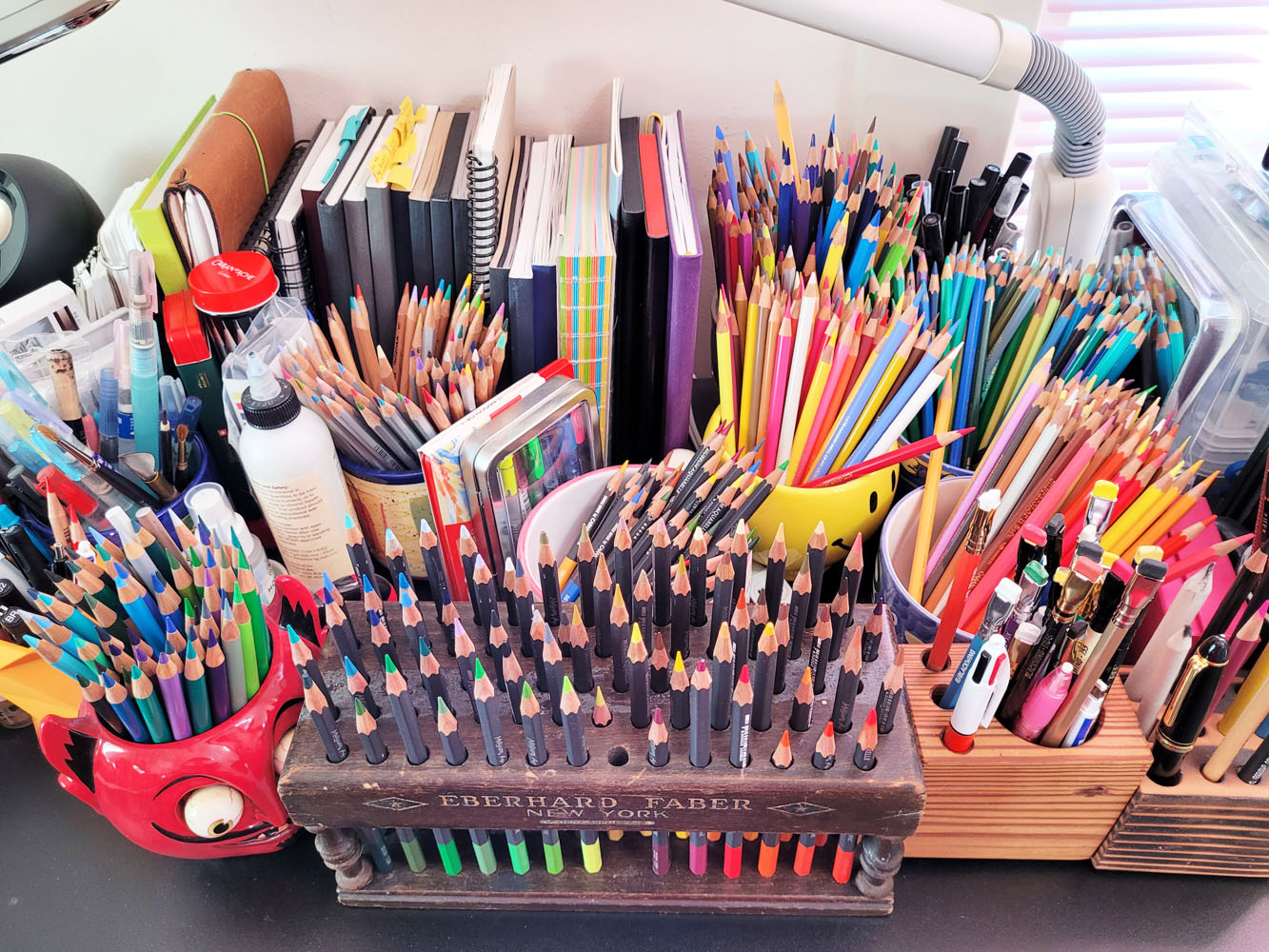
My New, Very Old Eberhard Faber Pencil Stand


Nearly a century old and now on my desk. When I purchased it, the Eberhard Faber pencil stand came with several vintage and affectionately hacked pencils from the seller.

Despite my obvious love for vintage colored pencils, I’m not a collector or hunter of antique furnishings or other objects. In general, I stay out of antique shops to avoid temptation (though occasionally I can’t resist). Apparently I always have one eye open, though, for special items that are exactly right.

One day in the Erasable Podcast Community Facebook group, a member posted photos of a vintage Eberhard Faber pencil display stand that he was selling. A 1923 Eberhard Faber catalog shows the pencil stand, which means the model is nearly a hundred years old. As soon as I saw it, visions of pencils danced through my head: It’s the perfect display for some of my favorite vintage pencils! In fact, it’s exactly what I’d been looking for, although I didn’t know it until I saw it.

Image from Pen Collectors of America

The advertisement for the Eberhard Faber Diamond Star “No. 29 Mahogany Stand With Assortment of High-Grade Items” indicates that it was a retail display. (What?? Consumers didn’t display pencils in their homes this way??!) Here’s what it says about the stand, which came with pencils:

The mahogany stand is an extremely useful advertising display piece, as well as a handy “silent salesman.” It is a high-class stand, with high-grade articles, and the finest stationery stores of the country will be proud to display it.

Imagine walking into a stationery store (sadly, such stores are becoming increasingly rare) and seeing “high-grade articles” displayed this way! Indeed, that “silent salesman” wouldn’t have to work very hard on me.

With some signs of age and wear, the pencil stand has many stories to tell. I could clean and polish it if I wanted to, but I think I’ll hear those stories better if I leave it as is.

Of course, I had initially intended to fill it with vintage colored pencils; in fact, I have several Eberhard Faber sets I considered. But the rack had probably been sitting in a dark storage unit for years, despondently without purpose. It deserved to be put to daily use as well as admiration.

With 72 holes, it was almost perfect for my favorite Caran d’Ache Museum Aquarelle pencils. After weeding out duplicates and some stubs too short to fit in the stand, my Museum Aquarelles fit beautifully – with a couple of holes to spare. The Eberhard Faber Diamond Star retail display is once again both high class and functional.

Still functional and beautiful after all these years.

Two empty holes after filling with my Museum Aquarelles.

Nicks and wear have a hundred years of stories to tell.

Museum Aquarelle stubs and duplicates

Incidentally, the seller was Ali Serra, owner of the Etsy shop Ernest Theodore, where I have made fun and inspiring purchases the past few years. He’s local, and we had met last year at an in-person pencil meetup (yes, there is such a thing). Shortly after I had made the purchase, a few Erasable members got together for another meetup. With my pencil peeps admiring my new acquisition, it was an appropriate handoff for the old Diamond Star.


A parking lot transaction. 

Although we would have preferred to chat about pencils over a table of food or beverages, we settled for a tailgate meetup at a Tesla charging station (where one member had to make a quick stop while breezing through Seattle). With me are Ali, Julia, John and adorable Ernest Theodore, the namesake of Ali’s shop.

A new home for the No. 29 Diamond Star display

Monday, November 23, 2020

Vintage Colored Pencils: Eberhard Faber Colorama


Vintage Eberhard Faber Colorama
Although vintage Eberhard Faber Mongol and Colorbrite colored pencils seem to be a dime a dozen on eBay, the Eberhard Faber Colorama name was unfamiliar to me when a new old-stock set crossed my radar. As usual, I couldn’t find much historical information about it, but the logo and other branding look similar in age to the Mongols and Colorbrites.

The set of 12 came in a hard plastic box (which I think has yellowed with age; I’ve seen Mongols in boxes like these too, and they look similarly yellowed). I must give kudos to this eBay seller – although unsealed, these were possibly the cleanest vintage pencils I have ever purchased! (I have purchased other supposedly NOS pencils that were dusty or grimy.) I took a moment to admire them in their pristine, unsharpened state.

As lovely as they were in their mint condition, I buy vintage pencils to use (if only to satisfy my curiosity about what they are like). After a bit of reverence, I sharpened them all up – and what a joy that was! Look at the clean, beautiful points I got from my Carl Angel Royal sharpener! Be still, my heart.


The cores are much thicker than Mongols and Colorbrites. The unfinished ends make it easy to see their diameter.

Similar to many colored pencil sets of this era, the box lid flips around to form an easel.

Thick cores!
A classic easel box.


My initial swatches made me hopeful – pleasantly soft and with good pigment for colored pencils of this era. Although they are much softer than Mongols and Colorbrites, they are not as soft as the Eberhard Faber Design pencils of the same era.

When I sketched my hand holding the garlic (is garlic the new apple, my previous colored pencil-testing standby?), however, I became a bit frustrated that I couldn’t build up enough pigment in the darkest cast shadow areas. I ended up adding black over the blue. By vintage standards, the Coloramas are better than most, but perhaps they were intended for students and coloring book users while the Eberhard Faber Design (and later Design Spectracolor) pencils were intended for artists and other professionals.

11/18/20 vintage Colorama in My Colors notebook


Even if I won’t be using them regularly, the Coloramas are a lovely set that I’m happy to add to my vintage collection.

Friday, October 19, 2018

Vintage Colored Pencils: Eberhard Faber Aquarello

Vintage Eberhard Faber Aquarello

Early in my vintage colored pencils series, I reviewed the Eberhard Faber Mongol (which I also mentioned months later when I experienced my most exciting colored pencil geek moment ever!). At the time, it was the only water-soluble colored pencil in my fledgling vintage collection. Of course, as a subset of the colored pencil universe, water-soluble pencils are of particular interest to me, since they are my current coloring medium of choice. As is true of contemporary materials, historic pencil manufacturers produced many more traditional colored pencils (wax- or oil-based) than watercolor versions, and the latter are more difficult to find.

Since the Mongols, I’ve acquired a few other vintage watercolor pencils, including the Faber-Castell Goldfaber and Venus. Most recently, I found a set from Eberhard Faber that was new to me: Aquarello “water color” pencils, which “inaugurate a new era in the field of art.”

Although the used set I got on eBay was not complete, the cool original box was in better condition than most I’ve purchased from the era.
 
The hinged trays can be made to stand up on the desktop.

I get a kick out of the marketing copy: “The colors can be ‘SUPERIMPOSED.’” I see that the same “Paint with pencils” tagline that appears on Mongol packaging is being used here, too.


I love the snap tab closure; a similar tab was used in some production years of the Mongol, too. (My Mongol box doesn’t have one, but I saw it on the one that appeared in The Post.) These similarities in packaging make me wonder if one superseded the other in Eberhard Faber’s collection or if they existed side by side.

A snap tab keeps the compact box closed.

The Aquarello has a plain, unfinished end. I miss the lovely metal end cap and equally beautiful typeface on the Mongol. I wish I knew the years they were produced relative to each other.


Unfortunately, this is a brief and mostly pictorial review, as these washable “colored leads” are just as wimpy as those of the Mongol. A bit softer and containing slightly more pigment than the Mongol when dry, the Aquarello takes some scrubbing to activate. Perhaps the Mongol was intended as a harder pencil for details, while the Aquarello is slightly softer for coloring.

The Mongol and Aquarello have similarly pale washes.

As a colored pencil historian, I appreciate seeing these early American predecessors to my favorite art medium. And using them makes me doubly grateful for contemporary water-soluble colored pencils, which are so much softer, contain more pigment and dissolve with greater vibrancy. Honestly, even very inexpensive contemporary watercolor pencils seem better than vintage ones. Of course, I don’t buy vintage pencils with the hope that I’ll find one of better quality than what I can buy easily off the shelf today; I collect them for their historical interest. As I concluded when I compared vintage and contemporary Goldfaber sets, it’s good to know that technology and manufacturing processes have improved over time, making it possible to produce better quality pencils, even at the low end of the price range.

Thursday, January 25, 2018

Vintage Colored Pencils, Part 4: Eberhard Faber Colorbrite

Eberhard Faber Colorbrite pencils

Almost all of the Eberhard Faber Colorbrites in my collection came to me unsharpened as new old stock from Ana Reinert after she’d heard that I was interested in vintage colored pencils. A couple came in the eBay mixed lot. The dozen or so display at least two logo and brand variations, and “Woodclinched” and “USA” are treated in slightly different ways. Most have a colored end cap that matches the hexagonal barrel color and a gold band; two have a grooved silver end cap.
 
Gorgeous packaging (courtesy of Ana)
As when I was writing the Mongol post, I couldn’t find much historical information about Eberhard Faber except on Wikipedia, and even there it was a bit confusing. But I found nice images on the blog Pencils and Other Things that show a well-preserved boxed set with silver end caps. In that post, Sola notes that the red, yellow and green pencils say, “Recommended for print marking,” while the others do not. I spotted the same text on my Scarlet pencil but not the rest. A blog commenter implied that pencils with the colored end caps were older than the silver.

1/19/18 vintage Colorbrite, Verithin and Col-erase pencils on Stillman & Birn Epsilon
As far as I know, this brand is no longer in production, so unlike with Prismacolors, I had no expectations one way or the other. Test scribbles indicated that they were medium-hard, so I thought they’d be a good match for Stillman & Birn Alpha’s slightly toothy surface, where softer pencils can’t get into the texture easily. I had difficulty building up color, though, so I gave up halfway through a sketch and switched to the smoother Epsilon paper, which was better. I usually find Epsilon to take softer pencils better, so I was a bit perplexed – to my hand, Colorbrites feel hard and retain a good point, yet they interact with smooth paper as if they are softer. I can’t explain that.

In my vintage pencil series, I’ve been trying to remain “pure” by using only the brand I’m reviewing in the sample sketch. However, I don’t have a yellow Colorbrite, so I substituted a vintage canary yellow Col-erase and a vintage Verithin in olive green, which seemed to have a similar hardness. They all blended and played together well. (I was especially pleased with the detail I was able to get on the tomato’s leaves and stem, but that came mostly from the Verithin.)

Colorbrites are probably not pencils I’d continue to acquire for use, but I love having these beautiful specimens along with the Mongols to represent the Eberhard Faber side of historic pencil manufacturing. 


Sunday, October 27, 2019

Vintage Colored Pencils: Design Watercolor

vintage Design Watercolor Pencils

For a while, my eBay foraging was focused on vintage Design Spectracolor Pencils, including the more elusive Doublecolor version that I came across serendipitously. Once I had acquired a decent range of these truly delightful colored pencils with soft, rich cores, they dropped off my eBay radar.

Then one day I spotted something extraordinary in the middle of a large vintage pencil lot: Design Watercolor Pencils! The pencil branding and design looked identical to the Eberhard Faber Design Spectracolor pencils I owned except the barrel was stained and varnished natural wood instead of painted matte black. This was the first time I had ever known that a water-soluble version of this pencil line existed! How had I not seen it before? After much internal debate about not wanting to be saddled with the rest of that lot, I reluctantly let it pass.

As soon as I started searching for these Design Watercolor Pencils, I realized why I hadn’t spotted them before: They are scarce, indeed. I kicked myself for not going after that lot. Sometime later, another set appeared on eBay, and this time I bid actively for it, but at the last minute, a sniper app swooped in and grabbed it. Design Watercolor Pencils remained a grail, as I have not seen any more come up on eBay again. 

A while later, I was having an email correspondence with a blog reader who was also interested in vintage Spectracolors, and I told her of my grail. She had managed to acquire not one but two sets of Design Watercolor Pencils – and she offered to give me one! I don’t know how I’ll ever repay her for her kindness and generosity, but I am certainly thrilled to have the set.

The 12 pencils came in a vinyl case that is of the same design as the non-watercolor Spectracolor sets. Neither the pencils nor the case include manufacturer information (the pencils say only “USA”), but my benefactor told me that they are of the Eberhard Faber era. That would date them to before 1987, when EF was purchased by Faber-Castell.

Natural wood barrels stained and varnished.


As mentioned, the round barrel is unpainted wood stained reddish-brown and varnished. The round end cap indicates the core color – a feature that matches the Spectracolor pencils.

Colored end caps indicate the core colors.

Shown below are all the iterations I own in various, mostly incomplete and used sets: Faber-Castell Design Spectracolor Doublecolor (natural wood), Design Spectracolor (natural wood), Design Spectracolor (black wood), Faber-Castell-branded Design Spectracolor (black wood), and Design Watercolor. Venus-branded Spectracolor pencils (that company was purchased by Faber-Castell in 1973) look distinctly different with barrels color-matched to the cores, but the cores are the same softness and pigment quality.

 
From top: F-C Doublecolor, Design Spectracolor with natural wood, Design Spectracolor with black wood, Faber-Castell-branded Design Spectracolor, Design Watercolor

Venus-branded Spectracolors, which preceded the others, have color-matched barrels.


In application, the Watercolor cores feel similar to their traditional Spectracolor sisters – very soft and waxy. A bit softer than vintage Sanford Prismacolor watercolor pencils, they are not as soft as contemporary Caran d’Ache Museum Aquarelles (still the softest water-soluble colored pencils I’ve used). The Watercolors have a high level of pigment – on the same level as the vintage Prismacolors and contemporary Caran d’Ache Supracolors – but not as high as Museum Aquarelles. They have much stronger pigment than Caran d’Ache Prismalo pencils of around the same vintage, which surprises me a bit, since the Swiss company invented water-soluble colored pencils. What a coup for a US-made watercolor pencil to be of higher quality!


In my sketch of the pears made with three primary hues only, it was easy to apply multiple layers of dry-wet-dry pigment and develop intense hues. I’m guessing that Design Watercolor Pencils were the best of their kind in their day. I’d love to grab a larger set – I’ve seen photos indicating that they had been available in sets as large as 48 colors – but given my searches so far, these pencils are as common as unicorn teeth.
 
10/6/19 vintage Design Watercolor pencils in Stillman & Birn Beta sketchbook

No matter. I’m happy to use and enjoy these lovely pencils that I do have, thanks to my very generous reader.


Edited 12/1/25: A reader requested the color numbers and names of the Design Watercolor pencils I have. I wish I had an original box listing all the colors, but I don't, so I simply photographed them (in no particular order below). I say "simply," but it's quite a task to get round-barreled pencils to sit still long enough to get a group photo. . . like a bunch of dogs! 


Related Posts Plugin for WordPress, Blogger...