Friday, April 6, 2012

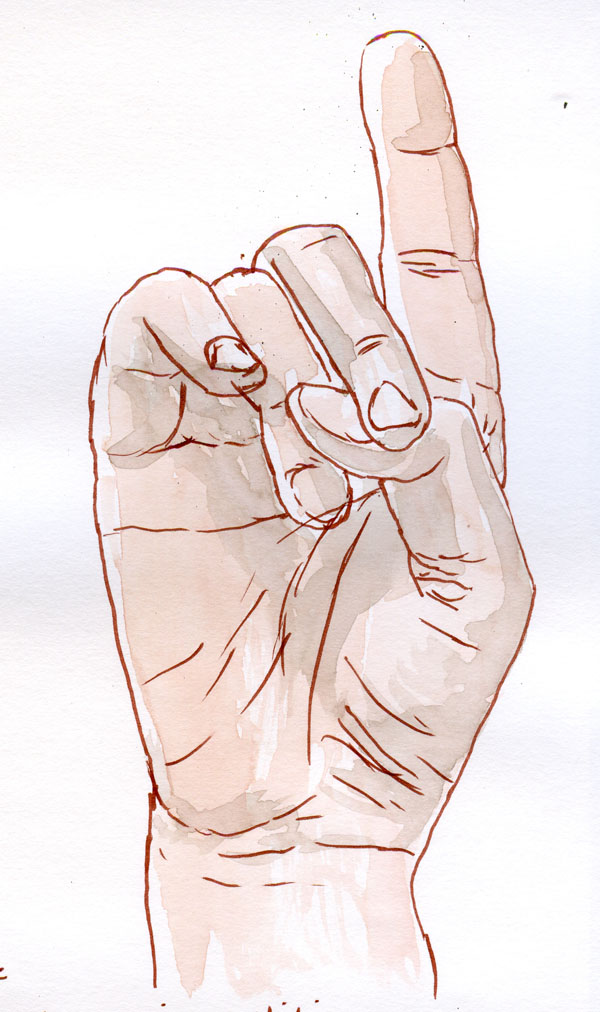
Homage to the Prehensile, Multi-Fingered Extremity

3/16/12, Akashiya watercolors
The human hand has 27 bones, including 14 phalanges of the fingers and five metacarpals between the fingers and the wrist. Hand muscles are both intrinsic and extrinsic. Wikipedia lists four types of articulations related to the hand and three types of bony arches, which are formed by the fixed and mobile parts of the hand adapting to various everyday tasks. Then there are the four fingers and that all-important opposable thumb, which distinguishes us highly evolved hominidae from other critters who can grasp tools (a gross motor skill) or pick up a pebble (a fine motor skill) only in their dreams. (On the Wikipedia page, you’ll see a delightful photo of a Javanese tree shrew that has remarkably human-like hands, but alas, lacks opposability.)

While these impressive facts alone are enough to make me appreciate my two hands (which, as a lifelong crafter, I’ve always held in high regard anyway), my recent drawing practice makes me respect all the more the complexity and design of hands. Now that I’ve finished sketching my own hand 100 times, I’ve moved on to the hands of total strangers. This means I have come full circle, since my difficulty with drawing hands in coffee shops is what initially prompted my marathon.

Did the marathon help? Even with a 0.25 mechanical pen point, sketching skin stretched over those 27 bones and both intrinsic and extrinsic muscles forming three types of bony arches remains difficult. The four types of articulations result in at least four types of frustration. The rolling hills at the top of the metacarpals require subtle shading that I have yet to master. Defining wrinkles over knuckles alone is enough to make one weep.

4/5/12, Akashiya Thin Line
These challenges are exacerbated by the fact that the hands of strangers have the annoying tendency to move around. However, two things have helped: One is to select slow typists as models. The other is something Don Colley mentioned when he was asked how he is able to capture people’s gestures and expressions with such detailed accuracy when they aren’t paid models who are standing still. Don said that even when people are moving around, they are creatures of habit who tend to repeat the same series of gestures. So if a person he is sketching changes positions, it’s likely that the previous gesture will return at some point.

Don is right; I’ve made the same observation. If I start sketching a man with his chin propped up with his left hand, and he moves that hand to absent-mindedly scratch an ear, if I wait a bit, the left hand will return to the chin. So I take Don’s advice and start a series of sketches, one for each gesture, and as the model moves, so do I, from sketch to sketch.

4/5/12, Akashiya Thin Line
I also work on several victims simultaneously. This method decreases the chances of my being caught by any one victim, reduces my impatience while I wait for the hand to return to the chin, and increases my sketching mileage per cup of Americano.


Thursday, April 5, 2012

100 Hands: Done!

2/22/12, hand #1, Graphitint water-soluble pencil
I finished the 100th drawing of my hand yesterday. Have my skills improved since hand No. 1? You decide.
4/4/12, hand #100, Copic Multiliner SP pen, Akashiya watercolors


Markers, You’ve Come a Long Way, Baby

11/17/11, F-C PITT Artist Pens
The first felt-tip marker pen I ever used was the Paper Mate Flair. I was about eight years old, and these sensuous, richly pigmented pens – available in black, blue and red – seemed far superior to ordinary ballpoint pens. It was the beginning of my lifelong lust for colored pens.

Marker pens, you’ve come a long way in the past half century (ouch) since those first Flairs. Available in a dazzlingly seductive range of colors, marker pens with various types of pigment and tips have been elevated to an art medium by artists who take advantage of their versatility, portability and convenience.

A couple months after I began my adventure in drawing, I went to a demo at Seattle’s Daniel Smith store given by fine artist Don Colley (the multi-pocketed vest he wore that day inspired a quest for my own similar vest). His marker of choice is the PITT Big Brush Artist Pen, so much so that his work is used in maker Faber-Castell’s advertising. These markers, says Faber-Castell, “are famous for combining a modern brush nib design with a tradition of India ink. India ink offers artists odorless, permenent (sic), waterproof, lightfast inks with 48 vibrant colors. The durable nib gives the freedom to create verstaile (sic) ink brush strokes of broad, medium to narrow with an even application of color.”  

Colorful, friendly marker pens? Something I’ve loved since I was a child? Surely, they would become my ideal art medium!

The only problem was that Colley made it look so dang easy! I have a bit more practicing to do.

Wednesday, April 4, 2012

Product Reviews: Tombow, Akashiya Sai and Akashiya Thin Line Brush Pens

2/20/12, Tombow marker
If I could take only one type of sketching medium with me to the proverbial desert island, it would be Japanese water-soluble brush pens. These sophisticated, high-tech marker pens have amazing tips that mimic the marks of traditional Chinese and sumi ink brushes. What’s more, the pigments they contain are water soluble, so a skillful hand (and sometimes even a clumsy one) can create subtle washes for shading and contouring with nothing more than a brush and water. Colors from multiple pens can also be blended right on the paper.

Three of my favorites are Tombow, Akashiya Sai and Akashiya Thin Line. All three types of pens are non-toxic and acid-free but not lightfast. This chart compares lines made with a few sample colors, including the effect of a light wash. (I’ve also included a line made with Akashiya’s Outline Brush Pen, which contains permanent ink.)

Tombow dual-brush pens, so-called because they have a fine point on one end and a “brush” tip on the other, are a favorite among manga artists because they come in 96 dazzling colors. The tips are not actual brushes but made of a hard fiber. They don’t flex like a real brush, but holding the tips at various angles results in varying line weights. The self-portrait above, the hand sketch below and a close-up of the line were all made with the “brush” tip of a Tombow pen.

3/30/12, Tombow marker
Tombow marker
I’ve been experimenting with these pens for only a couple months, and I’ve been using them mainly as a sketching medium. Other artists use them more as a painting medium, which I aspire to. Most notably, Scott Wilson of the Taranaki Sketchers makes lively, colorful urban sketches (that look more like watercolor paintings) using Tombow markers as his primary medium. One technique I learned from his blog is literally painting with Tombow pigment by picking up color from the pen tip with a wet brush, and using the brush to apply the color to the paper, rather than applying it with the pen itself. (This technique works with Akashiya pens also.)


Unlike Tombow markers, both Akashiya Sai (available in 20 colors) and Akashiya Thin Line (in five colors meant to evoke traditional sumi painting colors) brush markers have actual brush tips made of synthetic hair. They both make beautifully variable line widths, and the Thin Line collection can, indeed, make a very thin line – as thin as a Copic Multiliner SP 0.25 mechanical pen. Because the tips are real brushes, they can flex and make such subtle line width changes that it’s difficult to believe the marks weren’t made with a traditional brush and ink.

Compared to the Akashiya pens, the Tombow makes a line that clearly looks like a marker. The Akashiya pens resemble markers only in their convenient (and unfortunately expensive and disposable) plastic casing. Shown here are sketches made with each type of Akashiya pen and close-ups of the lines.
3/8/12, Akashiya Sai
Akashiya Sai


An Akashiya marketing video shows the Thin Line in action. The Thin Line pens are designed to appeal to women by resembling cosmetics. Ironically, I find a pen as slender as an eye liner to be difficult to sketch with – gimme a big, beefy man’s pen! Even worse is the perfectly cylindrical shape, which allows the pen to roll off the table top constantly. But these are my only complaints about an otherwise remarkable pen.
3/29/12, Akashiya Thin Line

Akashiya Thin Line


As with the Tombows, I’ve been using the Akashiya pens for only a short while, so I’m still just beginning to learn about their potential as a sketching medium. With all of these pens, some of the pigments can turn out surprising hues when washed with water, so if accuracy of hue is important to you, it’s a good idea to make test swatches. Me – I live for happy accidents, so test swatches be damned. Rock on, Japanese brush pen makers!

Tuesday, April 3, 2012

Product Review: Graphitint Pencils

3/21/12, Derwent Graphitint pencil
I’m a huge fan of water-soluble colored pencils. They can be used dry like ordinary colored pencils, applied with a wet brush as if they were watercolors, dipped into water to become creamy and crayon-like, or applied dry and then wetted with a brush on the paper to bring out a wash of color. These handy pencils are particularly portable because all you need is a few basic colors and a waterbrush (water is contained within the plastic handle so that a separate vessel of water is unnecessary) to make a color sketch or painting in the field.

I’ve tried a number of brands of water-soluble pencils, and the colors of most look slightly different when water is applied compared to the dry pencil marks alone. One brand that looks significantly different when wet is the Graphitint line made by Derwent. In fact, while each pencil of most brands has two colors – one dry, one wet – Graphitint pencils have three: one dry, one wetted on paper and one wetted on the pencil.

The first row of my color samples shows the pencil strokes dry. The dry hues in the Graphitint line are all relatively dark and neutral, so they work well for sketching the way ordinary graphite pencils would. The second row shows the same colors as the row above, this time with a light wash of water applied with a brush. The third row surprised me. I used a wet brush to pick up color directly from the pencil point and then applied the color to the paper with the brush. As you can see, using the pencils this way produced entirely different hues, so each pencil was like having three colors in one.

The sketch of my hand, above, was done with Graphitint Russet. I did contour shading with a light wash from a brush (as in row 2), and the cast shadows (under two fingers) with color picked up from the pencil point (as in row 3).

A note on lightfastness: I have read consumer reviews stating that Graphitint pencil colors are fugitive (Fugitive is one of my favorite art terms: I imagine David Janssen running from the law with a fistful of colored pencils). I will heed this information when I receive a phone call from MoMA requesting my work for its permanent collection. In the meantime, I’ll just keep my sketchbook closed.

Monday, April 2, 2012

You Get What You Pay For

3/14/12, Akashiya watercolors, no-name brush
As a mixed-media artist, I like to keep a large supply of the cheapest, crappiest brushes I can find so that when I abuse them with my unrefined painting and collage techniques, I can trash them without remorse. Color junkie that I am, when I began sketching, I also began using watercolors almost immediately. Every book I read on watercolor painting recommended buying the best brushes one could afford because they would make a difference in the results. Always the skeptic, I was convinced that the holder of the brush makes a much bigger difference in the results than the price of the brush. But I also love an excuse to go art-supply shopping, so I went out and got my first sable brush.


3/14/12, Akashiya watercolors, WN sable brush


On close examination, I remained skeptical. This tiny but expensive brush looked disturbingly similar to all my tiny but cheap and trashy brushes. I decided to put them to the test. Using the same Akashiya watercolors, I sketched both of these on the same day, one right after the other. The hand shown above was made with one of my crappy brushes. The other was made with the sable. Even with my not-yet-educated painting hand, I could tell that the sable brush has a nice spring to it, while the cheap brush is better equipped for spreading glue. The sable also paints a range of thick and thin lines, while the 10-for-a-dollar brush barely has one line width. OK, I’m convinced.


Sunday, April 1, 2012

Hands in Action

3/22/12, Akashiya Thin Line, Hand Book sketchbook

My difficulty in sketching hands I saw in coffee shops prompted me to give myself the assignment of drawing my own hand 100 times. Lately I’ve been going back to the original challenge by trying to draw other people’s hands (usually typing, mousing or holding a book or coffee cup). Sometimes drawing the hand attached to the person made the task all the more difficult, so to get further practice, I simply detached the hands in my sketchbook.

3/29/12, Akashiya Thin Line, Hand Book sketchbook
Related Posts Plugin for WordPress, Blogger...