|
| 4/30/23 Maple Leaf neighborhood |
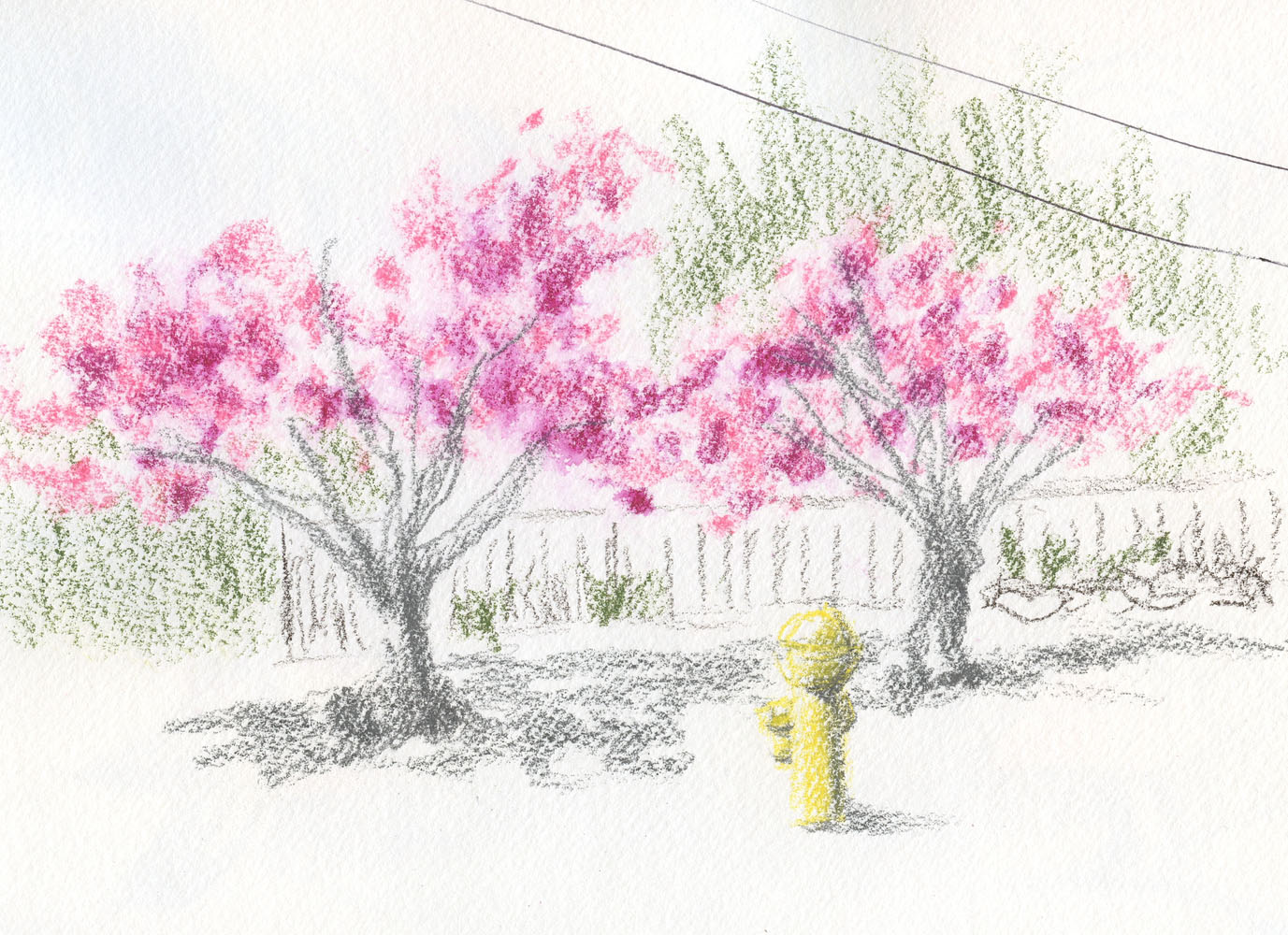
Their time is short, so I’m sketching Kwanzan cherries as
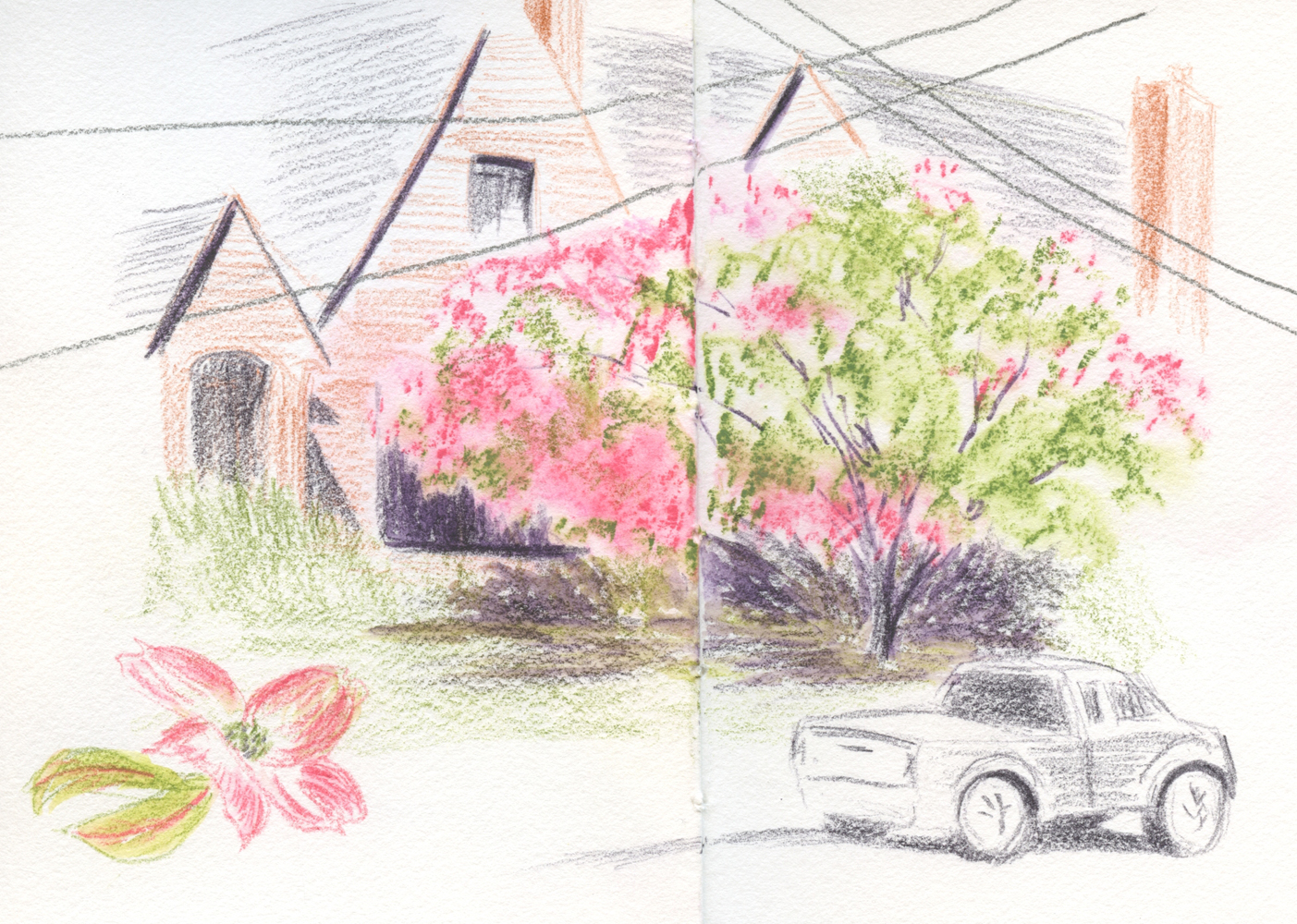
fast as I can. In the same walk one afternoon, I spotted all of these close to
home – an enormous one on busy Fifth Northeast (at right), and then a row of smaller ones (below).
The smaller ones had leaves that were more green than orangey (like most
Kwanzans), so they could be a different variety. They were all bright pink and
spectacular.
Compositional thoughts: As a pedestrian and general neighborhood
citizen, I don’t like it when cars park on the sidewalk (and apparently aren’t
ticketed). As a sketcher, though, I like the Jeep that is habitually parked this
way (below). Compositionally, it adds an interesting visual element that wouldn’t be
seen if it had been parked properly next to the curb.
As an urban sketcher who was “raised properly” to follow the Urban Sketchers Manifesto, which includes the item, “We are truthful to the
scenes we witness,” I think frequently about what to include or exclude in sketches.
It usually creates a bit of tension in the sketching process, which I enjoy.
Like all artists, of course, I use artistic license constantly to move things
slightly to improve the composition, change the colors of objects, or omit street
clutter that distracts or detracts. I certainly didn’t include every parked car I saw on Fifth Northeast. It’s impossible to include everything one sees, even
in a fairly quiet scene, and many beginning sketchers get into trouble when
they don’t know how to exclude details or simplify. I don’t think that
simplifying makes a sketch less truthful to the scene if it helps to tell the story
more clearly.
 |
| 4/30/23 Maple Leaf neighborhood |
Some artists would simplify by eliminating stuff like utility
lines and poles, trash cans and even an entire construction crane behind a
building because they look messy or unattractive. (Frankly, if construction is
going on, that is the story!) As you know, I include most of that kind
of stuff because I’m not here to make only pretty sketches. I also think that selective
street detritus can be rhythmic and improve a composition.
But what about adding things that aren’t in the scene at all
for the sake of an improved composition (the “design” of the piece)? As an
urban sketcher, I wouldn’t dream of putting a Jeep into a sketch as a
compositional device if it weren’t actually parked there – not only because it
isn’t “truthful;” more likely, it wouldn’t even occur to me. But I do think
more about this question as I continue studying composition through Ian Roberts’ videos. A master of eliminating and simplifying a scene for the
benefit of a painting’s compositional design, Roberts is not an urban
sketcher. Although he’s more likely to remove something rather than add it, he
would not bat an eye about putting a Jeep on a sidewalk (well, OK, maybe not a
Jeep, but certainly a boat on a lake) if it improved the composition. He’s an
artist who believes in the truth of his design, not in being truthful to whatever may have inspired the painting.
(To see how Roberts develops a design for a painting by first making a drawing from a photo, his latest video is a great place to start. I do have a problem, however, with one example: His photo reference includes a woman walking a dog – and he eliminates the dog! I suppose he found it “distracting” to the design, but I have not forgiven him for that. Maybe the resulting painting would be better compositionally, but it certainly would tell a better story with the dog included.)
If I were a studio painter, I might add the Jeep – no harm
done if it benefits the painting. As an urban sketcher, I have to work harder to find
the Jeep – as both a “truthful” element as well as a design element – and that’s
at least part of the fun of urban sketching. (And I would never eliminate a dog.)