Showing posts sorted by date for query minimal sketch kit challenge. Sort by relevance Show all posts

Thursday, July 3, 2025

“But I Might Need it”: How to Downsize Your Kit

2013 (Note the spare ink cartridges and multiple waterbrushes)

Long-time readers of this blog have seen my sketch kit get smaller over the years. Sometimes the reduction was only temporary, and more materials eventually crept back in. Sometimes the reduction was only hypothetical (search the term “Gilligan’s Island” on my blog, and you’ll find many examples of how I’d pack my kit for that fateful “three-hour tour”).

It took a global pandemic to shrink my sketch kit permanently. Once I got used to a daily-carry bag that was small and light enough to take fitness walks with, there was no going back. Even when I occasionally missed the so-called “full arsenal,” I enjoyed the liberty of lightness too much.

2015

Seeing my compact bag and kit, other sketchers have exclaimed that they’d like to get their own sketch kits (hauled in a huge backpack or wheeled bag) down to a more manageable size, but they just haven’t figured out how. Peering into their bags, I can see that they continuously carry items they “might need,” yet they confess they have not used them in months/years/decades. (By the way, all of this resonates with general downsizing of an entire home, if you catch my drift.)

I’ve noticed that often the people who seem overburdened by their loads are the same people who lament that they don’t get out to sketch as much as they’d like. Hmmm . . . ya think there’s a connection?

2016 (This was my most mixed-media year! I loved fountain pens,
markers, watercolors, watercolor pencils and brush pens, and darned
if I wasn't going to bring them all to the Manchester symposium!
While it’s none of my business how much stuff others want to haul around, I believe strongly that anything that keeps you from sketching as much (or as easily) as you’d like is a problem. The objective is to sketch, and we shouldn’t let carrying our materials keep us from that objective. (For that matter, we shouldn’t let owning too many materials keep us from that objective. See: downsizing.)

I’ve been thinking for a while about writing this post, and my recent visit to Poulsbo when I inadvertently left behind my auxiliary tote bag reminded me of the very points I wanted to make in such a post (and I had to listen to my own lecture that day). The first bullet point is my guiding principle for carrying less. The other points are suggestions on ways to downsize:

2018 (disregard the numbers; they refer to a different post)

  • Having fewer options “forces” more creative solutions. A favorite example is when I was sketching a fire station during a minimalism challenge – and I had no red! How could I possibly sketch a fire station without red? Ta-da – my four-color ballpoint pen (which I keep in my bag for general notetaking, not sketching) came to my rescue.
  • A friend and I just had a conversation about how the 80/20 rule applies to sketch kits: We all use about 20 percent of our materials 80 percent of the time. That rule applies even with my minimal kit. Consider which items you use 80 percent of the time and remove the rest.
  • Whatever is your color medium of choice, choose a minimal palette – say, six to 10 colors. Esthetically, a limited palette looks more cohesive. It also encourages mixing and experimenting with hues that at first may not seem “right.” Some of my favorite sketches have been primary and secondary triad experiments. One time, I was dismayed that my limited palette didn’t include the right periwinkle hue to sketch a Bachelor’s Button. I was “forced” to optically mix some unexpected colors, and I was delighted with the result.
  • 2021 (This version of my pandemic kit was minimal even for me!)
    Stop prepping for every possible sketch “emergency.” I used to carry a small pencil sharpener routinely. It’s tiny and doesn’t weigh much, so it seemed like an easy carry. The one or two times I actually needed it, though, it was lost at the bottom of my bag. It wasn’t worth the bother of digging it out. I finally took the sharpener out and instead use other sharpeners at home that do the job more effectively.
  • Along the same lines, stop carrying “spares” of favorite materials. This was a biggie whenever I traveled. I knew I couldn’t just go back home to get more, and local stores might not carry exactly what I needed, so I always carried extras (pencils, pens, ink refills, entire sketchbooks) of things I felt I couldn’t live without. Almost always, I brought them all home again without using them. On all my post-pandemic trips (Dallas, Portland and L.A.), I cut the cord on spares. Guess what? I lived!

(Shown in this post are a few of my sketch kits over the years. For a look at all past sketch kits and bags, see my Sketch Kit Archive page.)

Current: lean and mean

Friday, October 7, 2022

Minimized and Matchy: Rickshaw Sinclair Model R


Matchy, matchy!

For several years, I challenged myself annually for a month or so to slim down my sketch kit to the bare essentials. The purpose of this exercise was to lighten my daily-carry load and see how little I could take with me and still sketch without feeling deprived or frustrated. Readers have told me (and shown me with their page hits) that seeing my minimal sketch kits is one of their favorite things on my blog. Something about attempts at minimizing seems to inspire many sketchers.

When the pandemic hit, I found myself doing most of my urban sketching during neighborhood fitness walks, which meant that I didn’t want to carry my entire, full-size sketch bag. Since my pandemic-edition sketch kit had become my daily-carry, my usual minimal challenge seemed unnecessary. By 2021, I was sketching beyond the neighborhood again, but I continued the habit of sketching during my fitness walks (a habit that continues to this day – one of the best things to come out of the pandemic). Again, I didn’t feel like a minimal challenge was necessary.

The primary triad palettes I used during the summer and now the secondary triads I am using this fall have given me a new twist on minimalism. Even when I’m working with a minimal palette, I  usually still carry the other colors as a security blanket. My bag shakeout a month ago made me commit to the minimal secondary palette and take out the security colors. The kit was slim enough that I could fit everything into my mini Sendak instead of the full-size Sendak I had been using.

My minimal pencil palette fits easily in the outer slash pocket. 

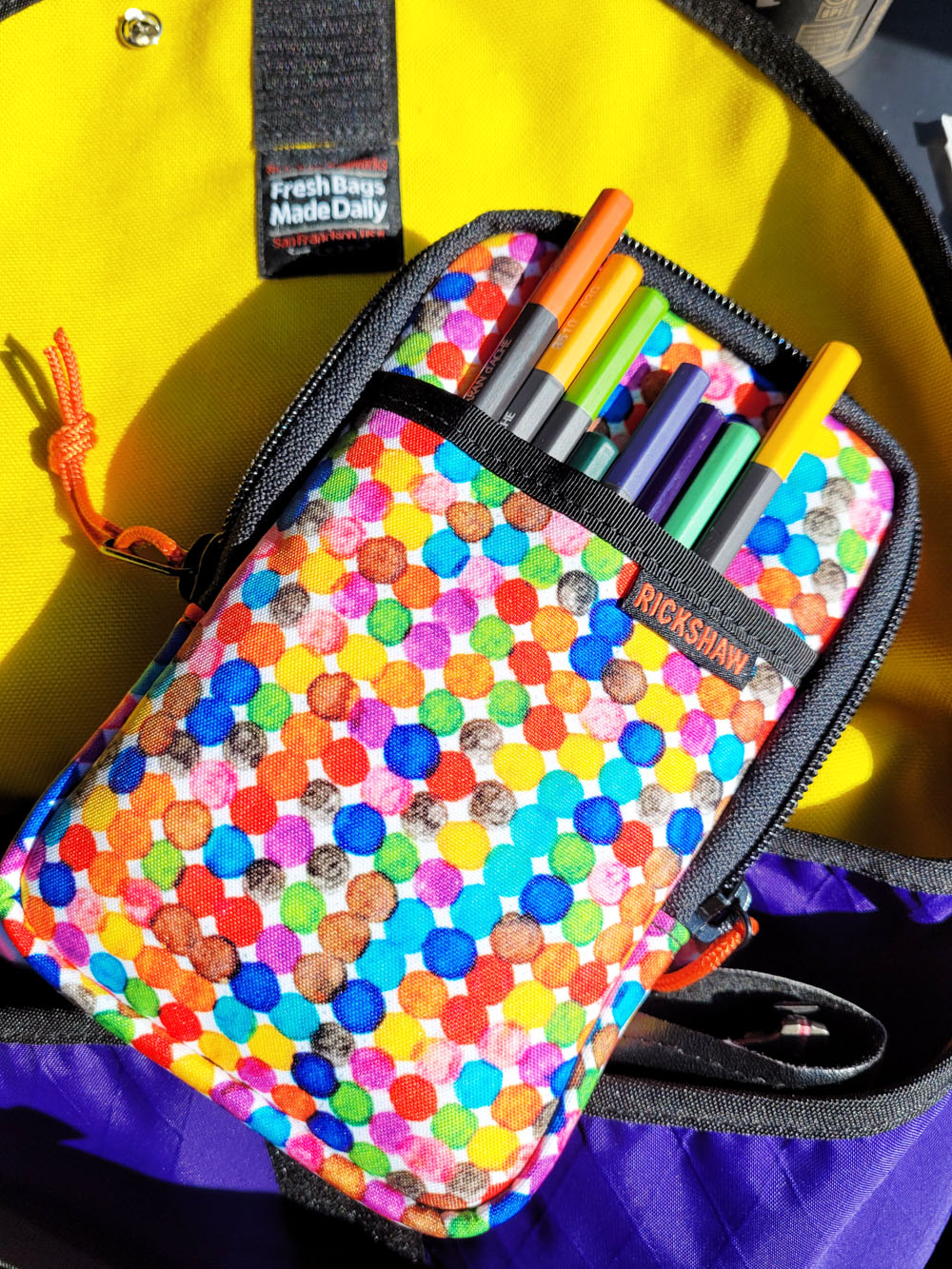
Here’s the next step in my bag diet program: Everything in my current kit fits into my new Rickshaw Bags Sinclair Model R pen case! Launched at the San Francisco Pen Show in August, the Model R was offered for a discounted intro price. A collaboration between Brad Dowdy of the former Nock Co. and Rickshaw, the new Sinclair is a clear improvement over its previous design – cushier interior, a new outer pocket and, most important to me, more fabric choices. I chose the Ink Dots fabric pattern because it includes colors that would coordinate with any of my Rickshaw bags (so far, I have bags in purple, another purple, black, pink, neon pink and red). I just switched from my pink spring/summer bag to my fall/winter waterproof purple bag, which has a bright yellow lining.

Although it most often appears in marketing and social media photos filled with fountain pens (the cushy lining is meant to protect them), the Sinclair Model R is not just for precious fountain pens – it’s a great little sketch kit organizer! That new slash pocket is just right for my minimal pencil palette, and the inner compartments hold the rest of my kit comfortably. With such a small kit, the entire bag is lighter and slimmer.

An essential characteristic of any bag organizer I would use is that the Model R can stand upright inside my bag, giving me immediate, single-handed access to my tools while sketching as I stand. If I’m sketching at the comfort of a café table, I can pull the whole thing out, and it takes up little tabletop space.

Two cushy inner compartments easily contain the rest of my sketch materials and tools, and everything stands upright and accessible in my bag.

A compact kit for a cafe table.

I’m sure it’s not a permanent change. As has always happened in the past, more tools and colors will creep back in over time, and one day I’ll decide it’s time to get out the fat pants again (in this case, that’s one of the Sendaks, which, unlike fat pants, are a welcome pleasure). But for now, my personal minimalism challenge is back on – with my smallest tool organizer yet.

Thursday, September 23, 2021

Ocean Shores, Part 2: Shells


9/15/21 crab parts sketched in situ

Nothing like a strong, single source of light!
Ocean Shores beaches are full of washed-up shells. This was new to us compared to Oregon’s Cannon Beach, where we more commonly see lots of kelp but not many shells. Crabs, clams, oysters and scallops were among the many shellfish remains we saw in all sizes. Some shells had been without their original owners for so long that they were encrusted with barnacles.

On one very sunny afternoon, I looked for good specimens that I could draw in situ. There’s nothing like a strong, single source of light to make still life drawing easier! When I walked on the beach, I took with me only my minimal-palette “pandemic” sketch kit (which now has even fewer colors than what’s shown in last year’s post), so I had the fun challenge of mixing hues I normally use in the urban environment – like stop sign red and heavy-equipment yellow – to sketch organic critters.

Although I had picked up a few shells, Greg was the big collector. Back at our cottage, I went through all the pretty specimens he had found and drew my favorites at the kitchen table (I had to draw the Dungeness crab leg right away and then toss it, as it was not smelling great; it was obviously only recently separated from its owner). Kitchen lights coming from all directions made it difficult to find the forms and cast shadows, but I had fun trying to capture the shell patterns and details. Now I have a whole box of shells to choose from when I need a still life to sketch this winter.

Sketched at the kitchen table

Too many lights in the kitchen, but more colors in my palette.

This was one of the tiniest crabs I spotted.

Many more to choose from when I sketch still lives this winter!

Thursday, January 28, 2021

2021 Minimalism Challenge: Most Extreme Ever


Downsized! Here's the sketcher's-eye-view of my extremely slimmed-down sketch kit.

Every winter since 2018 I’ve challenged myself to minimize and simplify my sketch kit (here are reports from other years: 2019, 2020). Not intended as a permanent kit change, the challenge usually lasts about a month during the most colorless time of year. Though it is occasionally frustrating, I enjoy the opportunity to clean out my kit and remove inessentials. With fewer materials to choose from, I look at my sketch opportunities with a fresh eye. Of course, after the end of each challenge, more materials inevitably creep back in, but not without a critical evaluation of whether they would earn their long-term keep in my bag.

This year, because my pandemic edition sketch kit is already smaller and pared down, I was tempted to skip the challenge – how much slimmer could my sketch kit possibly be? But then I looked at it critically one day, and I had to admit that quite a few things kept appearing over the summer and fall during the best color months. The kit could certainly stand to lose a few tools. It was time for a minimalism challenge after all.

A bit over-stuffed.


Before: Everything that was in my daily-carry kit.

And minimal it is – perhaps the most extreme kit ever (below). The kit’s focal point is a new rendition of a very old-school tool: the classic Bic 4-Color ballpoint pen, but with a twist – it comes with a mechanical pencil unit. I’ll be writing a full review of this fun tool soon, but for now, I’ll just say that the addition of the pencil makes it an interesting and functional Swiss army knife of ballpoint ink (red, blue and black) and graphite.

After (from left): Bic 4-Color, Caran d'Ache Bicolor, Uni Pin brush pen, Gelly Roll, Derwent
Drawing Pencil, all contained in Rickshaw Waldo field case.

I thought very carefully about color. Of course, I always want all hues, but which colors would be important in conveying meaning in an otherwise monochrome sketch? In my limited geographic sketching area, the only colors I felt that way about are heavy equipment yellow and traffic cone orange. I judiciously picked out the yellow/orange Caran d’Ache Bicolor pencil and called it good.

The Uni Pin brush-tip marker, white Sakura Gelly Roll gel pen and white Derwent drawing pencil made the final cut because I use them whenever I sketch in a red Sweet Tooth Field Notes, which is still one of my favorite fast-sketch approaches.

Slim and trim.

To keep myself honest, I went through my stash of bag accessories and found a bright pink Rickshaw Bags Waldo field case that I had received as a gift a while back. It’s a slightly smaller version of the one I used all last year in my pandemic kit. There’s a bit of space to spare, but not much, so it will prevent too many tools from sneaking in. (I mostly live in yoga pants these days, but every couple weeks, I put on my jeans to make sure I still can. Same concept.)

A tough but significant decision was to use dry materials only. (The Caran d’Ache Bicolor is water-soluble, but I’m using it dry.) This simplifies the kit significantly: I could eliminate both the waterbrush and the spritzing bottle. This also means paper quality is no longer an issue, so I can use any simple sketchbook or notebook. I took out the pocket-size Stillman & Birn Beta book that had been my daily-carry in the fall and replaced it with a slimmer Field Notes Signature. Although the latter’s paper has let me down with light washes, I enjoy using its slightly larger page size with all dry materials. The red Field Notes is already a daily-carry alternative to any white paper book I carry.

Sketchbooks: two Field Notes options

1/25/21 First sketch with the spartan kit

Too spartan? Probably. But it will be fun to find out how long I last and what I can’t live without. I took my ultra-lite kit out for a trial run the other day. News flash: ballpoint ink doesn’t blend well with colored pencil. And I’d like to get a softer lead for the mechanical pencil. It’s an interesting combo, though. Stay tuned for updates.

Saturday, January 18, 2020

Giving Epsilon a Shot

Out: Zeta; in: Epsilon (with some political commentary)

I just filled the Stillman & Birn Zeta that I started in October and had used intermittently with a S&B Beta. After the Beta was full, I continued in the Zeta, thinking I’d want to start the next Beta eventually, but by then the holiday colors were over, and it was graphite season again. I haven’t been using enough color to miss Beta’s surface, especially with my current minimal kit challenge, so Zeta worked out beautifully. In fact, it’s the ideal surface for the ArtGraf water-soluble graphite pencil I’ve been using a lot lately. On these dreary, colorless days, it’s my favorite ultra-minimal tool.

That brings me to Epsilon, which I use frequently at my desk but haven’t used as an everyday-carry. I often avoid sketching on the page that faces a graphite sketch because of the smudging that occurs. Epsilon has the same surface as Zeta, but the paper is thinner, so a book contains twice as many pages. As long as I’m using mostly dry media, the lighter pages are fine, and I can skip a facing page without regretting as much of the waste of the higher-price-per-page Zeta. I’m going to give Epsilon a try for the rest of my minimal challenge.

Saturday, January 11, 2020

Minimal Kit Check-in: Green, Gray, Bigger Book

Left: out; right: in

It’s been more than two weeks since I started using my minimal sketch kit, and I’ve already revised it, so it’s time to check in. After only a few days, I had to swap out the bright green/yellow-green Caran d’Ache Bicolor pencil for my tried-and-true Light Olive (245) in the Cd’A Museum Aquarelle line. The Bicolor greens were just too garish and unnatural for the dead of winter, and neither could be toned down with the other colors in my kit. By contrast, my favorite Light Olive is a versatile, medium green that can easily be brightened with yellow or darkened with blue. In addition, I took out the brown/amber Bicolor and put in my all-purpose neutral, French Gray (808) (also a Museum Aquarelle). Those Bicolor browns hadn’t been very useful, while the warm French Gray works well for both shading and standing in for an urban or natural brown.

According to my own rules, any change is fair game as long as I don’t increase the number of items in the kit. I still have a net of five sticks – but eight colors now instead of 10. (Surprisingly, I’m reducing colors instead of adding – who would have guessed?)

Ahhh.... it's nice to have my usual-sized "canvas" again.
During my walk/sketch fitness walks, the Field Notes Signature didn’t last long, either. I was afraid I was going to find the paper less than satisfying, but ironically, that part was fine; it was the page size that I found too constraining. I’m so used to having a full 8½-by-5½-inch page without a gutter in the middle that the smaller size cramped my style, literally. I’m now simply taking my usual daily-carry Stillman & Birn (currently a Zeta) on my fitness walks, too. It’s about 6 ounces heavier than the Signature, but I think it’s a worthwhile compromise to have a comfortable page size. Thankfully, it still fits in the mini-size Rickshaw Zero messenger bag I’m using for this purpose, so I didn’t have to change that.

Shown below is the revised kit – same number of tools with a few color changes. The ArtGraf water-soluble graphite pencil has proven to be a useful shading tool when some Bicolors have turned out to be too pale (as well as a fun drawing tool on its own). Normally, I would have reached for a cool gray or black for that role, so my minimalism challenge is teaching me to stretch the versatility of materials.

Revised minimal kit.

Monday, December 30, 2019

Winter 2020 Minimalism Challenge Begins

My walk/sketch fitness program materials (from left): Caran d'Ache Bicolor watercolor pencils,
ArtGraf water-soluble graphite pencil, waterbrush, Uni Pin brush pen, Bic ballpoint

My walk/sketch fitness program has motivated me to lighten my load. Let the annual sketch kit minimalism challenge begin!

Before I put my kit on a diet, I reviewed previous years’ attempts to see what went well during this temporary challenge and what didn’t. Last year’s challenge was less successful because I took out too many colors, forcing an extreme palette reduction, and I felt like I never had what I wanted. I was also wishy-washy about which sketchbook to use (the previous year I had stuck with a toned-paper Stillman & Birn Nova, which went much better), so I was constantly switching back and forth. Paper choice always leads the decision on which materials to use, so I kept that in mind this time. I’ve learned that minimalism only works for me if it’s not a radical departure from but more of a simplification of “normal.”

As you might guess, a key component of this winter’s kit is the Caran d’Ache Bicolors water-soluble colored pencil set that made my top products of the year list. Although they don’t have the pigment quality of my favorite Museum Aquarelles, they still have good quality pigment. More important, the bicolor form factor enables me to carry half the number of pencils compared to my usual daily-carry. I carefully selected five pencils (10 colors), so it’s not a drastic change from my usual full palette but a lot less bulk and weight.

In addition to the bicolor pencils, I put in one ArtGraf water-soluble graphite pencil, one compact-size Kuretake waterbrush, one Uni Pin brush pen and one Bic ballpoint pen. For the sketchbook, I’m taking a Field Notes Signature edition notebook. For a while I considered a pocket-size version of a Stillman & Birn Zeta or Beta, but the Signature has a slightly larger page size while being thinner, so it gives me more options. In the same way that the Cd’A Bicolors are a compromise in terms of quality, the Signature’s paper isn’t as good as Stillman & Birn’s, but I enjoy using it with all the media I will be carrying in my minimal kit.
 
Field Notes Signature notebook as sketchbook

These items all fit nicely into the Rickshaw pen case I used last year (below; this prototype design has not been produced and probably never will be at this point). The case has two important functions: It limits the number of tools that will fit comfortably, so it self-enforces my minimizing restrictions to the number of items you see here. (If I put something in, I have to take something else out.) Secondly, it is super-easy to switch materials from the small fitness-walking bag (see below) to my usual daily-carry bag. Nothing gets lost in the shuffle.
 
Everything fits nicely in this Rickshaw pen case.
Mini-size Rickshaw messenger bag with coordinating pen case!

My fitness-walking bag is the waterproof mini-size Rickshaw Zero Messenger Bag (at right) that I use in transit when I travel. It’s actually large enough to accommodate my daily-carry 5½-by-8½-inch S&B, so if I decide the Signature isn’t working out, I can switch books without changing the whole bag. Other than the sketch kit materials, the mini Rickshaw also holds my wallet, glasses, keys and phone.

Total weight of walk/sketch fitness program mini bag:
1 lb., 10 oz. (light as a feather compared to my everyday-carry; see below).

As my daily-carry (my usual small-size Rickshaw Zero Messenger Bag), I take all the same tools from my fitness-walking bag, plus the following (below): my usual softcover Stillman & Birn, a kneadable eraser, a tortillon, one Blackwing pencil, an M+R pencil sharpener, a white Derwent Drawing Pencil, a white Gelly Roll and a red Field Notes.
 
For my usual daily-carry, I added only the items not enclosed in the pen case.

Below are the items I took out: my full palette of watercolor pencils and Tran Portfolio pencil case, a Faber-Castell waterbrush (used only to spread clean water on the page), a full-length Kuretake waterbrush, a soft graphite pencil and my spritzer bottle. I might miss some colors and the ease of use of pigment-rich Museum Aquarelles, but I rarely use the spritzer or the F-C waterbrush in winter when the landscape is so colorless, so I probably won’t miss them at all.
 
These items came out: Tran Portfolio pencil case of my usual palette, 2 waterbrushes, another graphite pencil, water spritzer

The top view of my everyday-carry bag doesn’t look much slimmer, but the difference in weight is a half-pound:

Weight of daily-carry bag before diet: 4 lbs., 2 oz.
Weight of daily-carry bag after diet: 3 lbs., 10 oz.
 
The flap of the pen case stays folded back inside my bag so that everything is always accessible as usual.

As in the past, I intend to stick with this slimmed-down kit until at least the end of January. (I thoroughly enjoyed using a toned book during my minimalism challenge a couple of years ago, so I may make a switch at some point.) Even after I go back to my full kit, I plan to use the minimal kit indefinitely on my walk/sketch program.

Edited 1/29/20: See the results of my minimalism challenge.

Minimizing my kit was so satisfying that I looked at my studio desk and decided it needed to go on a diet, too. Shown below are the “before” and “after” photos (unretouched and without filters! The light through my window shows that that the sun went down while I worked). I put away some pencil sets I wasn’t using as much and weeded out at least a dozen waterbrushes that I had tested and rejected (so many bristled from the top of their mug that they could no longer be shoved in). Less obvious are two mugfuls of miscellaneous pens that kept multiplying, yet most were never used. Again, there were so many that I couldn’t shove them further in. A thorough weeding left the two mugs with only the tools I use regularly, and I can find and grab one easily without the rest falling out.
 
Before . . . 

. . . and after.

Some items that I cleared off the desk went into storage boxes for now. Many others went into the bag where I’m collecting items for the next Urban Sketchers Gab & Grab. One sketcher’s unneeded items are often another sketcher’s treasures.

Friday, December 27, 2019

My Walk/Sketch Fitness Program

11/24/19 Green Lake neighborhood

During the warmer, dry-weather months, it’s easy to get the recommended five-days-per-week of aerobic exercise with a combination of Jazzercise classes and walks around Green Lake. When the long wet and cold season begins, though, I have a hard time getting out the door for a walk, and I start slacking.

I thought about how I could motivate myself to continue walking during inhospitable weather, and I knew that one carrot on the stick would always work for me: sketching. I worked out a walking route that would give me a total of about 45 minutes of walking time (the same as one lap around the lake), but after about a half-hour, several coffee shops would be on the route. When the weather is wet and dreadful, I could stop for coffee and a sketch before finishing the walk home.

I’ve only done it a few times, but so far, I’m enjoying it, and the reward of a sketch is exactly the incentive I need to get myself out the door. The bonus that I hadn’t even thought of is that when the weather is tolerable, I can sketch outdoors along the walking route. If I were to simply step outside in temperatures in the 30s and 40s, I would be too cold to sketch. But after walking for 30 minutes, I’ve warmed up enough that stopping for a short sketch is bearable (and a treat during indoor-sketching season).

Last week, I made the palm tree sketch on one of those walks. On this day, I spotted a yellow excavator, orange dump truck and blue Porta-potty adding color to the winter dreariness.

So far I’ve been bringing along my usual everyday-carry bag on these walks, but I want to lighten my load. Now I’m motivated to put together a sketch kit for my annual minimalism challenge – both for my walk/sketch fitness program and for everyday-carry (at least for a while). Stay tuned!

Updated 12/30/19: My new minimal kit is in action!

Updated 1/25/20: A New Yorker magazine article talks about the benefits of walking in stimulating creative thought for writers. . . and I think it applies to drawing, too!

Thursday, February 21, 2019

A Small Box, Part 2: Sketchbookless and Primary Palette

2/18/19 Caran d'Ache Museum Aquarelle pencils on reused cardboard 

Once in a while I’ll see sketches shared on social media that are done on unconventional supports. Australian urban sketcher Peter Rush is well known for his sketches made on cardboard packaging (like cereal and cracker boxes). And other sketchers are even more spontaneous, using things like maps and brochures when they travel. I thoroughly enjoy the look of these drawings, especially travel sketches done on related ephemera. In fact, every time I travel, I have the intention in the back of my mind to do one or two sketches on a brochure about something I’ve experienced in that country, but somehow I always forget when I’m there.

As I’ve learned during my annual sketch kit diets, the tools I choose integrally depend on the sketchbook paper I choose. It turns into a complicated business: If I choose toned paper, then I need a white pencil and a tonal marker or two. If I choose a toothy watercolor paper, then I won’t enjoy using graphite on it. If I decide on thin, smooth Bristol, then I might as well forget about water-soluble pencils.

Yesterday you saw my pencil box from Portugal filled with my most beloved, most essential sketch supplies: four pencils (one graphite, three colored), one brush pen, one waterbrush, an eraser and a sharpener. Those items were chosen without regard to paper because I decided to see how basic I could be – a sketch kit that could work on any paper. Today I’m showing the results of my experiments sketching only on paper I found in my recycle bin.

2/18/19 Zebra brush pen on envelope
The apple sketch (top of post) was made on the inside of a light cardboard box that contained greeting cards for inkjet printing. It was the heaviest piece of paper in my bin, so I thought it would be the best bet for using a little water. The activated pigments in the Caran d’Ache Museum Aquarelle colored pencils sunk quickly into the cardboard’s unsized surface, so the hues aren’t as vibrant as they would be on watercolor paper. Otherwise, however, the smooth surface wasn’t unpleasant to apply pencil to, and the paper certainly didn’t buckle (and if I had only thinner paper, I could simply use colored pencils without water).

Next, I used the envelope a utility bill came in with the Zebra brush pen to draw Weather Bunny. Sometimes I like making simple line drawings with a marker, and the Zebra works well on almost any paper without bleeding, so I knew it would be fine.

2/18/19 Blackwing pencil on inkjet printer paper
Finally, I wanted to do a simple graphite sketch of the view from my studio roof window. Graphite pencil, of course, works on almost anything. I used the back of a discarded sheet of ordinary inkjet printer paper.

Obviously, these were just fun experiments; I have no intention of giving up my self-made or purchased sketchbooks. It was a good exercise, though, to prove to myself that the materials I chose for my pencil box are perfectly sufficient for all the ways I like to sketch – and they can be used on whatever paper is at hand. (I’m going to make a greater effort to try this when I’m traveling.)

How about that primary palette I chose? A big lesson I learned from last month’s minimalism challenge was that a secondary palette, though fresh and exciting, can be too limited. While predictable, a more basic primary palette is more versatile. It’s ideal for a honey crisp apple, and it’s probably also sufficient for urban sketching. That’s as yet untested, though; maybe when the trees start to leaf in a few months and it warms up, I’ll take this minimal kit, including this primary palette, outdoors for more experiments.
 
Caran d'Ache Museum Aquarelle primary palette

Imagine the freedom of traveling with only these eight implements and paper gathered along the way. . . .

Can you imagine traveling with a sketch kit this simple. . . ?

Saturday, February 2, 2019

Sketch Kit: Fat and Happy Again

Fat and happy!

Dieting is overrated. At least where my sketch kit is concerned.

I still believe it’s a good limited-time exercise for me to pare down to the essentials once in a while (if only to lighten my load). A minimal palette (especially an exciting secondary triad) forces me to be less literal and more open-minded about color. And most of the time, realistic hues are not important if I get the values right.

My skinny kit in January
Sometimes, though, a color is symbolically important and shouldn’t be substituted; I missed red and blue (there’s a reason why they are called primary colors). Maybe next year I’ll carry only the primaries and challenge my mixing skills.

As for the other absent tools and materials – the fountain pens, the water-soluble graphite, the detail eraser, the blending stump, the second brush pen – the only thing I missed was the stump. I did trade in the red/blue pencil for a ballpoint mid-month, which, in retrospect, was a faulty move, since I could have used both colors at the fire station.

I have been thinking about last year’s minimalism challenge, which lasted for two months, and wondered why that seemed more successful in terms of my tolerance for fewer tools. I think an important factor is that I had committed to using one sketchbook only – a beige Stillman & Birn Nova. The toned paper, by definition, made me focus on tonal materials, which also eliminated the need for lots of colors. And graphite wasn’t a serious option yet (I didn’t discover that until last July).

Papers that I use in my DIY sketchbook signatures.
This year I decided to allow myself to continue using any type of paper I wanted. I still generally carried only one signature at a time, but I had a choice of my default cold-press 140-pound watercolor paper (for use with watercolor pencils), smooth Bristol paper (for use with graphite) or tan-toned paper. Although I switched out the signatures as needed, I carried materials for use with any of those paper choices so that I wouldn’t have to pick out different tools each time.

The big lesson learned: It’s easiest to pare down my whole kit if I commit to using only one type of paper. Imagine how small and simple my kit could be if I’d commit to using only graphite – one pencil, one kneadable eraser and one detail eraser. Alas, it’s not that simple: The way I use graphite usually takes twice as long as my typical sketches, so it’s not something I can do every time.

As I gathered up my usual kit items to put back in (or not), I evaluated each carefully to see if I could stand to leave it out permanently – and ended up putting almost everything back. Frankly, my kit has been a lean machine for a while, and unless I’m willing to commit to one type of paper at a time, it’s unlikely to get much leaner as a permanent state.

And I’m fine with that. My kit serves me well every day. I neither regret something I left behind, nor do I waste time and energy making choices as I’m trying to walk out the door. The less time I spend thinking about my kit, the more time I have to sketch.


Although I detailed my basic palette last fall, I haven’t talked about my other tools and materials in a while, so here’s the full list:

1. Sailor Naginata Fude de Mannen fountain pen filled with Platinum Carbon Black ink (I removed the second Sailor fude fountain pen containing water-soluble ink because that ink is less versatile)
5. Faber-Castell Pitt Big Brush Artist Pen in a medium gray tone (currently it’s Warm Gray IV)
6. Kuretake waterbrushes, large and small (Eliminating the smaller brush has occurred to me more than once, but every now and then, it’s nice to have a tiny point.)
7. Kneadable eraser (housed in a slender, hinged Daniel Smith watercolor crayon box)
8. Viarco Artgraf water-soluble graphite pencil (I have seriously considered eliminating this item, as I don’t use it often.)
9. Blending stump
10. Tombow Mono Zero eraser for small details (This is a luxury that is probably optional; I may take it out eventually.)
13. A water-soluble hairy brush pen, currently a new Pentel Artist Brush Sign Pen that I’m trying out

A few more essentials
In addition, I always carry these essentials:
  • A DIY signature of paper (See this post for a photo of how thin it is – still the single-most weight- and space-saving item in my kit compared to a commercial sketchbook, which tends to be the heaviest item in most kits.)
  • My newly discovered M+R sharpener for larger colored pencils
  • A KUM Blackwing two-step sharpener for standard-size pencils (Yes, I certainly wish I could sharpen both standard and colored pencils with the same sharpener!)
  • Not pictured: spray bottle for certain watercolor pencil techniques


Related Posts Plugin for WordPress, Blogger...