Friday, February 17, 2023

Vintage Eberhard Faber Aquarello Oval Water Color Pencils


Eberhard Faber Aquarello Oval Water Color Pencils

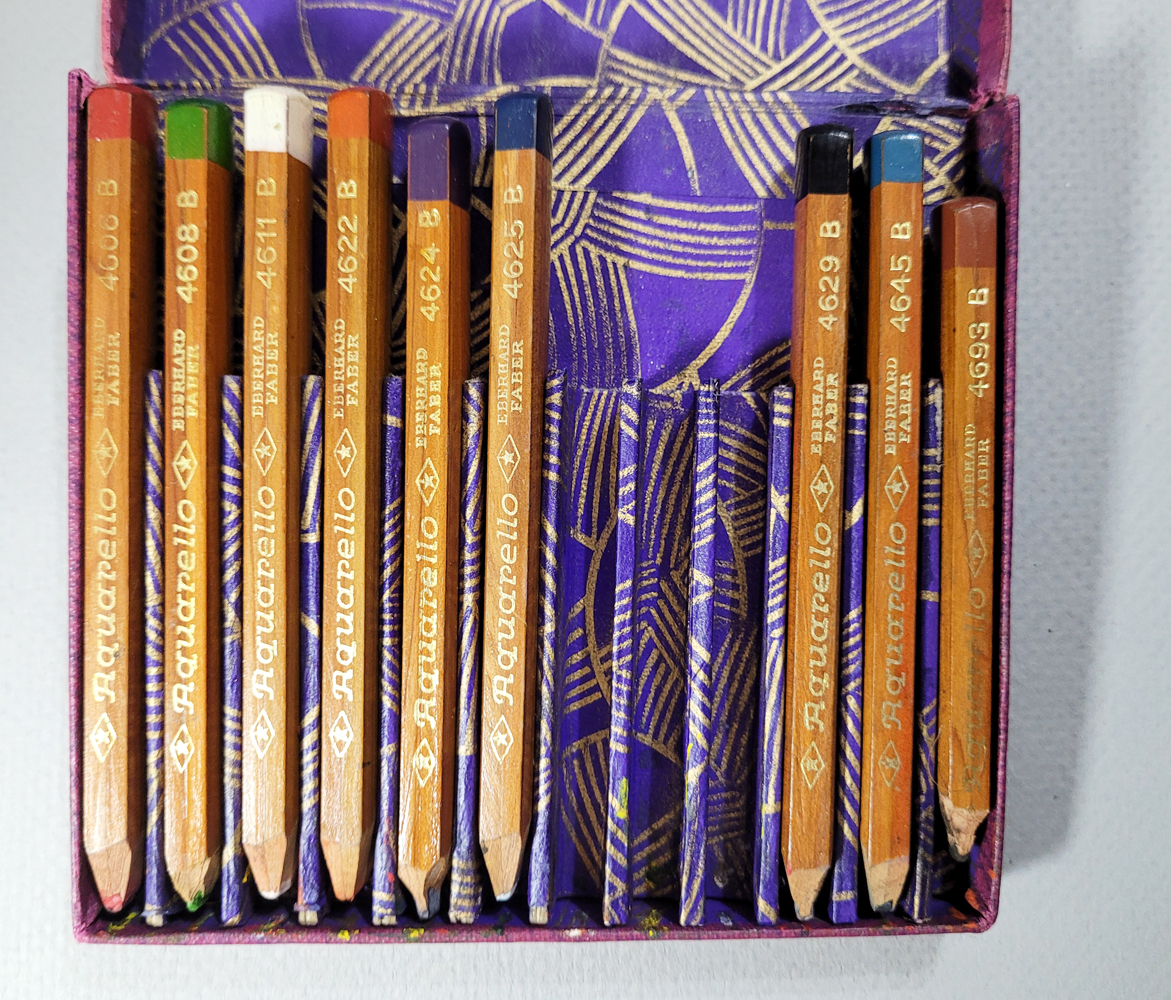
A true gem hopped into my eBay “buy it now” cart recently: a vintage set of Eberhard Faber Aquarello Oval Water Color Pencils. The first time I encountered Aquarellos (doesn’t that sound like something I should have smoked while riding a train back in the ‘60s?), the pencils were of the conventional size and shape (see my post from a few years ago). My latest find has a unique form factor: It’s like a mini-length carpenter’s pencil – and a really beautiful one, at that!

My first Aquarellos have a plainer, conventional form factor.

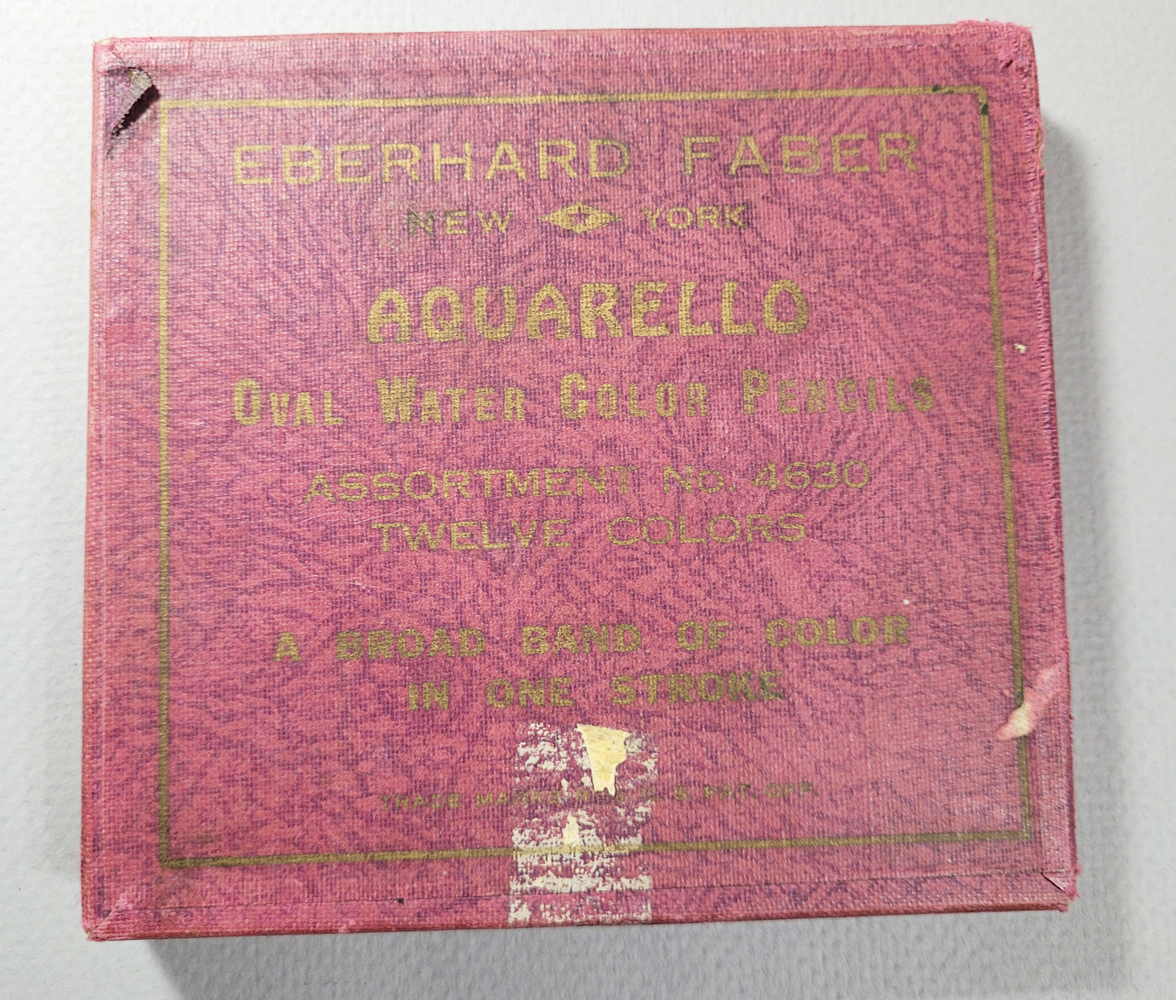
The hinged cardboard box (above) has a pattern that evokes fabric similar to my other Aquarello box (at right). The pencils promise “A broad band of color in one stroke,” and the core’s shape certainly looks like it could deliver.


The box interior has a different fabric-like pattern that recalls a modern brocade or Japanese silk. The box has dividers to keep the pencils from sliding. What a classy way to present colored pencils!


The pencil barrels are natural, varnished wood and painted end caps. So lovely! From the looks of the points, the original owner used them to the quick, but then didn’t want to bother knife-sharpening more than a couple of them.
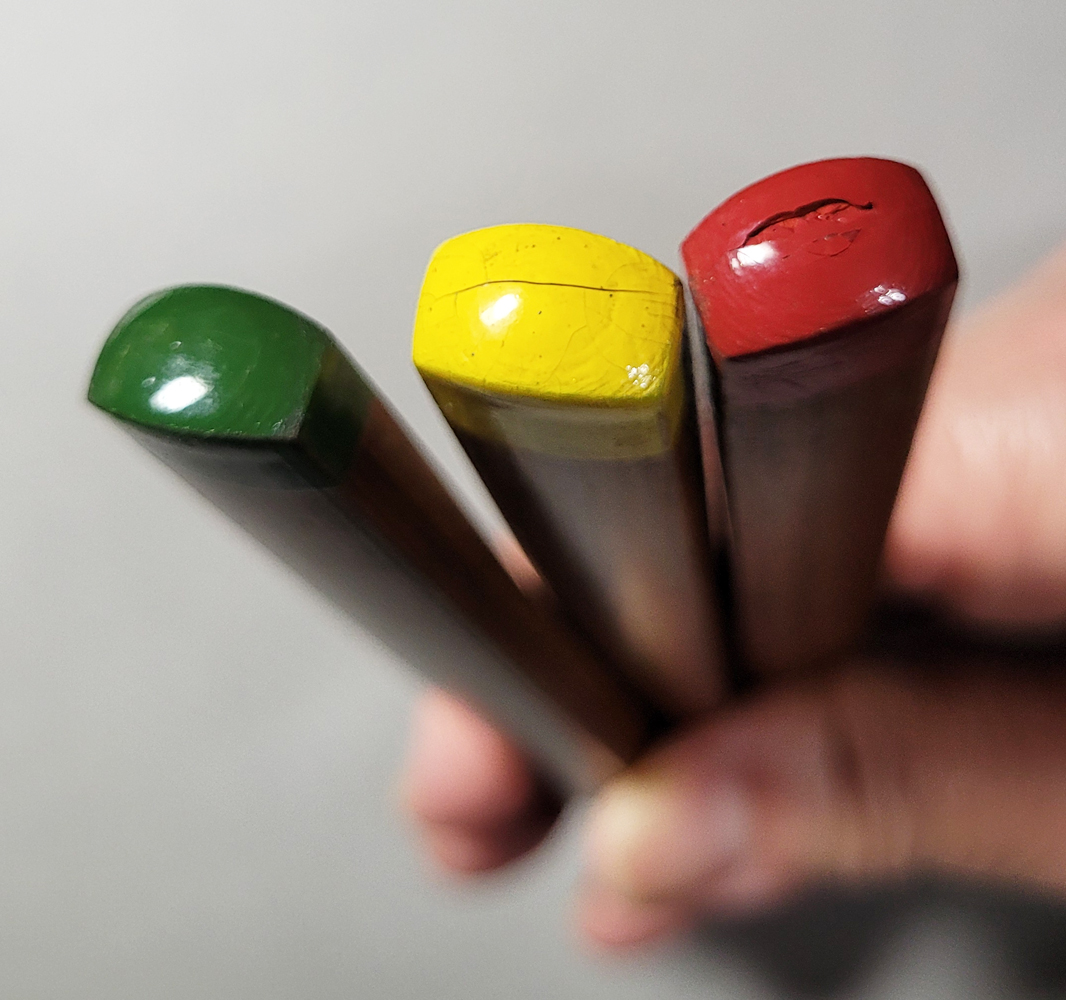
Painted end caps

Branding is on the narrow edge of the pencil only.

Dividers keep the pencils neatly in place.

I didn’t buy these to use, but I did make a quick scribble with a few to see the “the broad bands of color.” The dry pigment level isn’t bad for this era (others are certainly much worse), but like their plainer Aquarello sisters, these “water color” pencils activate without much enthusiasm.

I do like the practical shape of these Aquarellos; they remind me of the Rexel Cumberland Derwent Drawing Pencils that came in a similar form factor. It’s too bad that Derwent discontinued that line (though thankfully retained the same cores in the conventional pencil shape of their current line).

I’d love to see a contemporary pencil manufacturer put out a set of watercolor pencils with a similar broad, flat body that would support an extra-wide, soft core. Faber-Castell already offers the Albrecht Dürer Magnus jumbo pencils, so it’s unlikely to take on another thick core (and I wouldn’t want them as hard as Dürer anyway). Caran d’Ache would be ideal, of course – I could see the Swiss company coming out with a fancy (overpriced) box for them, too. Another one to put on my next wish list.

Edited 2/17/23: A member of the pencil community just showed an image from a 1930 catalog showing these pencils! These must be the oldest in my collection! And even more intriguing: Caran d'Ache has always claimed its flagship Prismalo pencil, launched in 1931, as the world's first watercolor pencil. But if the Aquarello appeared in a 1930 catalog...!

Thursday, February 16, 2023

Foggy, Frosty, 32 Degrees


2/12/23 Maple Leaf neighborhood
Indoors, the furnace was on high gear on an otherwise quiet Sunday morning. Outdoors, it was foggy, frosty and 32 degrees. I like indoors better, especially with a window to draw from.

Wednesday, February 15, 2023

Vintage Walnut Hollow Farm Colored Pencils


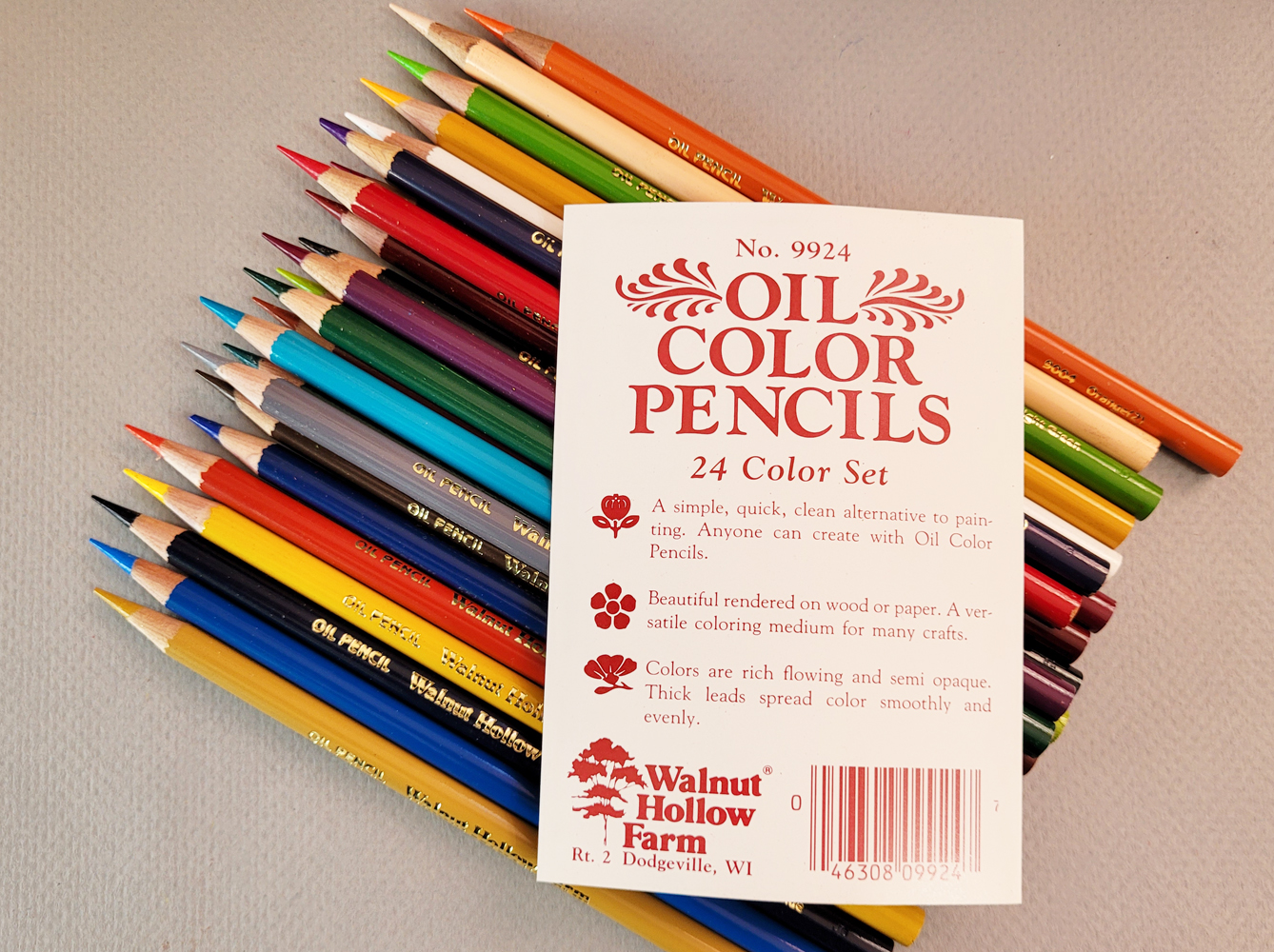
Walnut Hollow Farm colored pencils (The yellowed packaging crumbled when I 
opened it, so all that's left is the card that was inside.)

Ever since I started collecting vintage colored pencils, certain types would come up as highly collectible, but I didn’t always understand why. Of course, some are collectible just because of their name or rarity, but others seem to be hoarded for reasons unknown to me. One such was Walnut Hollow Farm colored pencils.

A family business in Dodgeville, Wisconsin, since 1972, Walnut Hollow sold woodworking supplies and tools. Although the website is still operating, a 2021 article in the Dodgeville Chronicle says the company was sold to Handprint, the home and décor business unit of UFP Retail Solutions.

All of that sounds like an unusual context for coveted colored pencils, but apparently they were sold by Walnut Hollow for the purpose of decorating woodwork. At some point, Walnut Hollow stopped making them – and the hoarding began.


Although I kept hearing about them in the colored pencil world, I didn’t pay much attention to these “oil color pencils.” I couldn’t quite imagine woodworkers hoarding them. I assumed that traditional colored pencil artists must have gotten wind of them at some point, and they were the ones hoarding. Huh – I didn’t need one more rabbit to chase down the eBay hole.

Well, you know how that goes. I was chatting about Walnut Hollow pencils with someone in the pencil community, and the next thing I knew, she generously offered to send me a few to try from her personal stash. Try them I did, and holy moly!


It turns out that they are not especially rare, and I easily found a used set of 24 at a reasonable price (less than what I expect to pay for vintage Prismacolors). I have no idea when production ended, but the plastic packaging on mine was so yellowed and brittle that it started breaking apart when I opened it. All but one pencil was unsharpened, and the sharpened one hadn’t even been sharpened all the way. An ideal “used” set! (In the same way that a new car becomes a used car as soon as you drive it off the lot, I just saw a ”new-in-package” set of 24 with a price four times what I paid.)

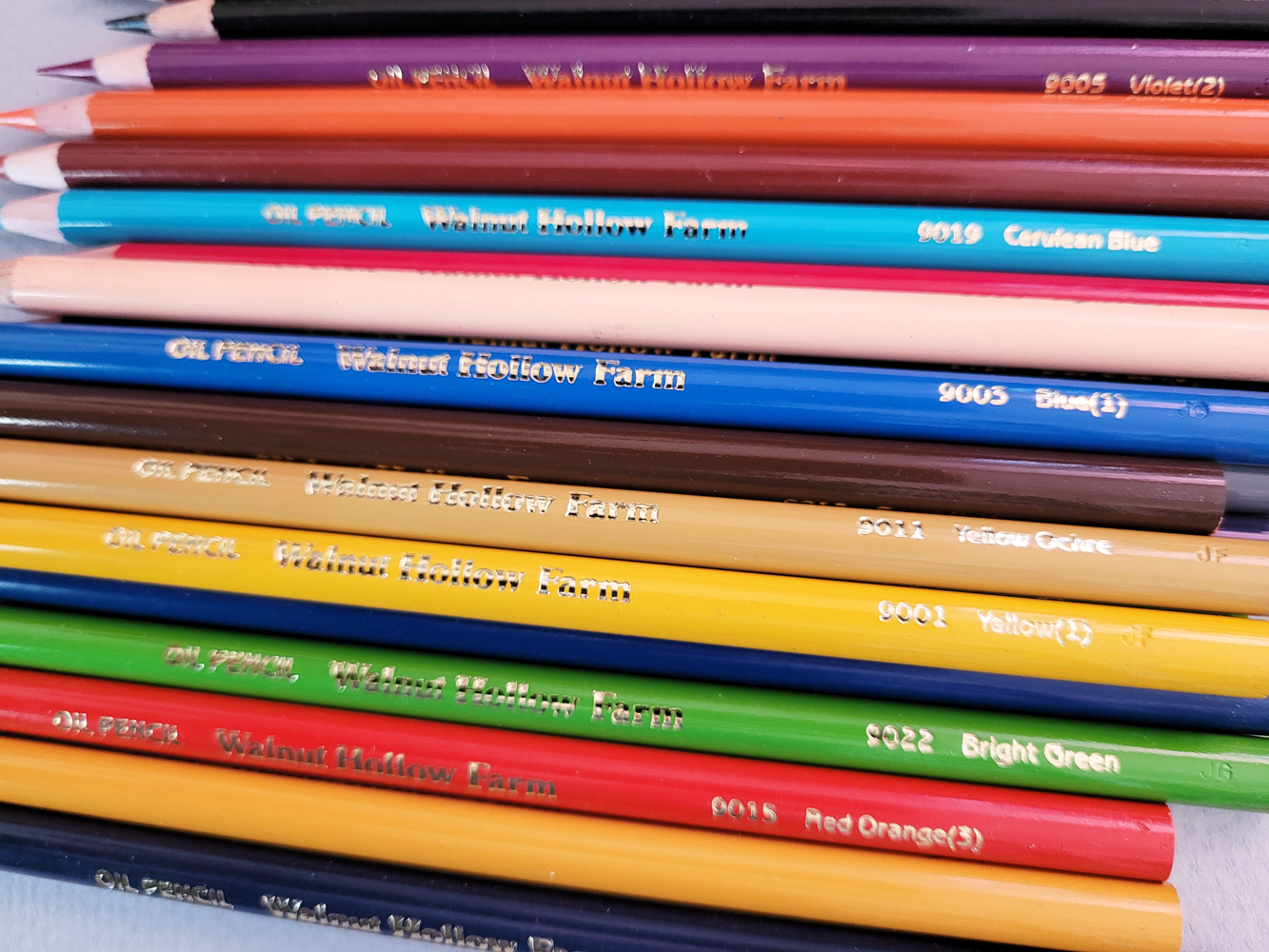
To my delight, they were delivered during my solitary confinement boredom. What a pleasure even to sharpen them! No, I still haven’t learned how to use my calipers, but the thick cores are right up there with 3.8mm Caran d’Ache Museum Aquarelles and Prismacolors. The round barrels with unfinished ends recall Prismacolors’ classic design. The Walnut Hollow logo, color name and number are stamped in gold foil.


Cores in the range of 3.8 - 4mm

They sharpen beautifully!

2/10/23 Walnut Hollow pencils in Stillman & Birn
Zeta sketchbook

My first try with Walnut Hollows was the selfie you saw a few days ago. The Earthsworld reference portrait shown at left was my second try, this time using a Zorn palette. Both were done in a relatively smooth Stillman & Birn Zeta sketchbook. Even with my hasty, crosshatched style, I can feel how easily they blend and layer. Rich in pigment, they glide on smoothly with absolutely no dust.

Although I typically wouldn’t use such soft pencils on a toothy paper, I thought I’d try an Uglybook, just for kicks, to see how they would feel on a slight texture (below). They are just as pleasant to use.

2/10/23 Walnut Hollow pencils in Uglybook


Although they are as soft as wax-based Prismacolors, their oil base gives them a very different feel by comparison. Application feels closer to oil-based Faber-Castell Polychromos – but much, much softer. Like Polychromos, they feel like they could be layered forever without reaching the point of sliding away as many low-pigment pencils start to do.

If Prismacolors and Polychromos, two extreme opposites on the hardness scale, got together at a drunken party, their offspring might be Walnut Hollows. And since those parents are two of my favorite colored pencils, you can imagine how I feel about their children! The contemporary pencil that feels closest is oil-based Derwent Lightfast, which has a very slightly larger 4mm core. (In fact, now that I am comparing them side by side, Walnut Hollows are very much like Lightfast, which I had never before thought of as the potential offspring of Prismacolor and Polychromos after a drunken party! I should be using Lightfast more!)

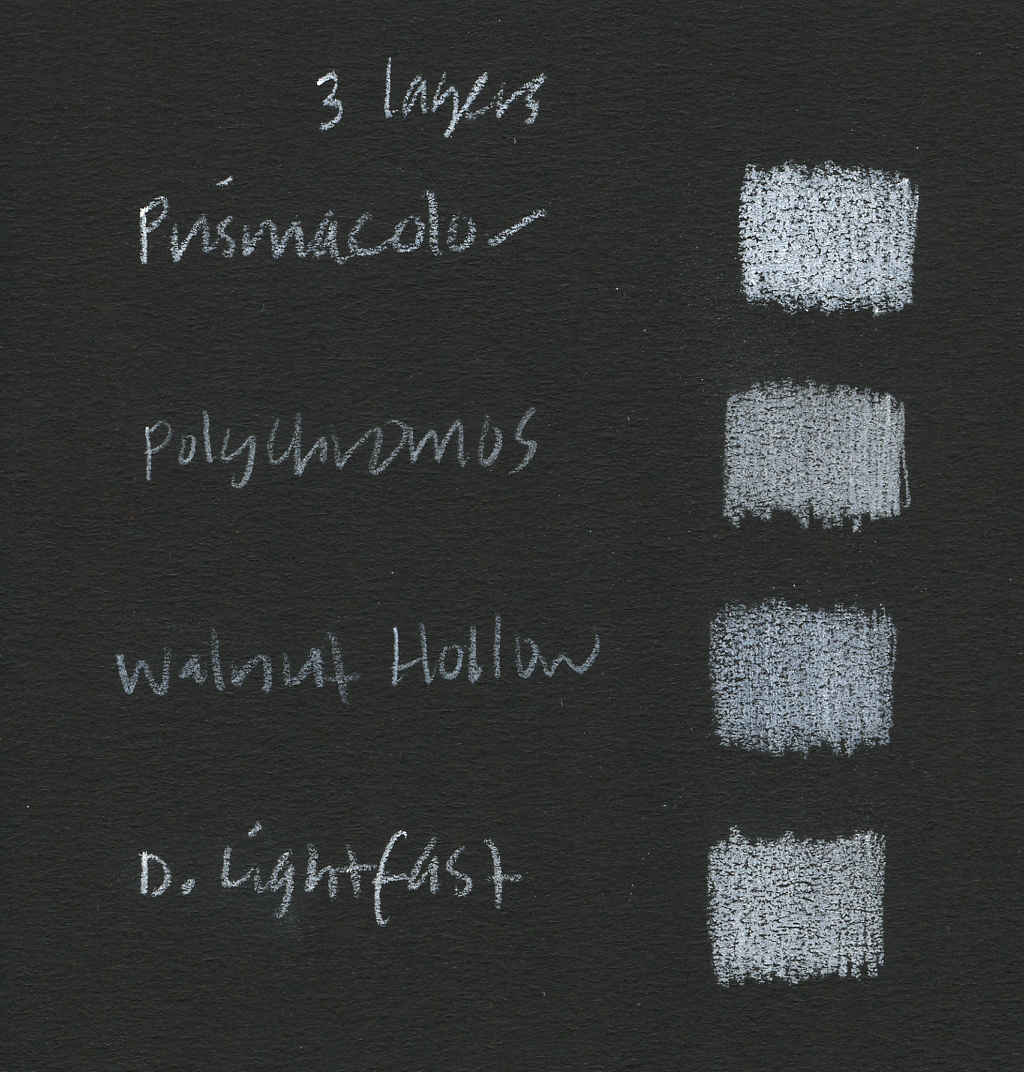
Despite their softness, Walnut Hollows are not as opaque as Prismacolors; they are closer to Polychromos in that regard. Lightfast is somewhere in between.

Opacity comparison in Uglybook sketchbook

The largest set of Walnut Hollow Farm pencils I’ve seen on eBay is 36 colors, which sounds right for a set intended for craft use. I’m not planning to hoard these (for one thing, they seem too easy to find. . . where’s the chase?), but I’m thrilled that I finally became enlightened about why others do: They are delightfully rich pencils to use. (Well, OK, I might look for a set of 36, but that’s it. Really.) They also make me very curious to see some woodwork decorated with these pencils.

The happy kids of Prisma and Poly.


Tuesday, February 14, 2023

Expressive Portraits with Veronica Lawlor


2/11/23 Exercise from Life Drawing Symposium's "Expressive Portraits" mini workshop

New York reportage artists Veronica Lawlor and Melanie Reim are offering mini online versions of their popular Life Drawing Symposium workshops this year. On Saturday, I took one on “Expressive Portraits” that I hoped would fit well with all the portraiture study I’ve been doing. (Unfortunately, Melanie was still recovering from complications from COVID, so Ronnie taught it alone.)

In the first exercise, we studied hands, an important part of human expression, and then the head by drawing them as structural, geometric shapes. Ronnie broke down all the parts in her demo and showed us images of masters’ drawings in which the artists were doing the same thing in their studies.


Next our model/actor Laura portrayed various emotions with her facial expressions. Each pose was only 30 seconds, so we had to capture the essence of the expression with just a few key features. Although eyes and mouths are always important in revealing feelings, I found that the shape of the eyebrow is also a critical component of expression.


The last exercise was the most fun as well as the most useful for real-life sketching: Laura improvised a character spinning a yarn about famous actors she claimed to know. Our task was to draw her as she told her tales, capturing as many expressions as possible. Occasionally Ronnie would ask Laura to freeze a pose for a few seconds, giving us more time to draw, but in general, we all had to keep up with Laura’s continual movements. It was a challenging but realistic exercise coming from a reportage artist. Ronnie packed a lot into two hours!


Monday, February 13, 2023

Green Lake at Dusk


2/10/23 Green Lake (Caran d'Ache Museum Aquarelles on Hahnemuhle postcard

After running an errand in the neighborhood, I found myself at Green Lake at dusk. As often as I walk there in the mornings, I rarely see the lake at that time of day, especially in winter. It was about 5:15 p.m., and the sun hadn’t quite dropped below the tree line; it was still somewhere behind a scattering of blue-violet clouds.

It was the kind of scene that a dear friend who lives at the lake often shares in photos. It was exactly the kind of sketch I wanted to make for her.

Sunday, February 12, 2023

Trying it on for Size: A6 Hahnemühle


New walking-bag sketchbook: A6 Hahnemuhle

Way back in April, I started using a 5 ½-inch square Hahnemühle sketchbook. The way I work with watercolor pencils, I didn’t think I would benefit from its 100 percent cotton paper, but it grew on me over time. In fact, it was in its last few pages when I made some portraits with watercolor pencils that I really appreciated the quality of its paper – both the tooth and the sizing.

Although the page size is a 5 ½-inch square, the cover makes it a 6-inch square. I love the versatility of a square format, but its size was too large for my fitness-walking bag, which is what I had initially bought the book for. It didn’t fit well enough to become my daily-carry, so I was always taking it in and out, and I never had it with me when I wanted it. I finally filled it nine months later, and as much as I enjoyed using it, I thought carefully about what I would replace it with. The 100-percent cotton paper was worth repeating, but I thought I’d try a form factor I’ve never used before: A6. Like the square version, I got mine at St. Louis Art Supply.

No wonder the A6 size (about 4.1-by-5.8 inches) is comfortable and familiar to me: It’s almost exactly the same as 4-by-6-inch Uglybooks. Although its hardcovers still make it bulkier than I would prefer, at least I can easily fasten the Velcro flap on my bag again.

The A6 Hahnemuhle's cover makes it a bit
larger than an Uglybook... 
... but the page sizes are almost identical.
(Sticker from Ernest Theodore) 

The hardcover Hahnemuhle is bulkier than I would like,
but I'm hoping not too bulky to daily-carry.

3 1/2" x 5 1/2" Stillman & Birn atop A6 Hahnemuhle

Years ago, I tried using the 3 ½-by 5 ½ -inch version of the Stillman & Birn Beta sketchbook in my fitness-walking bag. I thought the lightweight softcovers and small format would be ideal, but it didn’t last long. Something about that narrowish aspect ratio felt more cramped than it should. Just like Field Notes, which have the same dimensions: They’re good for commuter portraits and such, but they always feel a bit tight for urban sketching. I feel the same way about S&B’s larger 5 ½-by-8 ½-inch format compared to the A5 Hahnemühle that has become my standard urban sketching book: Somehow that slightly less longish aspect ratio (A5 size is 5.82 by 8.26 inches) makes a big difference. (Picky and idiosyncratic, I know – but when it comes to art supplies, what isn’t?)

I already know I love the paper, and the comfortable A6 size has a better chance of becoming a daily-carry in my walking bag. Let’s see how it goes.

Sketch notes: This time of year, the sky often has a pale-orange tint that looks like it’s close to dawn or dusk, even at mid-day (below). I love that dry-brush effect in the sky, and I credit both the texture and the sizing of the 100 percent cotton Hahnemühle paper.

2/9/23 Maple Leaf neighborhood (Caran d'Ache Museum Aquarelle watercolor pencils in A6 Hahnemuhle sketchbook)
2/10/23 Maple Leat Park (Museum Aquarelles in A6 Hahnemuhle)

I usually don’t bother using my “licking” method when I’m out on a fitness walk, but the sky over Maple Leaf Park recently was irresistible (at left). I also knew that the Hahnemühle’s paper could take it. 

Both of these sky effects were done with my usual Kuretake waterbrush. Some watercolor painters like to dis the lowly waterbrush, and I’m sure if one were trying to make big, juicy washes, these plastic bristles wouldn’t cut it. But if the page is small, I think the paper’s quality has a much bigger impact on the result than the brush. In fact, I think paper quality is more important than the brush under any circumstance. That’s a bold statement for a non-painter to make, but I’m standing by it.

Saturday, February 11, 2023

Sketch Face


2/7/23 Zoom face

During the first pandemic year when we were all getting used to Zoom as a way of life, Michele Cooper made a self-portrait from her own image on the Zoom screen. To my comment about whether she had been having a meeting all by herself, she retorted, “Of course – it’s the only way to get a word in edgewise.”

On the last day of my quarantine, I remembered Michele’s self-portrait, and it somehow seemed appropriate to make one myself. I almost titled this post “COVID Face,” but I really didn’t feel as bad as I look in the sketch. In fact, I was nearly fully recovered by then and looking forward to rejoining the world.

By the way, I don’t recommend using the Zoom screen to draw self-portraits from. The light kept shifting every time I moved. In addition, I had never noticed before that there’s a tiny lag in time between my movements and the video image, so I could actually watch myself blink my eyes completely. In a mirror, that’s not possible. Try it on Zoom sometime; it’s weird and a bit distracting.

Despite 100% attendance at my Zoom meeting, the agenda didn't draw much interest.

Related Posts Plugin for WordPress, Blogger...