Thursday, March 2, 2017

Feathery

3/2/17 graphite
Apparently this type of tree is called a weeping sequoia. I don’t know much about it except that I see many intriguing examples all over Seattle – their long, drooping branches are monstrous, messy and strangely humorous. Last year I couldn’t resist sketching one I saw in Maple Leaf, and today I couldn’t resist this one in Wedgwood. I happened to have a freshly sharpened graphite pencil in my bag – just right for all those feathery fronds. 

Monday, February 27, 2017

New Strategy

2/27/17 graphite, white colored pencil, Strathmore toned paper
A few weeks ago we had the first serious snowstorm of the season, which gave me an opportunity to try using gray toned paper to sketch snow. This morning we awoke to a couple of inches of accumulation, but I had a feeling it wouldn’t last (it’s 1 p.m. as I write this, and it’s almost all gone now), so I would have to do it quickly if I wanted another crack at it.


Hmmm. Pull on my boots and hat and gloves and tromp out into the still-falling snow, struggling to sketch on wet paper like last time? Or pour another cup of coffee and sketch through the bathroom window? Yeah, I like my new strategy better! J

Sunday, February 26, 2017

Clouds

2/26/17 colored pencil, smooth Bristol (photo source)
While I was playing on the beach last week, I missed a colored pencil class and got behind on homework from the previous week, which was depicting clouds.

As amorphous as clouds may seem, it’s still tempting to draw their rough contours to get a handle on them, but Suzanne warned against that. Attempting to draw them with a contour line, she said, would undoubtedly lead to the scallop-edged clouds of cartoons and our kindergarten drawings. Fighting that temptation, I did my best to shape them by coloring the shadows and negative spaces around them instead of the clouds themselves. I didn’t try to emulate the source photo exactly, but I attempted to evoke as much of its cloudiness as possible.

I probably say this about every class exercise, but I think clouds were the most challenging of all! I do wish I had done the assignment before going to Cannon Beach, though, because I might have been better prepared to sketch the clouds from life as they continually changed in the sky around Haystack Rock.

Friday, February 24, 2017

Mixed Media at Cannon Beach

2/21/17 water-soluble colored pencils, ink

Possibly our favorite place on earth, Cannon Beach is where we return as often as we can. No matter what is happening elsewhere in the world or in our country, visiting this tiny spot on the Oregon Coast revitalizes our souls and puts everything into perspective. I stand next to monolithic Haystack Rock and feel as small as a sand fly. Then we hike a mile or two down the beach, and Haystack isn’t so huge. We drive to the next beach and look back at Haystack, I see that it’s just another speck on the Pacific’s shoreline, where waves have been crashing in and pulling back out for millennia. At Cannon Beach, I always feel small yet whole.

This week was our fifth visit since I began sketching. Watercolor seems like an intuitively natural medium for capturing water views, so it’s always been my go-to. But the past several months I’ve been focusing almost exclusively on colored pencils, so I decided to leave my watercolors at home. When I was packing, I almost put my watercolors in, “just in case,” but I didn’t want to fall back on an easy old habit. It was an ideal opportunity to face a beloved, familiar landscape with new media.

From the comfort of our oceanfront hotel room (which I was grateful for, since the temperature was down in the 30s), I made my first sketch of Haystack with water-soluble colored pencils (above), which are wonderful for getting both rich color and texture. It helped that the sun came out long enough to put in some shadows. When I got to the partly cloudy sky, however, I switched to ink in a waterbrush. I just haven’t figured out how to make a sky look good with dry pencils (that’s my class homework from last week that I haven’t finished yet), and adding water tends to get streaky.

Later in the day I decided to try the layering techniques I’ve been learning in class using traditional (dry) colored pencils (below). I spent only about an hour on this 4 ½-by-6-inch, not the several hours I would have spent on a class exercise, so I wasn’t able to achieve the depth of tone and hue that I strive for (the overcast sky kept all the shadows away, too). Still, I was mostly happy with the textures (not that gravelly sky, though. . . I have to get to the homework!).

2/21/17 colored pencils

Prepared for rain, I sketched in my waterproof Expedition
notebook (sans glasses!).
 Maybe the most fun I had trying a new medium at the beach was when we thought the rain would continue to come and go as it had all morning. Pulling on my raincoat, I left my bag in the hotel room and stuck only a graphite pencil and my waterproof Expedition notebook in a pocket. Instead of more rain, the sun came out, so I pulled out my tools for a sketch – and I realized my glasses were still in my bag back at our room! No way was I going to hike back up the hill to get them. Not being able to see my small sketchbook well pushed me to stick to the large shapes and tones (below) – and I discovered what a joy it is to use a soft graphite pencil on that crazy Yupo paper! My Mitsubishi Hi-Uni 8B pencil is like velvet on that strangely toothless paper. It’s my designated sketchbook for inclement weather – but who knew I’d enjoy it even in sunshine?

2/22/17 8B graphite pencil, Field Notes Expedition notebook

2/21/17 ink
I also had enormous fun drawing tiny beach-walking stick figures casting shadows and reflections.

During low tide we explored the tidepools surrounding Haystack, where I sketched a variety of anemone, barnacles and other critters clinging to rocks. On a visit in 2014, I had sketched some colorful starfish but didn’t seen any this year, so I asked an Oregon Department of Fish and Wildlife staffer about them. He told me that a virus had attacked 98 percent of the starfish on the Pacific Coast during the past few years, and they are only just now beginning to make a slow comeback.


In any weather, in any season, in any medium, Cannon Beach is still one of the most beautiful places on earth. See my posts from previous visits.

2/21/17 brush pen, water-soluble colored pencils

2/21/17 brush pen

2/22/17 colored pencils
2/22/17 colored pencils, ink
Chilly beach

2/22/17 ArtGraf water-soluble graphite pencil

Tuesday, February 21, 2017

Review and Field Test: Expedition

2/18/17 graphite, Field Notes Expedition notebook
Winter weather curtails my sketching, but not completely. Since it typically doesn’t get deadly cold here, I can sketch quite a bit from my car. The only weather that really stops me is rain: Turning the windshield wipers off and on repeatedly is annoying, and it’s not pleasant standing in the rain. In addition, even watercolor sketchbooks don’t hold up well if you can’t decide where you want the water to go.

But what if there were a sketchbook that could withstand rain?

Last month in my post about the sketching materials I used during the Women’s March, I mentioned being prepared for rain by bringing a Field Notes Expedition notebook. Made of Yupo, a synthetic paper, the notebook is completely waterproof, inside and out, and very difficult to tear. It’s designed to be used by people who need to make notes while working outdoors in various weather conditions.

I did a lot of Internet research and my own tests to see what kinds of drawing materials would work on the slick, plastic-y surface that cannot absorb liquids. Although a variety of pens can be used, some inks take a long time to dry on it. Many pens with waterproof ink like Sharpies and brush pens will draw well on it while the paper is dry, and once the ink has dried, it will be waterproof if the paper gets wet afterwards. But if you try to write on wet paper with these waterproof pens, the ink won’t stick – it just floats away.

On the left side of my test spread below, I used a Sharpie, a Copic Multiliner, a Plumchester brush pen and a Kuretake brush pen containing Platinum Carbon Black ink (all waterproof inks) to make some scribbles on dry paper. I waited a bit to allow the inks to dry, and when I thought they were, I sprayed the page with a water spritzer. The Sharpie and Plumchester were dry, so the water didn’t affect them. The Copic Multiliner must not have been completely dry, as it smeared a bit. The brush pen with PCB ink looked dry but must have been quite wet, because it made a beautiful bloom.

On the right, I sprayed the clean page with water first, then tried to write on it with the same four waterproof inks. As you can see, none was successful.
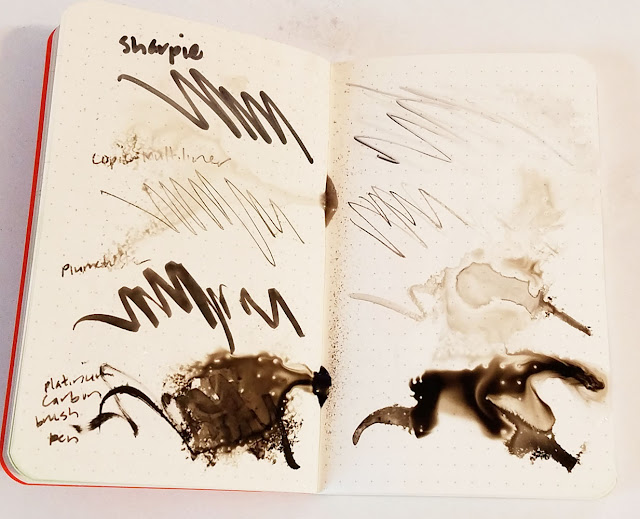
 
Waterproof ink tests

Most reviews I’d read said that graphite pencil and ballpoint pen fared well on Expedition paper, and my own test results partly concur. On dry paper (below), I used a couple of soft grade graphite pencils and a Uni-Jetstream ballpoint pen to scribble on the left side. On the right I used a few different types of traditional colored pencils.

Then I sprayed the page spread. As expected, water did no harm to the pencil or ballpoint scribbles. While the pages were still wet, I went back in with the same instruments to try scribbling again (those marks are labeled “wet”). While the graphite and colored pencils all did well, the ballpoint pen didn’t.
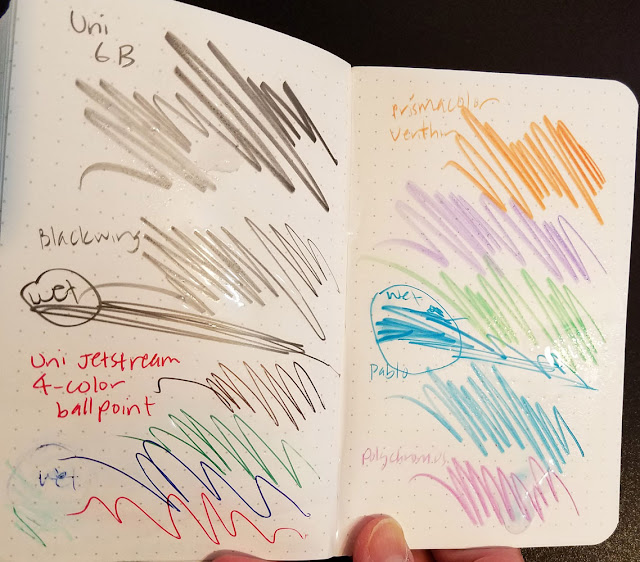
Dry media tests

I don’t really care for the way colored pencil looks on Expedition paper, and without any tooth, it’s hard to build up color. But strangely enough, I do like the way graphite goes on the paper, especially the softer grades – rich and dark – and it feels surprisingly pleasant. Despite the lack of tooth, it goes on well, stays on when wet and – most important – draws on a wet surface.

With laboratory testing done, it was time for a field test. You’d think I’d have plenty of opportunities in Seattle for field testing (and you’d be correct), but I was waiting for just the right rain conditions. I didn’t want to get drenched, so forget about the many downpours we’ve had recently. And I didn’t want to freeze, either, so I skipped the cold, wet days, too.

Then a few days ago it was just right – mild temperature but drizzly. On my way home from the post office, I stopped in the View Ridge neighborhood, pulled up my hood, and got out of the car. Using a Mitsubishi Hi-Uni 6B pencil, I scribbled the street scene, watching the drizzly drops cover my page. The pencil did beautifully, both while the page was relatively dry as well as toward the end of the sketch when it was dripping. When the page spread completely dried, it was as good as new – you can’t tell that it was ever wet (see scan at top of page). 

Using watercolors, artists like Joan Tavolott make paintings with gorgeous effects on dry Yupo paper. And now sketchers like me have no excuse on rainy days – Yupo paper is great for drawing on wet, too! 

Note the rain dripping down my pencil and on the page surface!

Sunday, February 19, 2017

Life Drawing on Steroids

2/19/17 ink, marker, colored pencils

One-minute poses at Gage life-drawing sessions seem like pure extravagance compared to the real-life drawing practice we got today at Seattle Bouldering Project. Urban Sketchers Seattle discovered it was more like one-second poses as people attempted to scale the vertical walls of the practice facility for rock climbers.

2/19/17 brush pen
A recreational venue as well as a training facility, Seattle Bouldering is a huge place with multiple artificial mountains for climbers of all ages and skill levels. Scaling the walls like spiders or hanging upside-down like chickadees, most of the climbers fell eventually, too. “Climbing is 90 percent falling,” we were told by Bouldering staff, and I was very happy to be sketching and not participating.

Almost exactly three years ago, USk Seattle visited Seattle Bouldering, and I remember clearly that I didn’t spend enough time warming up with gestural sketches. This time I heeded my own advice and used several pages of my sketchbook doing nothing but small gesture studies with a brush pen. Always looking for Suhita Shirodkar’s “line of action,” I just kept the brush pen moving. The upstairs balcony offered the best view of the high walls where the more experienced climbers were practicing. It was impressive to see these strong, agile people plan and execute each foothold and handhold.

Once I had loosened up a bit, I decided to make a few slightly larger figures and pay attention to shadows. They turned out to be just as challenging as the figures casting them because the light seemed to be coming from all directions.

From the lower level where I could stand nearly at the same level as the climbers’ thickly padded floor, I finally felt ready to take a larger view of both the people and the strangely shaped interior space.

2/19/17 ink, colored pencils

Saturday, February 18, 2017

Pocket Vignettes at Volunteer Park

2/16/17 brush pen, colored pencil
On Thursday we went to see the exhibit Tabaimo at the Seattle Asian Art Museum. Although I enjoyed the show, the sun’s unexpected appearance called to me. Before we got back into the car, I took a few minutes to put into practice the exercise we learned last week in Gabi’s Pocket Urban Sketching workshop. The concept is to use a pocket-size page spread to compose a montage of three small vignettes related in some way. To be visually pleasing and more cohesive, Gabi suggests varying the three elements in size.

While I was still viewing the exhibit, I sketched a dragonfly motif from one of the pieces. Then outside the museum, I started sketching Isamu Noguchi’s Black Sun sculpture when a tour bus of teenagers suddenly climbed all around and inside the sculpture’s hole for a photo opp. I quickly scribbled them into the sketch. Finally I looked out over Volunteer Park toward the Space Needle on the horizon and made a tiny skyline at the bottom of the page. As Gabi had suggested, I wrote a few notes about the visit in the white spaces around the vignettes.

The page spread, which is 5 ½-by-7 inches, took no more than 10 minutes to complete (by that point, I was too cold to stay out longer, since the sun had dipped behind clouds). Individually, each sketch doesn’t show much, but the three together tell a more complete story about my visit to the museum and the park. I don’t usually journal much as part of my sketch page, but the spaces between images asked to be filled in with brief notes. It’s really an ideal format for travel sketching on the go – very little time consumed, yet a lot of information and memories captured. 

Although I know many sketchers use this type of montage format, I’ve never put it into practice myself. Now I can easily see how to use it to my advantage in some situations. It’s an art journal technique (writing that supplements sketches) colliding with urban sketching in a way that fits some of my needs well. 
Related Posts Plugin for WordPress, Blogger...