 |
| Faber-Castell's Black Edition |
A few weeks ago, Faber-Castell USA’s Instagram account
made a big splash with several posts showing some black-barreled colored
pencils with candy-colored cores shown off on black paper. “JUST DROPPED: THE
BLACK EDITION COLLECTION” implied that the pencils were new. Huh? I’d been
seeing them on Amazon for months, dismissing them as kids’ stuff. In what way had
they “just dropped”? Confused, I posted a question, but it went unanswered.
Another follower had commented, “Already have this set since Christmas.”
It turns out that F-C wasn’t being misleading by announcing
this product as having “just dropped.” Making inquiries with knowledgeable
pencil friends, I learned that the Black Edition line is manufactured in
Brazil, and up until recently, had been available only in South America. So the
big splash was to let us know that we could expect to see them in US stores.
OK, that’s fair.
Regardless of the actual newness of the product or where it
was available, F-C’s marketing ploy worked supremely: I found myself looking
more closely at the set of 36 I had dismissed previously – hmmm, an
interesting set of all pastel colors – and then clicking “add to cart.” Funny
how that happens.
Available in a variety of set sizes, including the largest
of 100 (mentioned by reviewers, but I didn’t see it on Amazon), the set of 36 I
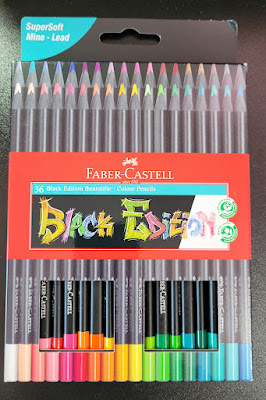
bought for $17.99 comes in simple cardboard packaging. The pencils are in two
“drawers” that slide out. The drawers are a bit fiddly to get back in, but it’s
a nice, compact set. If I paid double that price, I could get the same 36 pencils in a tin. Since I usually use and store pencil sets in plastic storage bins,
I’m happy with the cardboard packaging (especially at half the price).
 |
| Compact, economical packaging |
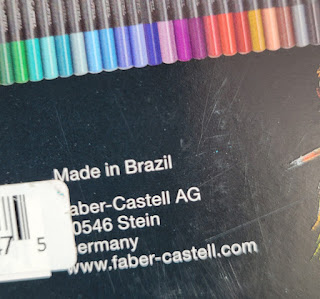 |
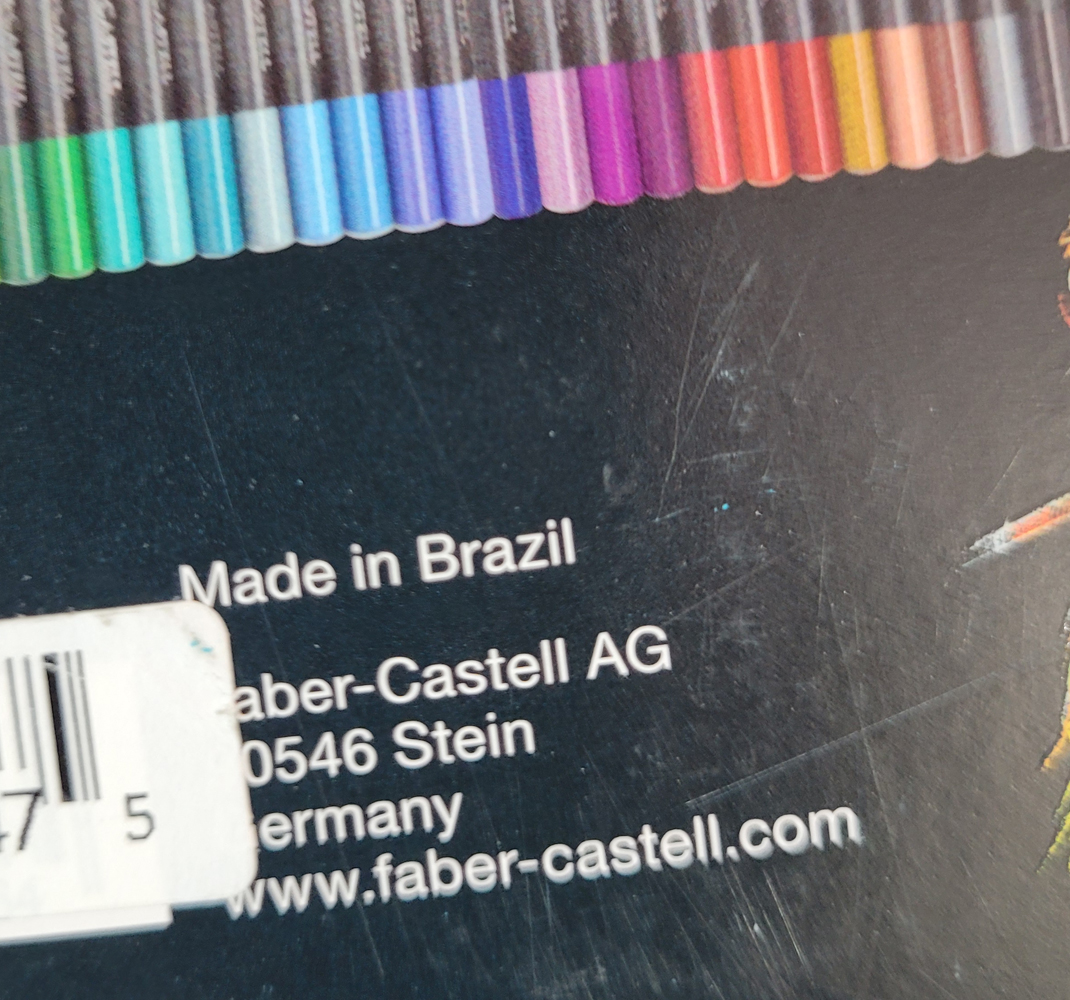
Originally made for the South American market,
the Black Edition pencils are manufactured in Brazil. |
The package information indicates that they are, indeed,
made in Brazil (I’ve seen other F-C pencils made in India). The Black Edition
seems to be part of F-C’s EcoPencil Supersoft collection, all made in
Brazil and at the same price point of about $0.50 per pencil.
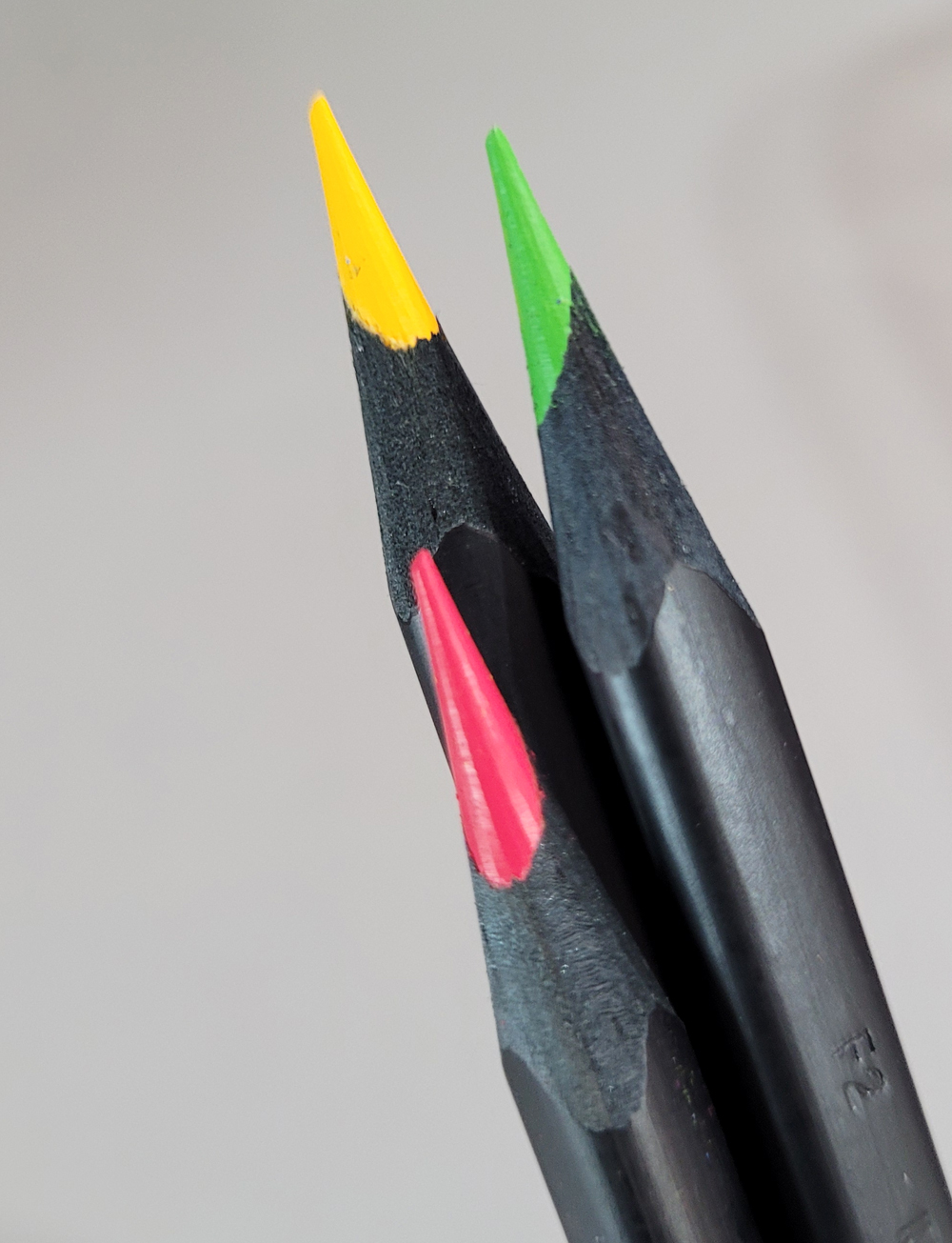
The triangular barrels are made of lightweight wood with the
distinctive feature of being black all the way through. (They evoke early sets
of vintage F-C Design Spectracolor pencils made of black wood; later
sets were made of natural wood. Some sources reported that the change was made
because the black wood was found to be toxic. That was a long time ago, so I’m
hoping that this black wood is different.)
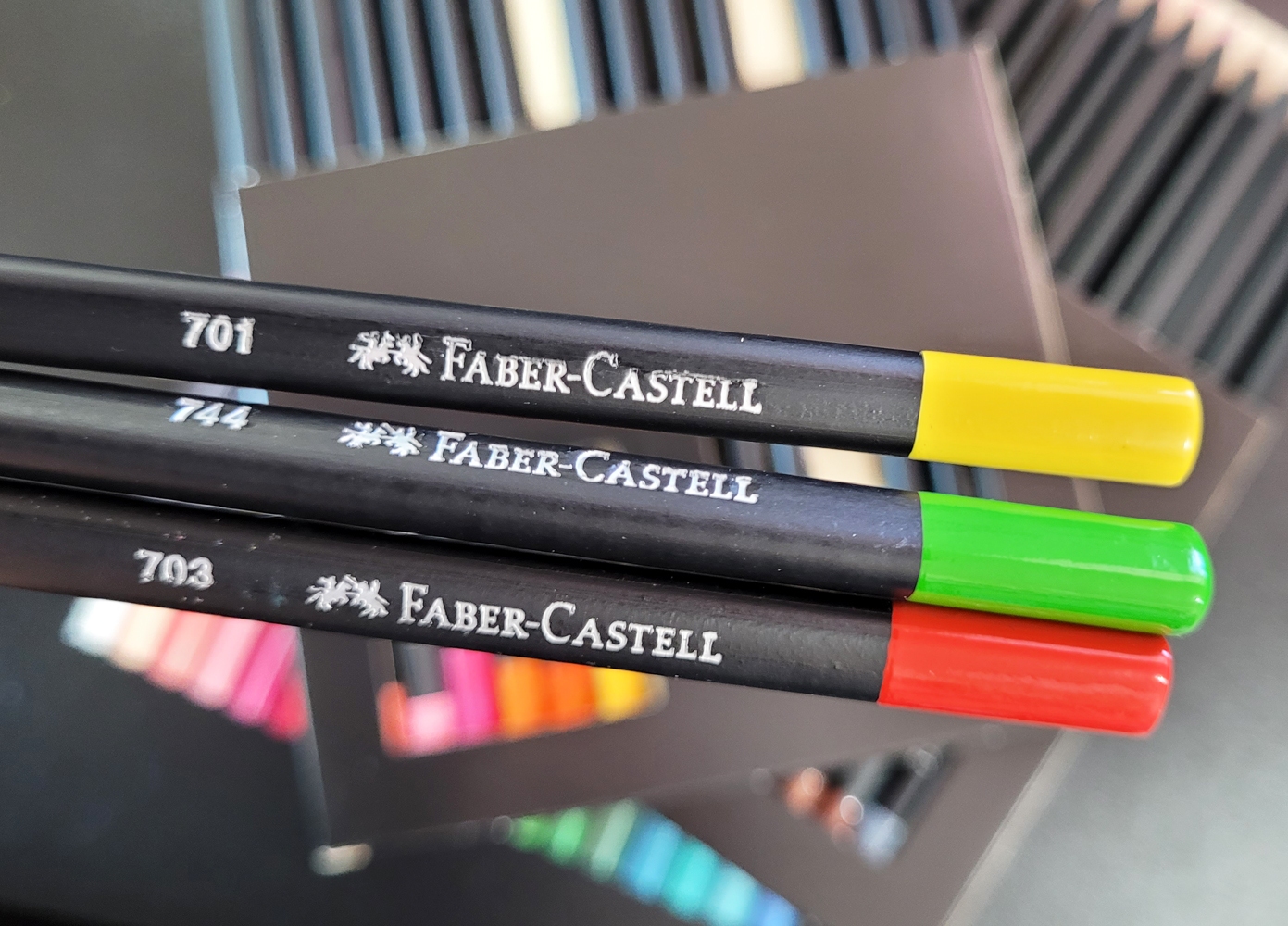
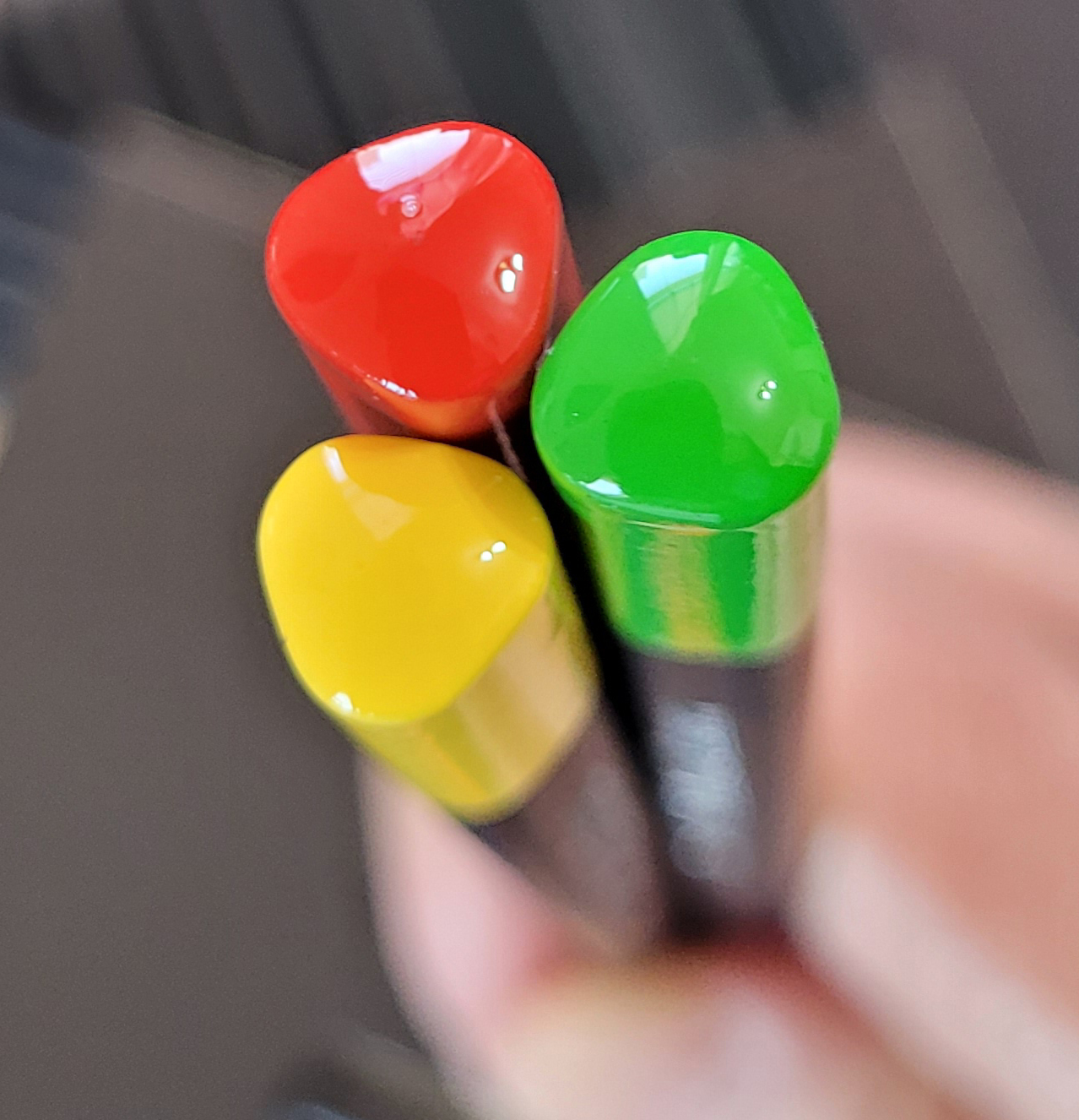
The matte black barrel has a glossy end cap identifying the
color. The color number but no name is stamped on one side. Although I’m not a
fan of using triangular-barreled pencils, I do like the appearance of the
round-cornered, triangular end caps.
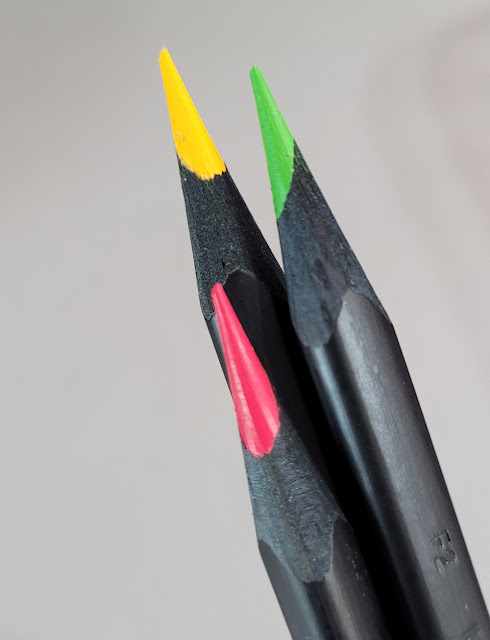 |
| The cores are not off-center as they look here... I think sharpening the triangular barrel gives that appearance. |
Compared to F-C Polychromos, the “super soft”
Black Edition pencils are surprisingly soft. Not Prismacolor or Caran d’Ache Museum Aquarelle soft, but softer than I expected for Faber-Castell.
They are also a bit dry and crumbly, but not so much to be unpleasant to use.
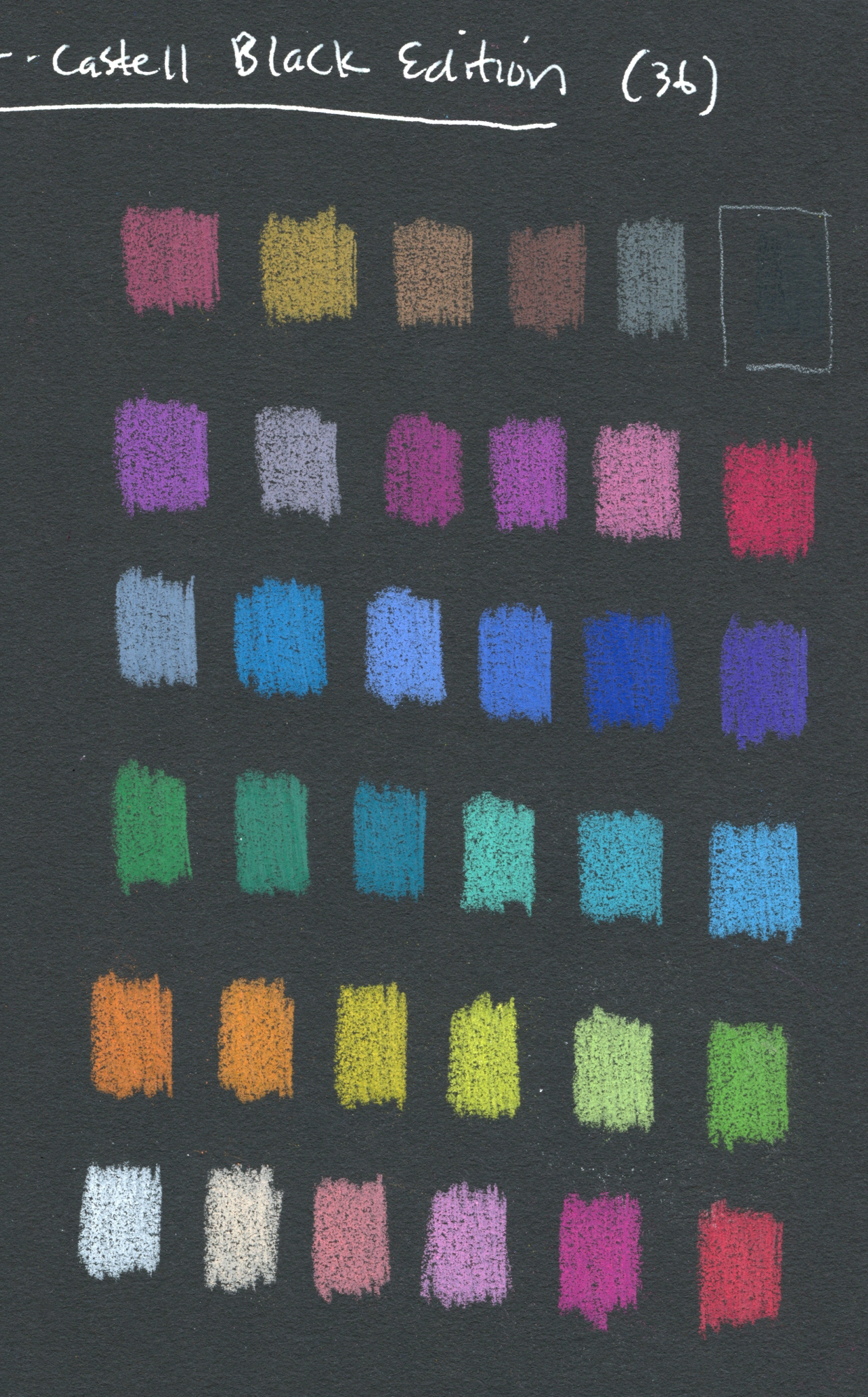
Since the Black Edition pencils are obviously made to be
used on dark paper, first I swatched the colors in a black Stillman &
Birn Nova sketchbook. After three layers, most colors do pop off the page
with brilliant opacity.
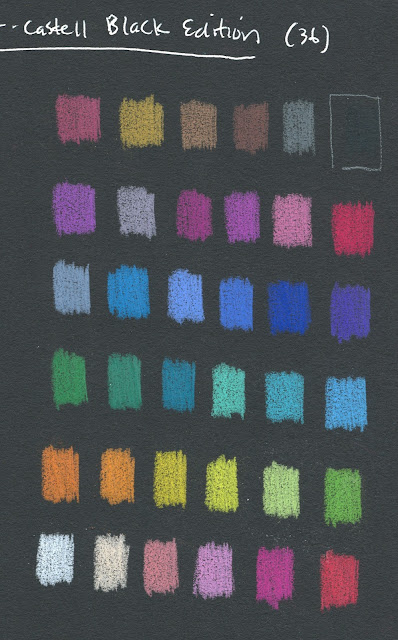 |
| Swatches made in Stillman & Birn Nova sketchbook |
Swatched in a Stillman & Birn Epsilon sketchbook,
most colors look unremarkable, and some look downright blah. Clearly they are
ideally used on dark paper.
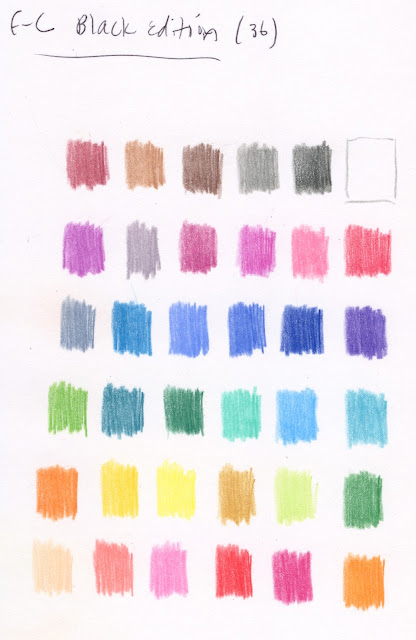 |
| Swatched in a Stillman & Birn Epsilon sketchbook (Sorry that these swatches are not in the same sequence as the black-page swatches! It was my intention to put them in the same order, but you know what they say about that pathway paved with good intentions.) |
To be fair, the Black Edition colors are no more blah on
white paper than most other pencils in the same colors would be on white. It’s
just that when you have a whole set of nothing but high-key hues, they are
bound to look washed out on white compared to black.
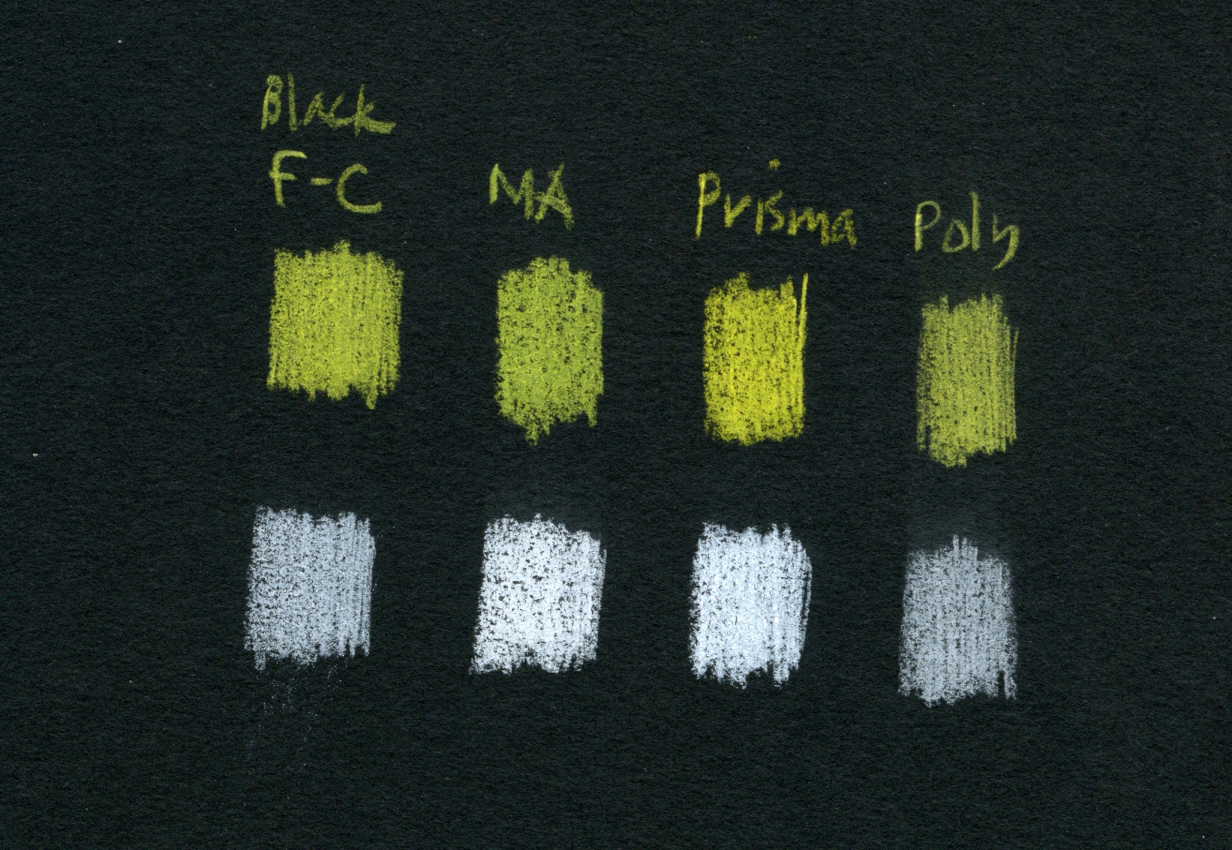
In addition to Polychromos, I grabbed a few other favorites
to compare color opacity (from left: Black Edition, Museum Aquarelle,
Prismacolor, Polychromos; three layers each). The yellow Black Edition shows
strong opacity, but white less so. (It’s hard to beat Prismacolor’s white
for opacity.)
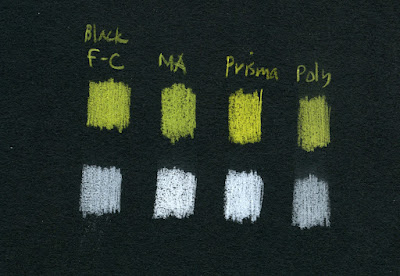 |
| Opacity comparison (from left: Black Edition, Museum Aquarelle, Prismacolor, Polychromos) |
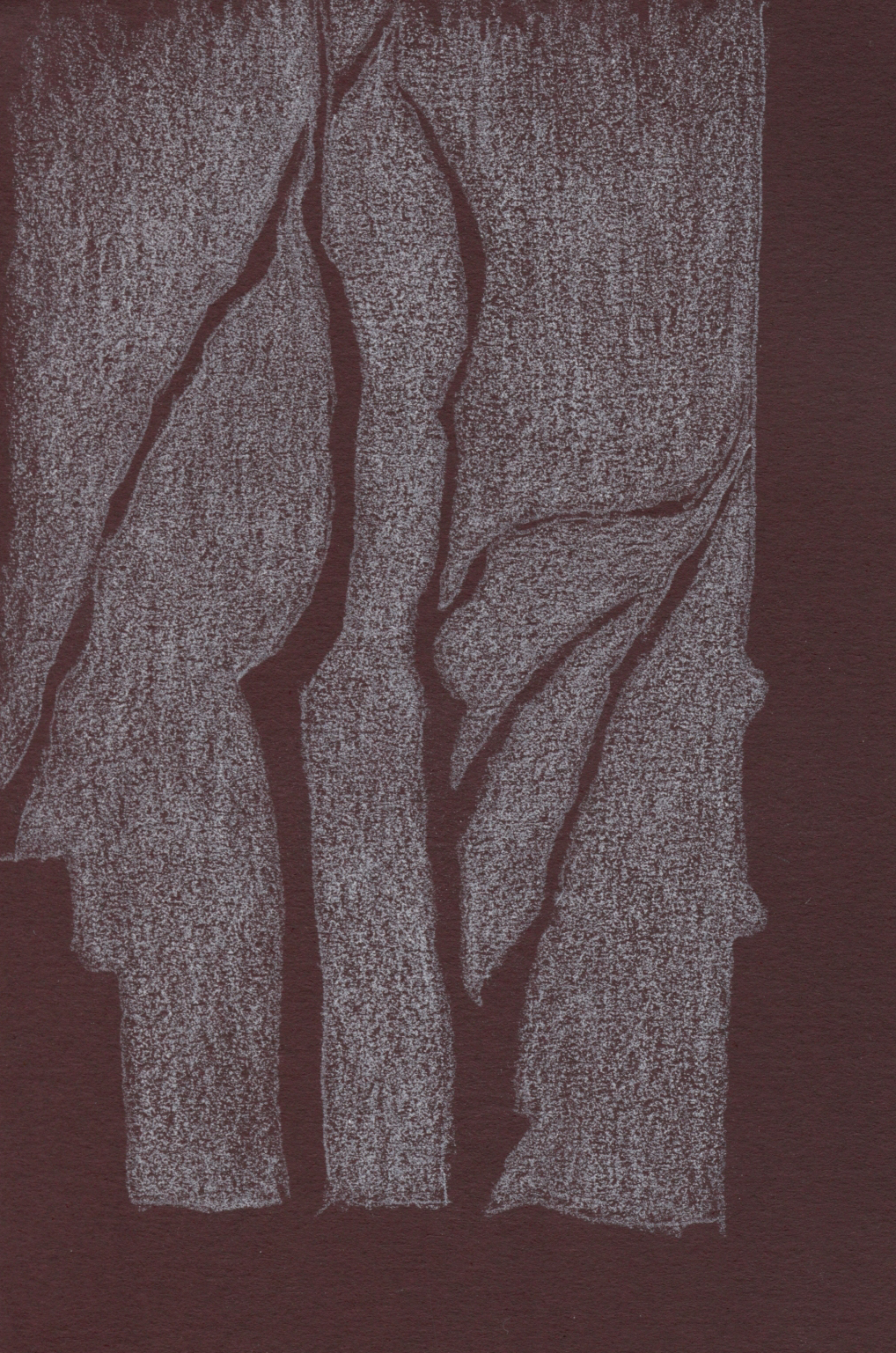
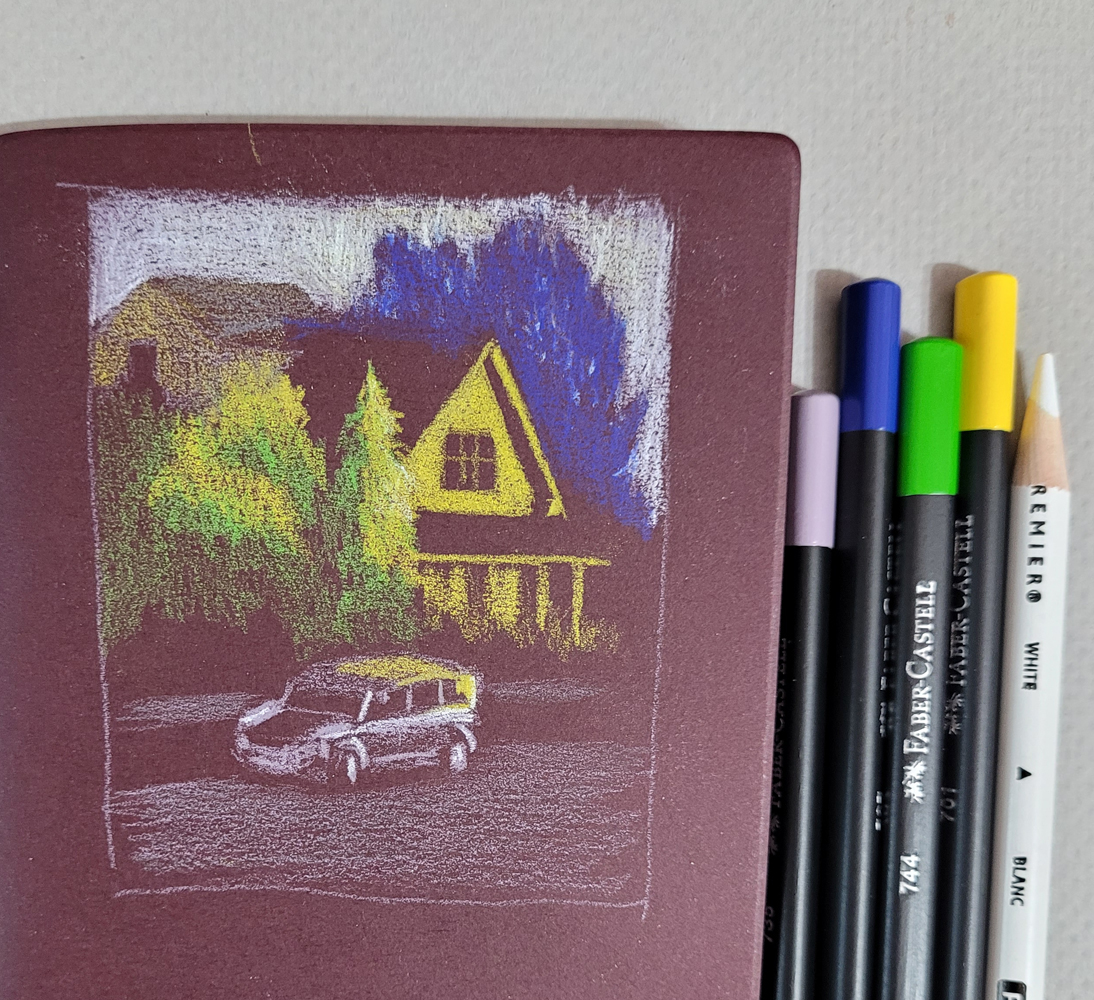
In the abstract-looking sketch, below left (it was actually
a negative-space drawing of trees), I was frustrated that the Black Edition
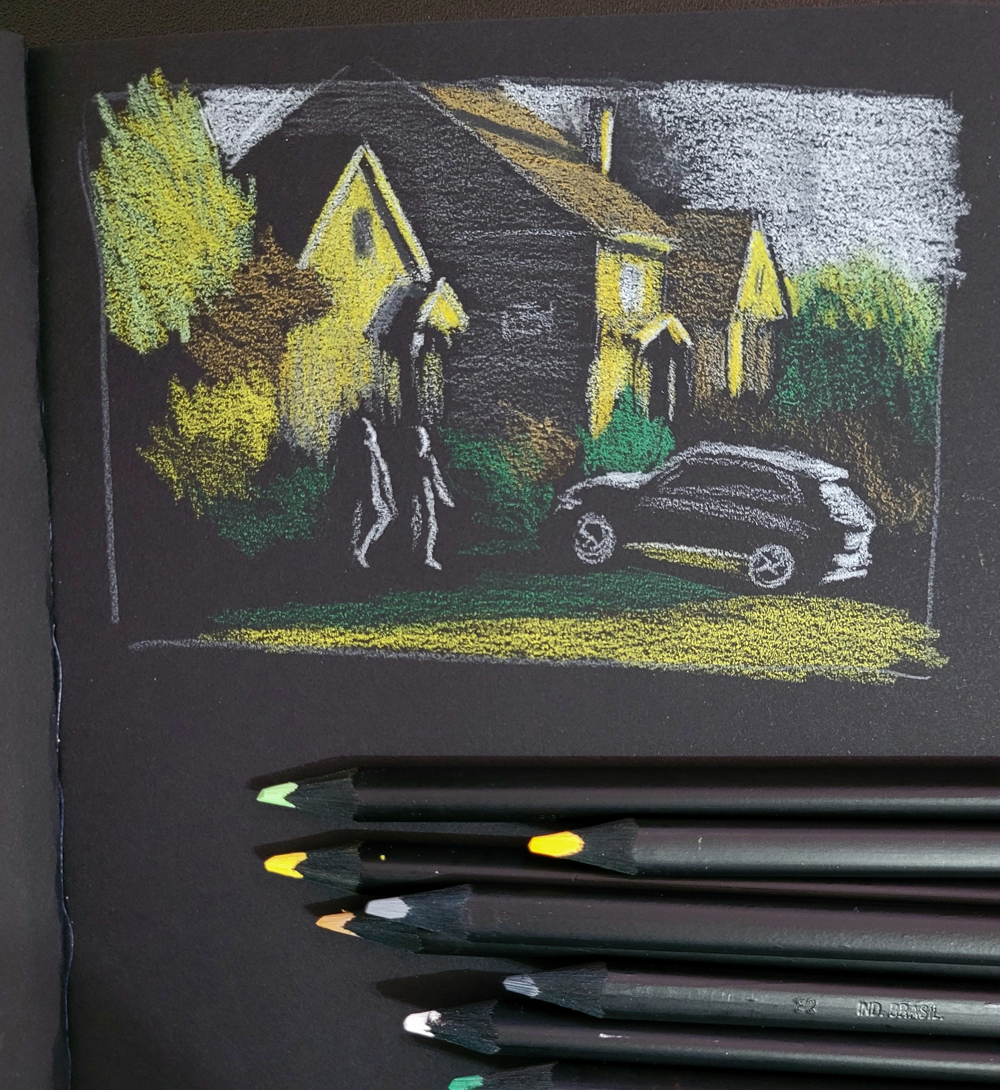
white didn’t cover the paper enough. In the sketch of the house (below right), I wanted the
sky to be as white as possible, so I had to bring in a Prismacolor for
assistance.
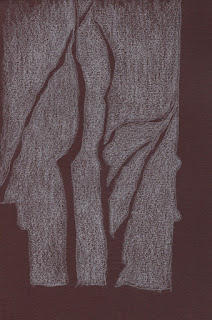 |
5/4/23 The white Black Edition pencil
didn't cover the dark burgundy Uglybook well. |
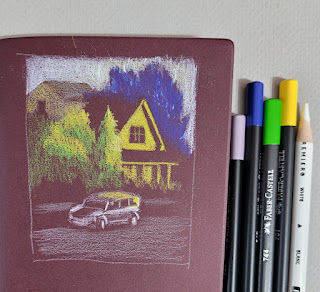 |
| 5/4/23 I used a white Prismacolor to assist with the sky (photo reference). |
In general, the Black Edition colors are good but not so
opaque or bright that they are better than other good-quality pencils, and some
other pencils are more opaque. However, to get a range of reasonably opaque,
high-key colors as wide as this, you’d have to buy a huge set of some other
pencil. From that perspective, 36 colors for $18 is a good value for decent
pencils in an intriguing color range.
I say “intriguing” because, more than anything else about
the Black Edition, the idiosyncratic benefit to me is that it inspired me to experiment
with light-on-dark drawings. These pencils pushed me to think about both
light and color simultaneously, which is a fun challenge that I’m going to
continue exploring. You’ve already seen most of these sketches in that post and read about my challenges with them, so I won’t repeat all of that here. I’ll just end this
review by saying that, for me, $18 is a very cheap price to pay to start
thinking in new ways.
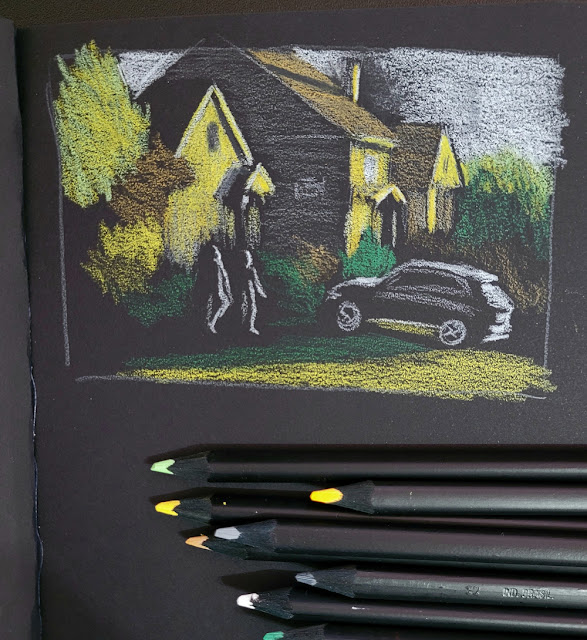 |
| 5/2/23 Stillman & Birn Nova (photo reference) |
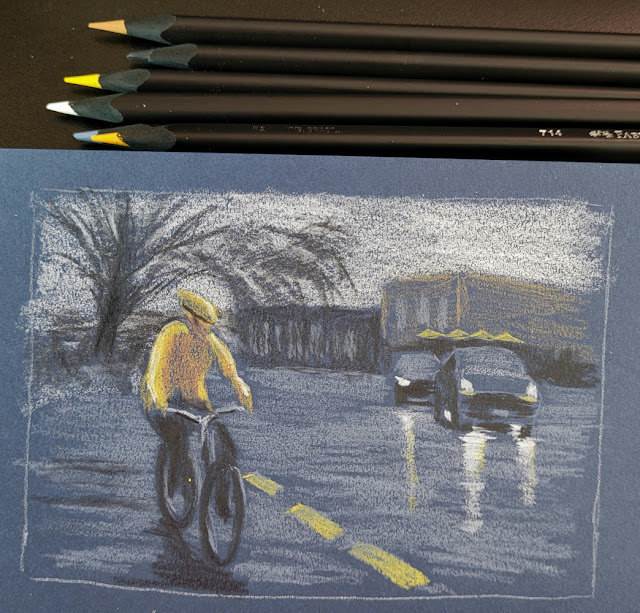 |
| 5/3/23 Uglybook (photo reference) |
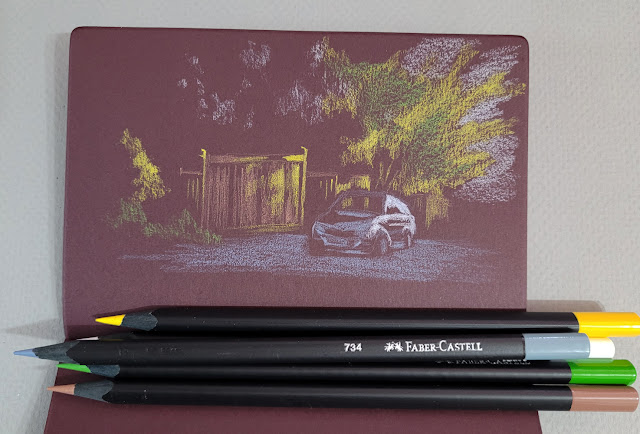 |
| 5/5/23 Uglybook (photo reference) |






.jpg)