Showing posts with label bag. Show all posts

Thursday, April 18, 2024

New Bag, Old Bag, Big Bag


Lilac is the new pink!

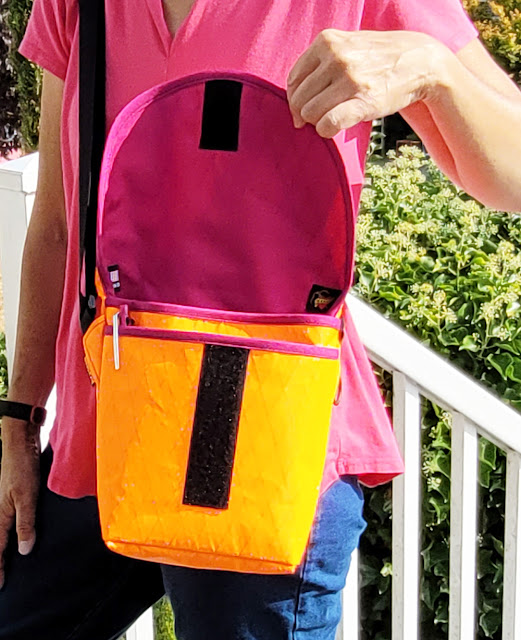
Bags, bags, bags – how I love ‘em. I seem to acquire them the way some women acquire shoes. Here’s my latest (at right): Lilac for spring and summer! (It looks larger in the photo, but it’s the same favorite mini-size Rickshaw Zero Messenger Bag style that I’ve been using for years.)

I hadn’t planned to get a new bag – I wanted to keep using the neon pink one (below) that I had gotten to brighten up the early months of the pandemic. When I pulled it out last month, though, it was so faded and dingy that it didn’t evoke the freshness of spring. Laundering didn’t help. After three years of spring and summer use, the sun had really taken its toll on this known fugitive color. It may be the type of fabric that exacerbated fading. Last fall’s neon orange bag, made of waterproof X-Pac fabric, is still as bright as ever.

I always carry bags with the flap facing out. You can see how badly
it has faded compared to the back, which was consistently away from sunlight.
 

Yarn and knitting needles instead of guns and ammo.

While on the subject of bags, here’s another: I snapped the photo at left a couple of months ago right before a trip to Goodwill. It’s my “Jack Bauer” bag, named for the main character of the TV series, “24.” (We loved the series so much that we watched all nine seasons twice. The series began in 2001, which tells you how old the bag was.) Jack used this basic, utilitarian, canvas bag to haul various firearms, ropes, hacksaws, cigar guillotines, hand grenades, flashlights, ski masks and other devices necessary for fighting off terrorists. I used mine to store and haul my knitting projects. I had to laugh at the scale: Somehow it fit Jack better than it did me.

Thursday, September 28, 2023

Eye-Searing Bag and Sketch Kit Update

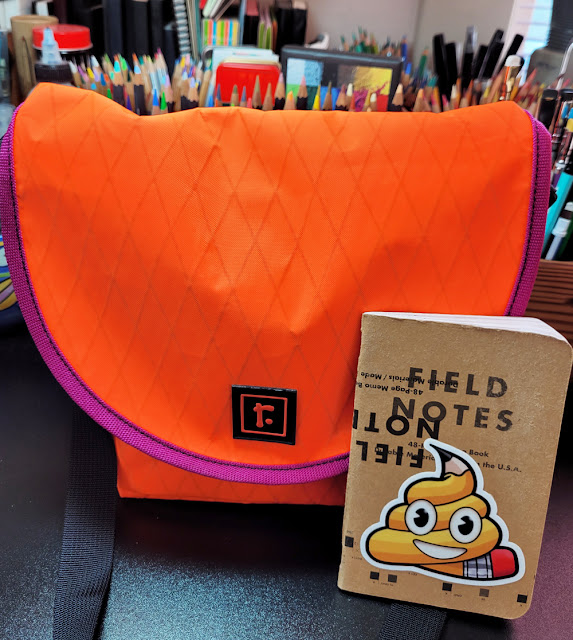
My latest Rickshaw bag in eye-searing orange for fall! (Field Notes shown for scale)

Although I frequently discuss materials I’m using, and I’ve mentioned issues that have come up since I committed to using a smaller bag, it has been quite a while since I wrote a post specifically on my bag and sketch kit. I recently bought a new mini-size Rickshaw Zero Messenger Bag for the change of the season, which is as good an occasion as any for this post.
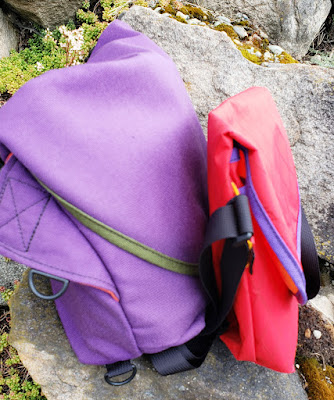
These two older bags show the size difference.
Left: "Small" Rickshaw messenger bag; right: "mini" size.
 
First, I want to summarize various mumblings I’ve made about using a smaller daily-carry bag. After nearly a decade of using Rickshaw’s messenger bag in the “small” size as my everyday-carry, I started using the smaller “mini” size at the beginning of the pandemic. Since I was hardly going anywhere except on daily walks and occasional errands, I didn’t need to carry as much. I also began sketching more while taking walks, so using the smaller bag as my simplified sketch bag made sense.

After I started going out more again, I used the larger bag at sketch outings and other occasions when I wanted to bring a larger sketchbook, but I still took the mini on fitness walks. (Switching bags constantly was a dangerous business – I left behind my entire wallet once, including my driver’s license, when I drove across town for a sketch outing.) 

Eventually, I realized that the mini bag had become my daily-carry without much conscious effort on my part. I just found myself using the larger bag less and less, and when I did, it felt heavy and cumbersome. I enjoyed the freedom and lighter weight of the mini, whether I was fitness walking or not.

It took me a long time to judiciously pare down my sketch materials, but I knew I was ready. I finally put the larger bags away and made the full commitment to the mini. Now, when I’m in the mood for a larger sketchbook, or on those rare occasions when I use watercolors in the field, I simply grab a tote bag as a supplement. (Ironically, I made the same decision nine years ago when I was considering various bag options for travel – but that time, the tote was a supplement to my larger Rickshaw bag! I’ve come a long way since then, and my shoulder thanks me for it.)

On to the new bag: For the coming wet months, I chose Rickshaw’s waterproof Xpac fabric for the exterior in eyeball-searing Orange Flo! I’ve already had comments from friends as well as strangers on the street about the high-viz color, which makes me feel safer when walking.
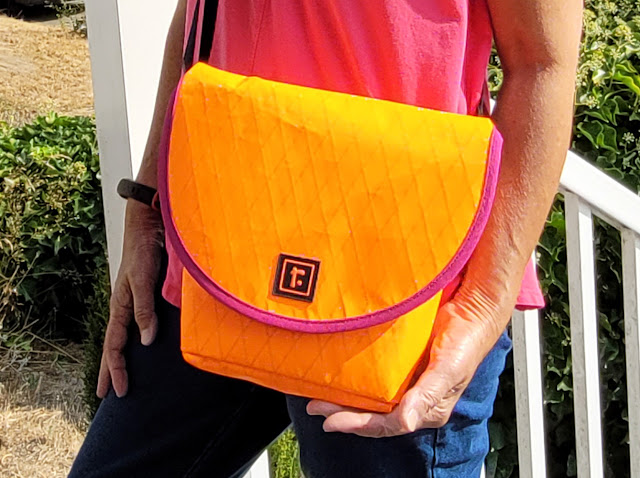
Over-exposed in this image, the bag looks more yellow-orange than it really is. The photo at the top of post shows the color more accurately. But I wouldn't mind a bag in this yellow-orange, too! 

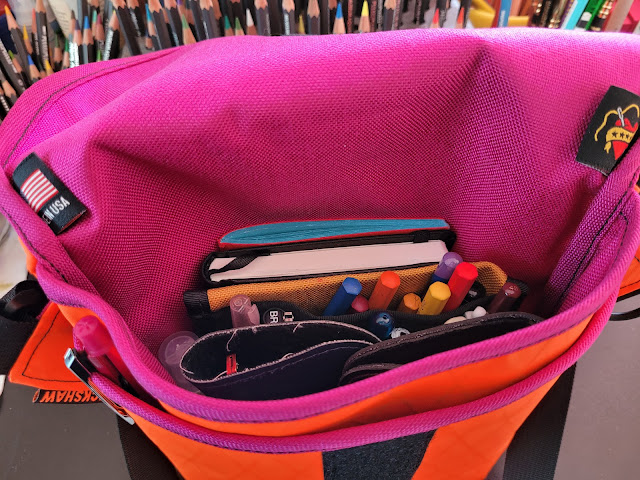
Fuchsia interior and trim

Two A6-size sketchbooks, materials, glasses take up the larger compartment.

As you can see from the bird
’s-eye view, my two pairs of prescription glasses (regular and shades) take up a substantial portion of the interior’s larger compartment, which is unfortunate, but I haven’t figured out a way to slim those down. The front pocket holds my phone, a Field Notes notebook, keys and a mask. The only other non-sketching item I carry is my tiny Rickshaw snap wallet (which, other than the bag itself, is my most essential Rickshaw product).

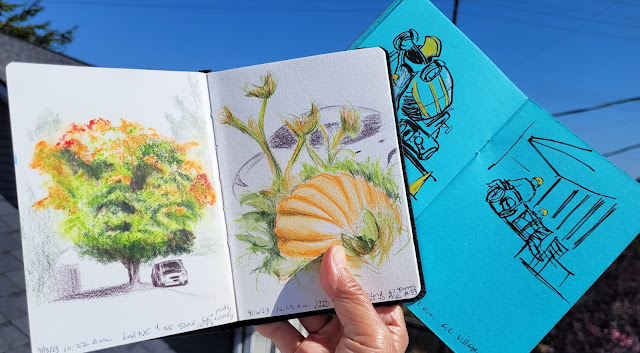
Switching from an A5-size sketchbook (a size I had been using most of my sketching life) to an A6 that is half the size was probably my most radical change in materials. My current favorites are an A6 Hahnemühle sketchbook and a similar size Uglybook.
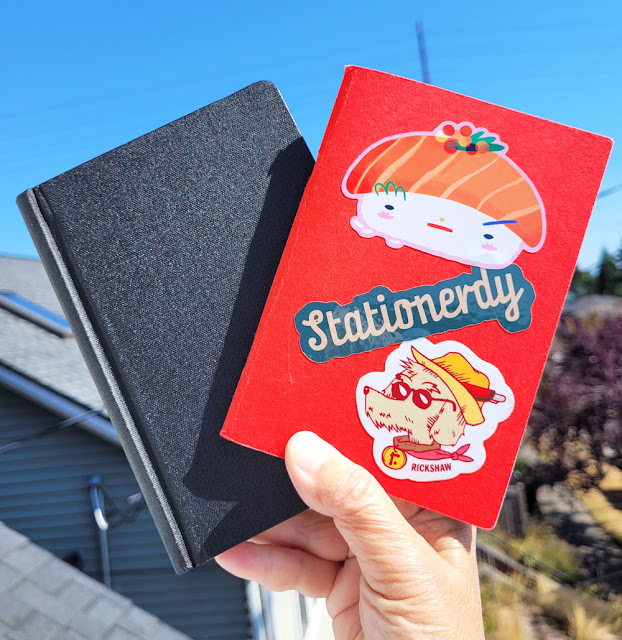
Hahnemuhle 100% cotton watercolor book and Uglybook, both A6, are my everyday-carry sketchbooks. (Stickers by Angelope Design, Dapper Notes, Rickshaw Bags)

A lot of sketching goes into small books!

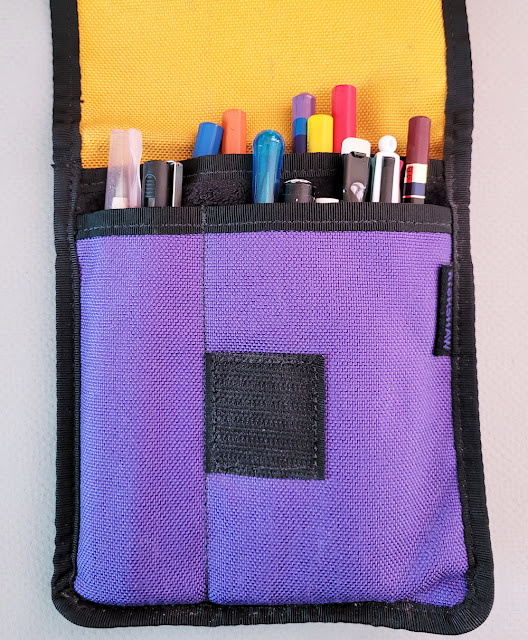
My other sketch materials are a bit of a snooze. Other than changing out the colored pencils frequently, the basic materials haven’t changed much in a long time. My rule is that everything except the
Derwent water spritzer must fit into the Rickshaw pencil case. (The one I’m using is a prototype that was never produced. It’s slightly larger than the standard Waldo field case, which is made to hold a Field Notes-size sketchbook.)

Total weight of the mini bag and contents is 2 pounds, 9 ounces. My larger Rickshaw, at its most recent weigh-in in December 2019 after a big diet, was 3 pounds, 10 ounces (according to my minimalism challenge blog post, before the diet, the bag weighed 4 pounds, 2 ounces).
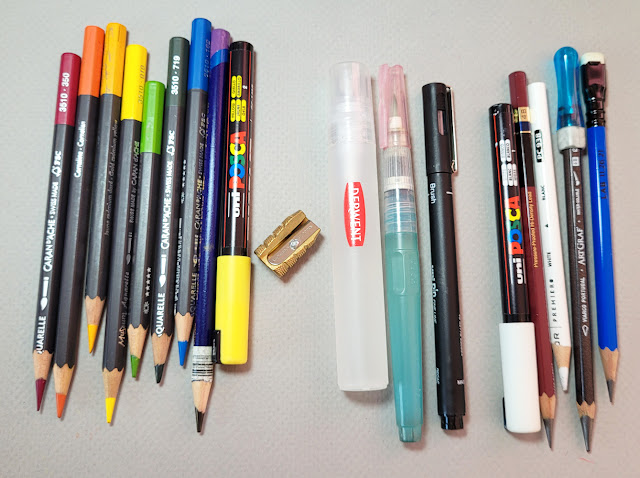
Today's selection. The colors change frequently, but most other materials remain consistent.

My rule is that all materials except the spritzer must fit in this Rickshaw case.

That’s it – as lean and mean as can be! It’s probably not a sketch kit or even a bag size that most sketchers would willingly use, but it suits my standing sketching style and fitness-walking routine. In other words, it affirms my blog’s tagline: Urban sketching: It’s not a hobby; it's a lifestyle.

Waterproof? Check!

The urban sketching lifestyle! (photo by Kate Buike)


Free goodies from Rickshaw with my bag order!

Friday, October 7, 2022

Minimized and Matchy: Rickshaw Sinclair Model R


Matchy, matchy!

For several years, I challenged myself annually for a month or so to slim down my sketch kit to the bare essentials. The purpose of this exercise was to lighten my daily-carry load and see how little I could take with me and still sketch without feeling deprived or frustrated. Readers have told me (and shown me with their page hits) that seeing my minimal sketch kits is one of their favorite things on my blog. Something about attempts at minimizing seems to inspire many sketchers.

When the pandemic hit, I found myself doing most of my urban sketching during neighborhood fitness walks, which meant that I didn’t want to carry my entire, full-size sketch bag. Since my pandemic-edition sketch kit had become my daily-carry, my usual minimal challenge seemed unnecessary. By 2021, I was sketching beyond the neighborhood again, but I continued the habit of sketching during my fitness walks (a habit that continues to this day – one of the best things to come out of the pandemic). Again, I didn’t feel like a minimal challenge was necessary.

The primary triad palettes I used during the summer and now the secondary triads I am using this fall have given me a new twist on minimalism. Even when I’m working with a minimal palette, I  usually still carry the other colors as a security blanket. My bag shakeout a month ago made me commit to the minimal secondary palette and take out the security colors. The kit was slim enough that I could fit everything into my mini Sendak instead of the full-size Sendak I had been using.

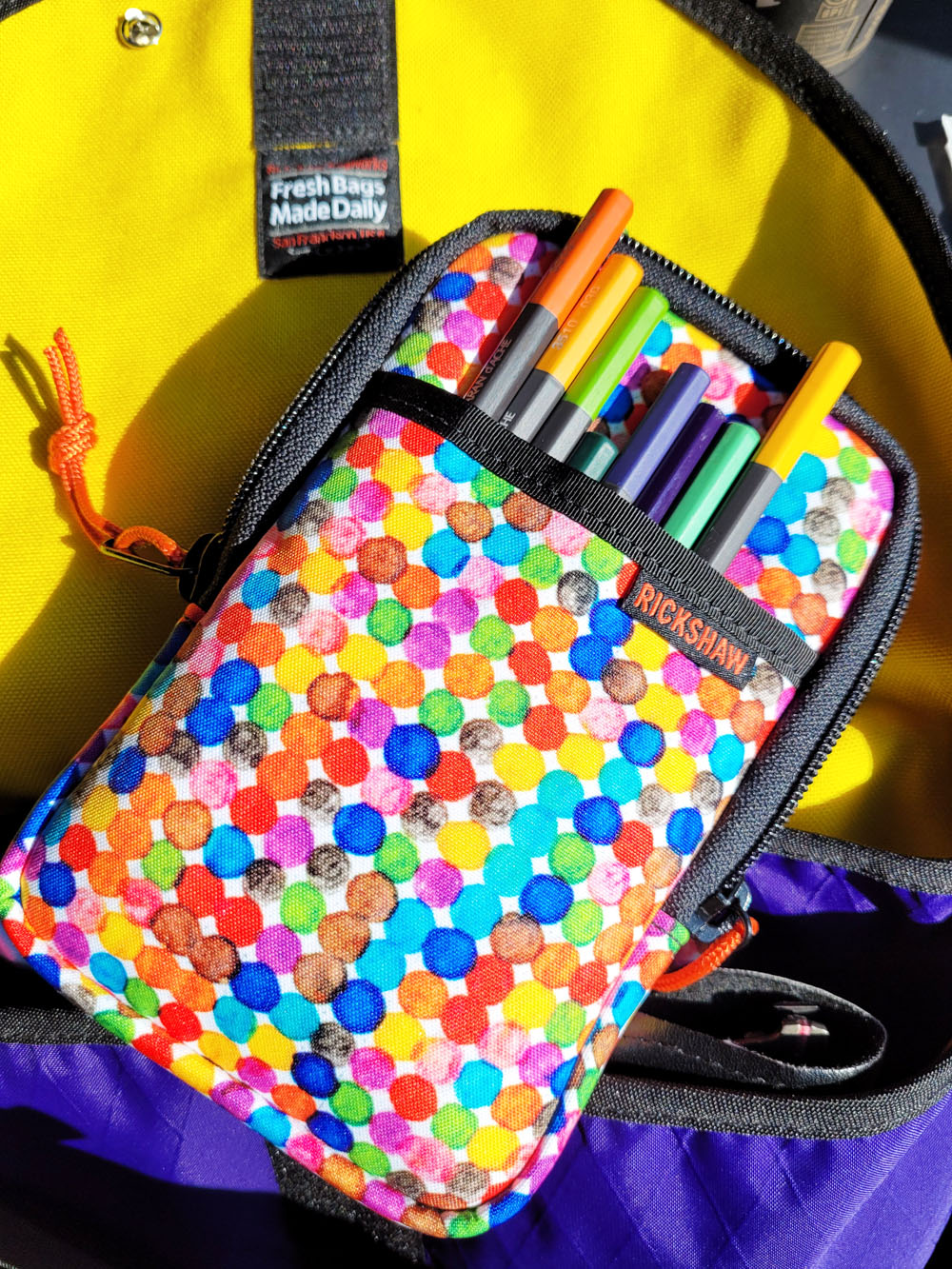
My minimal pencil palette fits easily in the outer slash pocket. 

Here’s the next step in my bag diet program: Everything in my current kit fits into my new Rickshaw Bags Sinclair Model R pen case! Launched at the San Francisco Pen Show in August, the Model R was offered for a discounted intro price. A collaboration between Brad Dowdy of the former Nock Co. and Rickshaw, the new Sinclair is a clear improvement over its previous design – cushier interior, a new outer pocket and, most important to me, more fabric choices. I chose the Ink Dots fabric pattern because it includes colors that would coordinate with any of my Rickshaw bags (so far, I have bags in purple, another purple, black, pink, neon pink and red). I just switched from my pink spring/summer bag to my fall/winter waterproof purple bag, which has a bright yellow lining.

Although it most often appears in marketing and social media photos filled with fountain pens (the cushy lining is meant to protect them), the Sinclair Model R is not just for precious fountain pens – it’s a great little sketch kit organizer! That new slash pocket is just right for my minimal pencil palette, and the inner compartments hold the rest of my kit comfortably. With such a small kit, the entire bag is lighter and slimmer.

An essential characteristic of any bag organizer I would use is that the Model R can stand upright inside my bag, giving me immediate, single-handed access to my tools while sketching as I stand. If I’m sketching at the comfort of a café table, I can pull the whole thing out, and it takes up little tabletop space.

Two cushy inner compartments easily contain the rest of my sketch materials and tools, and everything stands upright and accessible in my bag.

A compact kit for a cafe table.

I’m sure it’s not a permanent change. As has always happened in the past, more tools and colors will creep back in over time, and one day I’ll decide it’s time to get out the fat pants again (in this case, that’s one of the Sendaks, which, unlike fat pants, are a welcome pleasure). But for now, my personal minimalism challenge is back on – with my smallest tool organizer yet.

Friday, June 24, 2022

Soft Landing: Rickshaw Valet


Rickshaw valet and wallet

It’s no secret that I’m a huge fan of Rickshaw Bags. Ever since my first Zero Messenger Bag (now 10 years old and still looking great), which has traveled with me to four continents, I’ve found reasons (and excuses) to buy more bags in other colors, sizes, fabrics and styles. I also have several stationery and daily-carry accessories (search “Rickshaw” on my blog, and you’ll see most of my collection). Handmade in San Francisco, the products are all well made, durable and – the most addictive part – color-customizable!

Two accessories recently caught my eye. The one that’s art-related is the plush Valet Tray. Traditionally, a valet is used by men as a pocket dump, but it’s meeting a different need of mine. When I’m working on a drawing or other project at my desk, I’m constantly picking up and putting down various pencils, pens, scissors or other tools, and I don’t like the noisy clatter they make on my desktop surface or a hard tray. The rectangular 4-by-8-inch valet is an ideal size for giving my tools a soft, silent place to land – it’s plush-lined! (Yes, my pencils have a more comfy seat than I do. I don’t buy Rickshaw’s gorgeous, plush-lined fountain pen cases or coozies because I refuse to let my pens be better dressed than I am.) (OK, I do have one Clover Pen Sleeve [alas, no longer available], seen in this post, but it has a specific travel purpose beyond keeping my pens warm and stylishly dressed.)

This plush-lined valet is sized just right for pencils! When the corners are unsnapped, it flattens for storage or travel.

The second recent purchase is even more exciting because it’s something for which I have been searching a long, long time. I gave up on women’s wallets and “secretaries” decades ago because they are always too big, too bulky and have too many unessential compartments. I’ve been using a men’s “money clip” for years, but the leather slots have gotten stretched out, and the cards are no longer secure. Although I’ve looked, I haven’t found one as simple as the one I have.

Rickshaw’s newest product is exactly what I need: The small, thin Snap Wallet – just large enough for the few cards I carry and nothing else. Like my favorite Rickshaw bags, the colors and fabrics are customizable. Naturally, I got one in waterproof, purple X-Pac fabric to match my “winter” Zero Messenger.

Thin and small

Just enough room for a few cards, bills, ID and nothing else.

Will I get a wallet to match every bag (unfortunately, they don’t offer pink fabric to match my pink “spring” Zero Messenger)? Don’t even suggest it. But at $19, it’s certainly a good value.

Matchy, matchy.

Wednesday, March 30, 2022

More Pink


3/25/22 Wedding photo shoot at UW Quad

In case the weather changed and all the blossoms disappeared, we thought last Friday might be our last chance to see the fleeting sakura at the UW Quad. This time I made only one quick sketch that I couldn’t resist: a wedding photo shoot.

If you’re wondering about the pink notebook, it’s my current whatever journal in a Nomad Notebooks limited edition Sakura notebook. Sadly, it has been sold out for a long time, and this one was a gift, so it’s the only one I have. I wish I had hoarded a few packs when they came out!

While I’m showing off pink things, I can’t forget my new Rickshaw Bagworks bag. I bought it last fall when both the weather and reports of omicron were getting bleak, and I needed something to look forward to. I’m happy that it’s time to bring it out. It’s the same “small” size Zero Messenger Bag style that I’ve been using for years – just a new custom color combination. (I buy bags the way some women buy shoes: One for every outfit, need and season.)


My new spring bag from Rickshaw!

Spring flair (counter-clockwise from left): Urban Sketchers Seattle logo, fountain pen pin from the Well-Appointed Desk, Blackwing pencil pin, rainbow pencil pin (a gift)

Monday, December 30, 2019

Winter 2020 Minimalism Challenge Begins

My walk/sketch fitness program materials (from left): Caran d'Ache Bicolor watercolor pencils,
ArtGraf water-soluble graphite pencil, waterbrush, Uni Pin brush pen, Bic ballpoint

My walk/sketch fitness program has motivated me to lighten my load. Let the annual sketch kit minimalism challenge begin!

Before I put my kit on a diet, I reviewed previous years’ attempts to see what went well during this temporary challenge and what didn’t. Last year’s challenge was less successful because I took out too many colors, forcing an extreme palette reduction, and I felt like I never had what I wanted. I was also wishy-washy about which sketchbook to use (the previous year I had stuck with a toned-paper Stillman & Birn Nova, which went much better), so I was constantly switching back and forth. Paper choice always leads the decision on which materials to use, so I kept that in mind this time. I’ve learned that minimalism only works for me if it’s not a radical departure from but more of a simplification of “normal.”

As you might guess, a key component of this winter’s kit is the Caran d’Ache Bicolors water-soluble colored pencil set that made my top products of the year list. Although they don’t have the pigment quality of my favorite Museum Aquarelles, they still have good quality pigment. More important, the bicolor form factor enables me to carry half the number of pencils compared to my usual daily-carry. I carefully selected five pencils (10 colors), so it’s not a drastic change from my usual full palette but a lot less bulk and weight.

In addition to the bicolor pencils, I put in one ArtGraf water-soluble graphite pencil, one compact-size Kuretake waterbrush, one Uni Pin brush pen and one Bic ballpoint pen. For the sketchbook, I’m taking a Field Notes Signature edition notebook. For a while I considered a pocket-size version of a Stillman & Birn Zeta or Beta, but the Signature has a slightly larger page size while being thinner, so it gives me more options. In the same way that the Cd’A Bicolors are a compromise in terms of quality, the Signature’s paper isn’t as good as Stillman & Birn’s, but I enjoy using it with all the media I will be carrying in my minimal kit.
 
Field Notes Signature notebook as sketchbook

These items all fit nicely into the Rickshaw pen case I used last year (below; this prototype design has not been produced and probably never will be at this point). The case has two important functions: It limits the number of tools that will fit comfortably, so it self-enforces my minimizing restrictions to the number of items you see here. (If I put something in, I have to take something else out.) Secondly, it is super-easy to switch materials from the small fitness-walking bag (see below) to my usual daily-carry bag. Nothing gets lost in the shuffle.
 
Everything fits nicely in this Rickshaw pen case.
Mini-size Rickshaw messenger bag with coordinating pen case!

My fitness-walking bag is the waterproof mini-size Rickshaw Zero Messenger Bag (at right) that I use in transit when I travel. It’s actually large enough to accommodate my daily-carry 5½-by-8½-inch S&B, so if I decide the Signature isn’t working out, I can switch books without changing the whole bag. Other than the sketch kit materials, the mini Rickshaw also holds my wallet, glasses, keys and phone.

Total weight of walk/sketch fitness program mini bag:
1 lb., 10 oz. (light as a feather compared to my everyday-carry; see below).

As my daily-carry (my usual small-size Rickshaw Zero Messenger Bag), I take all the same tools from my fitness-walking bag, plus the following (below): my usual softcover Stillman & Birn, a kneadable eraser, a tortillon, one Blackwing pencil, an M+R pencil sharpener, a white Derwent Drawing Pencil, a white Gelly Roll and a red Field Notes.
 
For my usual daily-carry, I added only the items not enclosed in the pen case.

Below are the items I took out: my full palette of watercolor pencils and Tran Portfolio pencil case, a Faber-Castell waterbrush (used only to spread clean water on the page), a full-length Kuretake waterbrush, a soft graphite pencil and my spritzer bottle. I might miss some colors and the ease of use of pigment-rich Museum Aquarelles, but I rarely use the spritzer or the F-C waterbrush in winter when the landscape is so colorless, so I probably won’t miss them at all.
 
These items came out: Tran Portfolio pencil case of my usual palette, 2 waterbrushes, another graphite pencil, water spritzer

The top view of my everyday-carry bag doesn’t look much slimmer, but the difference in weight is a half-pound:

Weight of daily-carry bag before diet: 4 lbs., 2 oz.
Weight of daily-carry bag after diet: 3 lbs., 10 oz.
 
The flap of the pen case stays folded back inside my bag so that everything is always accessible as usual.

As in the past, I intend to stick with this slimmed-down kit until at least the end of January. (I thoroughly enjoyed using a toned book during my minimalism challenge a couple of years ago, so I may make a switch at some point.) Even after I go back to my full kit, I plan to use the minimal kit indefinitely on my walk/sketch program.

Edited 1/29/20: See the results of my minimalism challenge.

Minimizing my kit was so satisfying that I looked at my studio desk and decided it needed to go on a diet, too. Shown below are the “before” and “after” photos (unretouched and without filters! The light through my window shows that that the sun went down while I worked). I put away some pencil sets I wasn’t using as much and weeded out at least a dozen waterbrushes that I had tested and rejected (so many bristled from the top of their mug that they could no longer be shoved in). Less obvious are two mugfuls of miscellaneous pens that kept multiplying, yet most were never used. Again, there were so many that I couldn’t shove them further in. A thorough weeding left the two mugs with only the tools I use regularly, and I can find and grab one easily without the rest falling out.
 
Before . . . 

. . . and after.

Some items that I cleared off the desk went into storage boxes for now. Many others went into the bag where I’m collecting items for the next Urban Sketchers Gab & Grab. One sketcher’s unneeded items are often another sketcher’s treasures.

Friday, August 23, 2019

Travel Journal and In-Transit Bag

Travel journals I've used during the past couple decades.

A travel journal has been an integral part of each major trip I’ve taken during the past couple of decades. I’ve used a variety of sizes and formats depending on the duration of the trip and other factors. Their contents haven’t changed much over the years: The focus is still primarily on writing supplemented by ephemera, photos and, in recent years, sketches.

For several years I enjoyed using a pocket-size Rhodia notebook. Its sturdy faux leather hardcover is rugged enough for daily abuse (I tend to be rougher on notebooks when I travel compared to daily-carry at home), and its smooth, fountain-pen-friendly paper is a joy to use with any implement. The pocket inside the back cover stores ephemera.

For the Netherlands, I went back to a trusty Rhodia.
Last year when I went to Portugal, I tried a Field Notes Signature notebook instead. Although I questioned whether the paper cover would hold up well (it did, and very well, in fact), the larger page size appealed to me. While I did enjoy having more space for larger ticket stubs and other ephemera, ultimately the Signature was too small in a different way: not enough pages. I ran out the last few days of the trip and had to supplement with the backs of receipts that I taped into the back afterwards. For my trip to the Netherlands this year, I switched back to a Rhodia.

Since I always have my primary A5-size sketchbook with me, I don’t sketch much in the travel journal, but it does serve a few specific sketching needs:

  • While in transit, I don’t like to pull my full daily-carry Rickshaw bag out of my under-seat backpack (which also contains other travel essentials). The travel journal, though, is easily accessible in my small in-transit bag (for lack of a better term; more on that later), along with a few drawing implements. When I’m on the light rail train or waiting at the airport, for example, it’s an easy grab.

    Dude on the light rail train.
  •  I like making quick sketches of our beverages while we wait for our meals. (I rarely sketch my food, however; photos document that.) The pocket-size Rhodia is discreet and handy when I don’t have much space on the table.

  • Sometimes the little notebook is what I happen to have at hand – literally. Walking through the botanical garden in Amsterdam, I suddenly spotted a heron – “Adam,” the symposium mascot – and sketching one had been a personal goal for the trip. Afraid that Adam would fly off if I delayed, I quickly sketched in the journal with the ballpoint I had been writing with. (It turned out that Adam was in no hurry, so I had plenty of time to make a more leisurely sketch later.)


Beverages documented . . .
. . . and Adam sketched at last!


Writing takes up the bulk of the pages. In addition to making observations and reflections while traveling, I start making notes in the travel journal as soon as I’ve committed to take the trip. For example, I note the price of our airfare, addresses and dates of accommodations, currency exchange rate, tips from Rick Steves, and attractions we might want to see. (I also keep the same information in OneNote, so it’s available on my phone, too, but I can’t tell you how many times it has been easier to simply flip open my notebook to find a bit of information instead of tapping on my phone in the middle of a busy sidewalk, hoping for a strong signal. Hooray for analog!) For a complicated itinerary with multiple cities, I also include a small map and calendar.

I also start a glossary of simple phrases I want to be able to say in the language of the country I’m visiting and names of foods I want to try (or avoid). After listening to the words on a language app, I jot pronunciation guides so that I have a chance of being understood. As I learn new words during the trip, I jot them down.

Years later when I thumb through my travel journals, things I’ve glued in are among the most fun to look at again – ticket stubs, Sprocket-printed photos, a bit of a napkin with a café logo. Each item evokes a time and place and gives me an opportunity to relive it.

Bus ticket stub

A handy place for a sticker and related note.

In the evenings in our hotel room, I review the photos I've taken
that day and print just a few of the most memorable moments.

 In addition to a travel journal, the second essential element to my overall travel kit is what I call my in-transit bag. For several years I used a mini-size Rickshaw Zero Messenger Bag – a smaller version of my daily-carry Rickshaw – in a classy-looking herringbone fabric. The last time Rickshaw had a sale, I sprang for a second mini bag, this time in a bright red waterproof fabric, that I took to Holland. It doesn’t look much smaller than the daily-carry purple bag from the front, but from the side, you can see that it has a much slimmer profile.
 
Purple daily-carry in the "small" size; waterproof red in the "mini" size.


The photo below shows everything I typically carry in it (not shown: phone and passport). Note the purple pen case that holds four implements. It’s a Rickshaw Clover Pen Sleeve. Like the Tran Portfolio case I use for colored pencils, the sleeve keeps my few pens and pencils upright and easy to find. This bag is used during transit only; once I reach my destination, its contents go back into my daily-carry. 

Creature comforts and entertainment for the long flight.

Before I buckle up, I grab my Kindle and this bag, and I’m good to go. With these essentials by my side throughout the flight or ride, I rarely need to rummage through my carry-on backpack or roller bag. Accessibility is especially handy if whoever is sitting next to me is asleep or my seat-back tray is down. (Remember that time you were about to start eating dinner, and the infant behind you started howling – but your ear plugs were in your bag tucked away under your seat-back tray? Yeah – me, too.)

Related Posts Plugin for WordPress, Blogger...